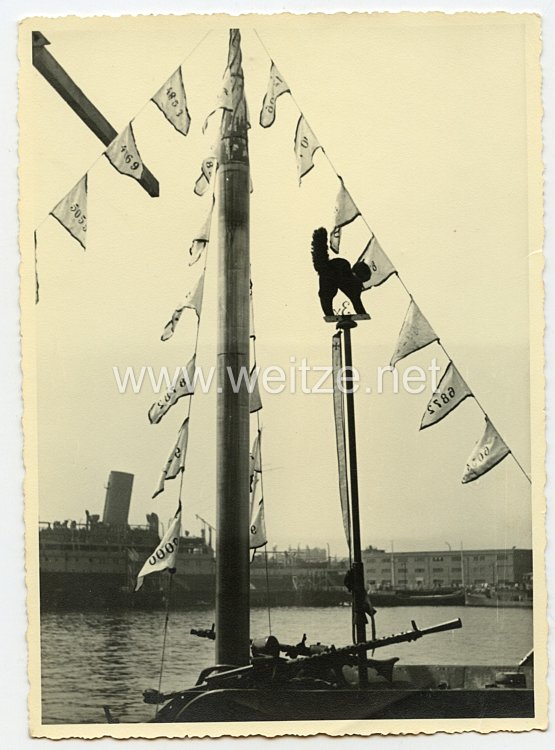
Kriegsmarine Photograph, Conning Tower of U-boat U-48 with Victory Pennants and 3 x Black Cat
Historical Context: Kriegsmarine U-Boat U-48 Conning Tower Photograph with Victory Pennants and “Black Cat” Emblems
This photograph documents the conning tower of the German submarine U-48, one of the most successful U-boats of World War II. The image shows the characteristic practice of the Kriegsmarine of marking successful sinkings with victory pennants (Abschusswimpel) on the periscope or tower structure, along with the triple depiction of the “Black Cat” emblem.
U-48: A Legendary Submarine
U-48 was a Type VII B U-boat launched on April 22, 1939, at the Germaniawerft in Kiel and commissioned on June 22, 1939. Under various commanders, including Kapitänleutnant Herbert Schultze and Korvettenkapitän Hans-Rudolf Rösing, U-48 became the most successful German U-boat of the entire war. During its service, the boat sank a total of 51 ships with a combined tonnage of over 310,000 GRT (Gross Register Tons) and damaged three additional vessels.
U-48's operational period extended from 1939 to 1943, when it was finally assigned to training duties. The boat conducted twelve successful war patrols, primarily in the North Atlantic and off the British Isles.
The Tradition of Victory Pennants
The victory pennants or success pennants were a tradition maintained by German U-boat forces since World War I. These small, usually white pennants were attached to the periscope or tower to mark successful sinkings of enemy ships. Each pennant typically represented one sunk vessel, with tonnage or ship type sometimes indicated through symbols or numbers.
This practice served multiple purposes: it boosted crew morale, documented successes for propaganda purposes, and expressed the esprit de corps within the U-boat service. Upon returning from successful war patrols, U-boats were often photographed with their pennants, both for war reporting and for crew members' personal archives.
The “Black Cat” Emblem
The “Black Cat” symbol was one of the most well-known boat emblems of the Kriegsmarine. Various U-boats carried cat emblems, which were often considered lucky charms. The black cat traditionally stood for luck and cunning – qualities of existential importance for U-boat crews.
The triple appearance of the emblem in this photograph could have various meanings: it might represent repetition of the motif at different locations on the tower, or it could have special significance related to particular successes or missions. Boat emblems were usually designed and applied by crew members individually, often on their own initiative and with great craftsmanship.
Photographic Documentation
Photographs like this were important documents during the war. They were used for military intelligence and documentation as well as propaganda purposes. The Wehrmacht's propaganda companies regularly photographed returning U-boats, especially when they had completed successful war patrols.
For crew members themselves, such photos were valuable mementos. They documented the dangerous work, often lasting months, under extreme conditions. The format of approximately 12.5 x 17.5 cm corresponds to the photo formats commonly used for private and military photographs at the time.
Historical Significance
Documents like this photograph are important historical sources today for researching submarine warfare in World War II. They provide information about the visual culture of the Kriegsmarine, the morale and traditions of U-boat crews, and concrete warfare practices. U-48 itself survived the war and was sunk in 1945 off Northern Ireland as part of Operation Deadlight.
The combination of victory pennants and emblems in this photograph impressively documents the mixture of military efficiency and personal expression that characterized the U-boat service. Today, such photographs remind us of the reality of naval warfare and the thousands of sailors – on both sides – who lost their lives in the Atlantic.