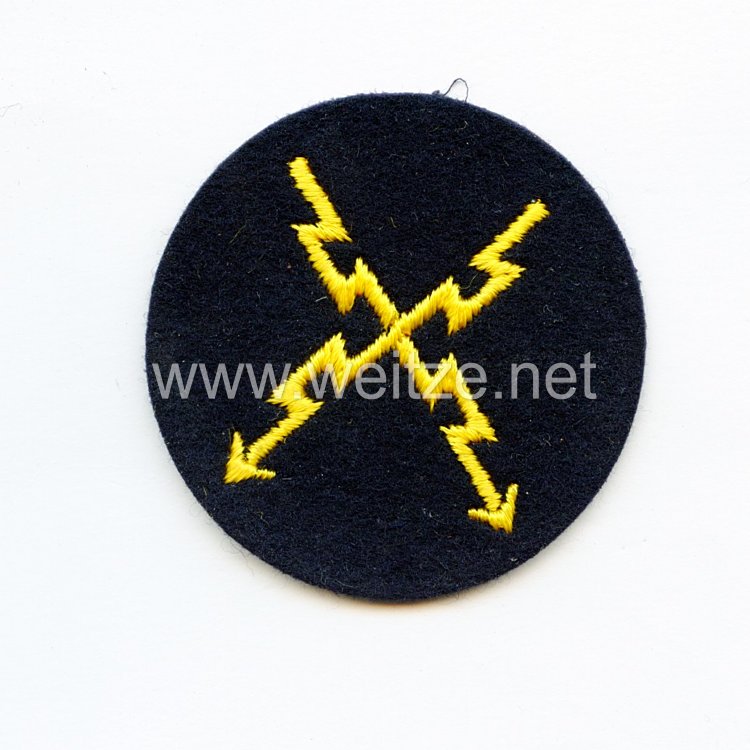
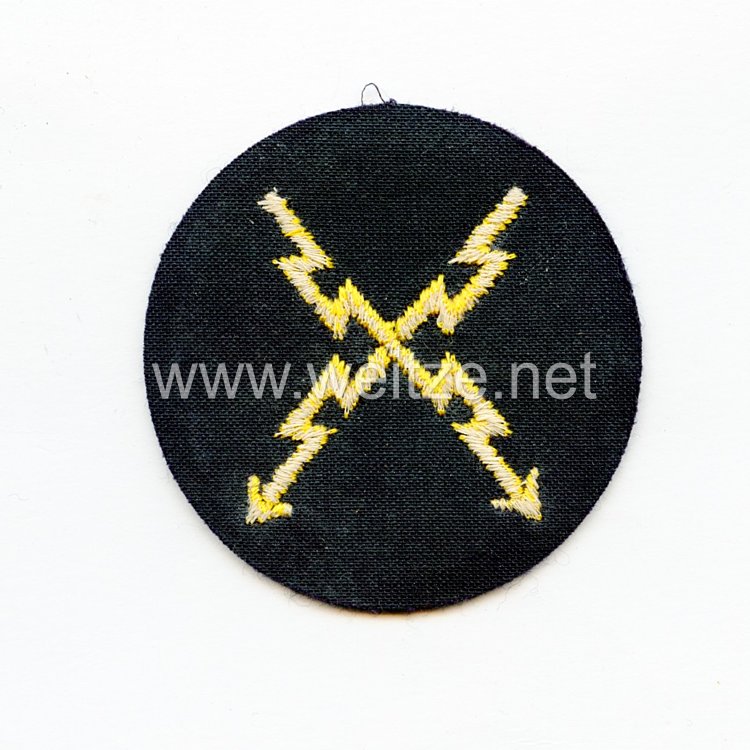
Kriegsmarine Enlisted Man's Sleeve Trade Badge for Teleprinter Operator
The Kriegsmarine sleeve badge for Teleprinter Operators represents a fascinating testament to specialized communication technology within the German Navy during World War II. These badges were worn by enlisted ranks and identified a highly specialized function in the field of telecommunications.
The Kriegsmarine, the official designation for the German Navy from 1935 to 1945, developed a comprehensive system of trade badges to identify various specializations within the enlisted ranks. These career badges, also called Tätigkeitsabzeichen (trade badges), were worn on the left upper arm of the blue blouse according to uniform regulations.
The introduction of these badges occurred gradually from the mid-1930s onward. The system served multiple purposes: it enabled quick identification of specialist personnel, strengthened the sense of belonging within trade groups, and recognized acquired specialized skills. The position of Teleprinter Operator required thorough training in what was then modern teleprinter technology.
Teleprinter technology had developed rapidly during the 1920s and 1930s and was of crucial importance for military communications. Teleprinters enabled the fast and reliable transmission of encrypted messages between ships, coastal stations, and naval bases. Operators of these devices had to master not only the technical operation but also possess knowledge of encryption procedures and message protocols.
The machine-embroidered execution described here was typical for badges manufactured throughout the war. Machine embroidery allowed for more cost-effective and faster production compared to hand-embroidered variants, which were primarily reserved for officers. Badges for enlisted ranks were manufactured on dark blue cloth backing and displayed the respective specialization symbol in lighter thread.
The badge was worn on the blue blouse, which was part of the working and shipboard uniform of the Kriegsmarine. The exact position was specified in uniform regulations: on the left upper arm, approximately midway between shoulder and elbow. This standardization ensured a uniform appearance and facilitated the identification of specialist personnel.
Training as a teleprinter operator took place in specialized naval schools and training facilities. Candidates first had to complete basic training and were then instructed in the operation of various teleprinter systems. These included both land-based and shipboard equipment. Training also encompassed fundamentals of communications technology, encryption, and military communication protocols.
In operational deployment, teleprinter operators were stationed aboard larger warships, submarines with appropriate equipment, and in coastal radio stations. They formed an important link in the Kriegsmarine's communication chain and were responsible for forwarding orders, situation reports, and other important messages. The reliability and speed of teleprinter communication was particularly significant for coordinating fleet operations.
The system of trade badges was adjusted and expanded several times during the war. New technical specializations led to the introduction of additional badges. The Kriegsmarine had a wide spectrum of such identifications, from technical professions such as mechanics and electricians to specialized functions such as radio operators, clerks, and teleprinter operators.
From a collection-historical perspective, these trade badges are today important documents of naval history. They illustrate the increasing mechanization and specialization within the armed forces and provide insight into the organizational structure of the Kriegsmarine. Worn examples, such as the one described here, possess particular historical value as they were actually used in service and thus represent authentic witnesses to the period.
The preservation and documentation of such objects contributes to understanding military history and enables the reconstruction of the technical and organizational developments of this era. They serve as material evidence of a time of profound military-technical transformations.