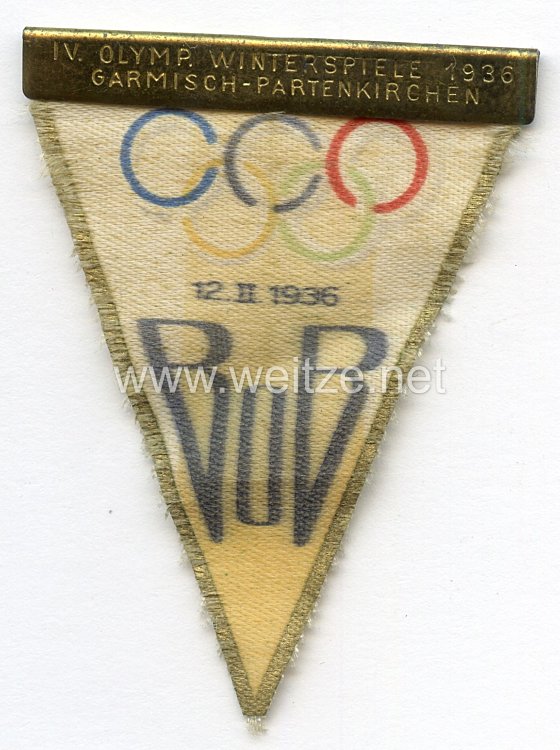
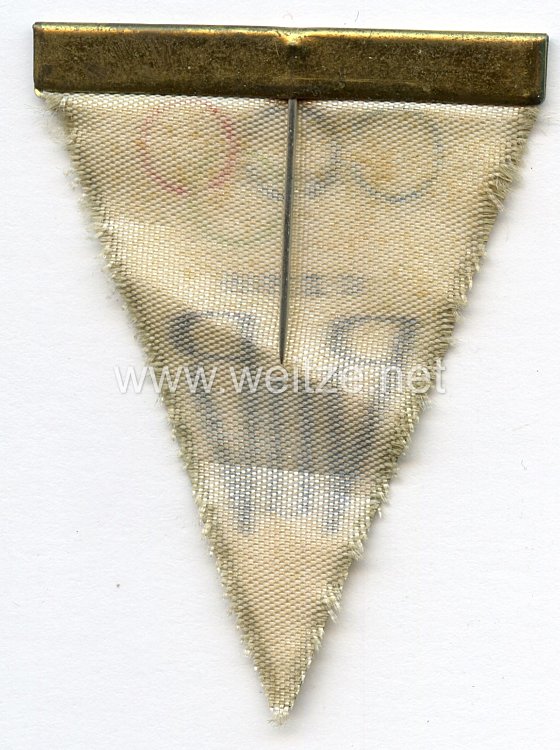
IV. Olympic Winter Games 1936 Garmisch-Partenkirchen - Admission Badge for the Bobsled Competitions 12.2.1936

colored silk pennant on gilded brass clasp, pin fastener on reverse, rare.
316067
230,00

IV. Olympic Winter Games 1936 Garmisch-Partenkirchen - Admission Badge for the Bobsled Competitions 12.2.1936

The present admission badge for the bobsled competitions of the IV Olympic Winter Games 1936 in Garmisch-Partenkirchen represents a fascinating testimony to the sports history of Nazi Germany. Dated February 12, 1936, this badge represents not only a major sporting event but also a significant propagandistic moment in the history of the Third Reich.

The 1936 Winter Olympics took place from February 6 to 16, 1936, in Garmisch-Partenkirchen, just a few months before the better-known Summer Games in Berlin. These events were the first Olympic Games held under Nazi rule, and the regime exploited them extensively for propaganda purposes. The Winter Games served as a kind of dress rehearsal for the Summer Games and were intended to present to the world a modern, hospitable, and peaceful Germany.

The described object consists of a colored silk pennant attached to a gilt brass clasp. On the reverse, it features a pin that allowed the badge to be attached to clothing. The use of silk and gilt brass indicates high-quality workmanship, which was typical of official Olympic badges from this period. Such admission badges were necessary to gain access to the various competition venues and simultaneously served as control and security instruments.

The bobsled competitions were one of the main attractions of the 1936 Winter Games. The sport of bobsledding had developed into one of the most spectacular winter disciplines since its Olympic debut in 1924 in Chamonix. In Garmisch-Partenkirchen, competitions were held in two-man and four-man bobsled. The German team, under enormous pressure to shine before a home audience, actually won both gold medals in the bobsled events, making the event a propaganda success for the Nazi regime.

The organization of these Olympic Games was characterized by unprecedented perfection and attention to detail. The Organizing Committee, led by Dr. Carl Diem and under the patronage of Reich Sports Leader Hans von Tschammer und Osten, ensured that every detail was perfectly planned. This included the sophisticated system of admission and access control badges, to which the present object belonged.

The rarity of such badges, as noted in the description, is due to several factors. First, these daily badges were issued only for specific events and dates, which limited their production numbers. Second, many of these ephemera were not preserved after the Games because their practical utility ended with the conclusion of the event. Third, the historical distancing from the Nazi era after World War II led many people to dispose of such items.

In the context of militaria collecting, this object is of particular interest because the 1936 Olympics were heavily permeated with military elements. The Nazi regime used the Games to demonstrate its organizational efficiency and national strength. Many of the organizers and officials had military backgrounds, and the entire event was conducted with quasi-military precision.

The bobsled run in Garmisch-Partenkirchen itself was a technical masterpiece of its time. With a length of over 1,500 meters and numerous challenging curves, it presented an impressive spectacle for both athletes and spectators. The competitions on February 12, 1936, were of international interest and attracted participants from fourteen nations.

From a collector's perspective, this badge represents an important document of sports history and twentieth-century history. It connects Olympic tradition with the problematic history of National Socialism and recalls a time when sports and politics were inextricably intertwined. The preservation of such objects is of immeasurable value for historical memory, as they represent authentic testimonies of a complex historical period.

Today, such Olympic badges are sought after by specialized collectors who focus on Olympic memorabilia or the history of German sports. The combination of historical significance, rarity, and craftsmanship makes this admission badge a remarkable example of this category.

r