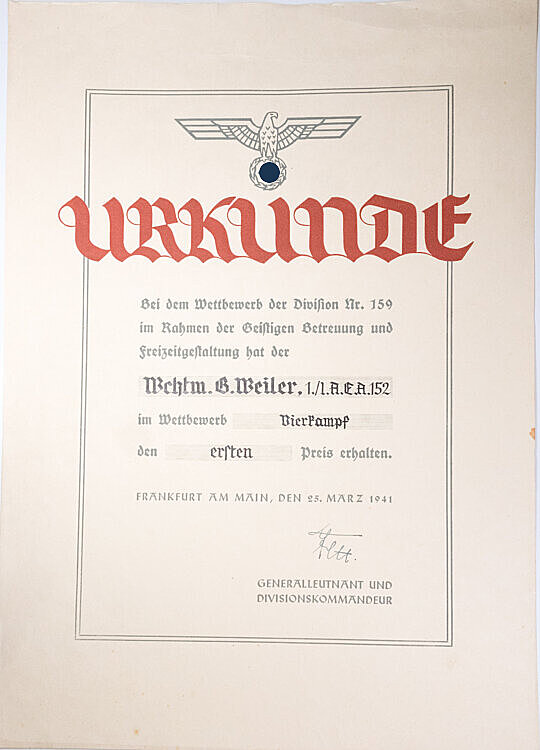
Army - Award Certificate for Division No. 159 Competition in the Framework of Morale Support and Recreation Programs

A Wachtmeister (Sergeant) of the 1./l.A.E.A.152 received 1st Prize in the Four-Event Competition, issued in Frankfurt a.M. on March 25, 1941 by a Lieutenant General and Division Commander; large format 30 x 42.5 cm, with some signs of use.
153067
75,00

Army - Award Certificate for Division No. 159 Competition in the Framework of Morale Support and Recreation Programs

Wehrmacht Award Certificate: Recognition of Military Achievement in Troop Welfare Programs

This decorative certificate from 1941 represents a significant yet often overlooked aspect of military life in the German Wehrmacht: the spiritual welfare and recreational activities of the troops. The document was issued on March 25, 1941 in Frankfurt am Main and honored a Wachtmeister (sergeant) of the 1./l.A.E.A.152 (1st Battery of Light Artillery Replacement Battalion 152) for achieving first place in the four-event competition of Division No. 159.

The 159th Infantry Division was mobilized in November 1939 as part of the 10th deployment wave and, at the time this certificate was issued, was in the buildup and training phase. The division was primarily formed from Military District IX (Kassel) and initially served in training and security duties in occupied France.

Spiritual Welfare and Troop Support

The concept of “spiritual welfare” (geistige Betreuung) was an integral component of Wehrmacht organization. Following experiences from World War I, military leadership recognized the importance of morale and psychological well-being of soldiers. Troop welfare encompassed various activities: sports competitions, cultural events, film screenings, theater performances, and educational programs.

The four-event competition (Vierkampf) mentioned in the certificate was a standardized military athletic test, typically consisting of four disciplines: running, long jump, shot put, and either high jump or another athletic performance. These competitions served multiple purposes: they kept soldiers physically fit, promoted comradeship, and provided variety from military routine.

Artillery Replacement Battalions

The Light Artillery Replacement Battalion 152 was a training and replacement unit responsible for basic training of artillerymen and providing replacement personnel for field units. These replacement battalions were stationed in the home territory and played a crucial role in the Wehrmacht's personnel system. The mentioned Wachtmeister was a mid-level non-commissioned officer, comparable to a modern sergeant or staff sergeant.

Award Certificates as Recognition Instruments

Decorative certificates (Schmuckurkunden) were widespread in the Wehrmacht and served as official recognition for various achievements that did not necessarily warrant a medal or decoration. They were awarded for athletic accomplishments, cultural contributions, service anniversaries, and other meritorious actions. The large format design (30 x 42.5 cm) and issuance by a Lieutenant General and Division Commander gave the document considerable prestige.

The artistic design of such certificates often followed a uniform pattern with military symbols, coats of arms, and calligraphic script. They were printed on high-quality paper and were intended to be kept and framed by the recipient.

Historical Context of 1941

The date of March 1941 places this certificate in a significant phase of World War II. Germany had victoriously completed the Western Campaign and was preparing for Operation Barbarossa, the attack on the Soviet Union, which would begin in June 1941. Frankfurt am Main was an important military and administrative center in the German Reich.

At this time, morale in the Wehrmacht was still buoyed by rapid military successes. The emphasis on troop welfare and athletic activities demonstrates that even during wartime, efforts were made to maintain fighting morale and physical fitness.

Collector Value and Historical Significance

Today, such decorative certificates are important documents of military history. They provide insights into the daily lives of soldiers beyond combat operations and document the organizational structures of the Wehrmacht. For historians, they are valuable sources for researching military culture, personnel policies, and motivational strategies.

The mentioned signs of use on this document testify to its authentic history and that it was actually valued and preserved by its recipient. Such personal military documents complement historical understanding far beyond the major strategic events and give face to the individual experiences of soldiers. They represent a tangible connection to the human dimension of military service during a pivotal period in world history.