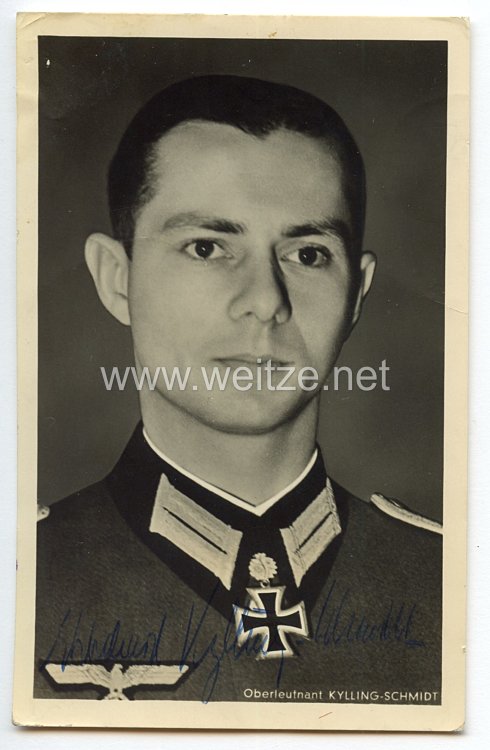
Army - Original Signature of Knight's Cross Recipient Oberleutnant Ekkehard Kylling-Schmidt

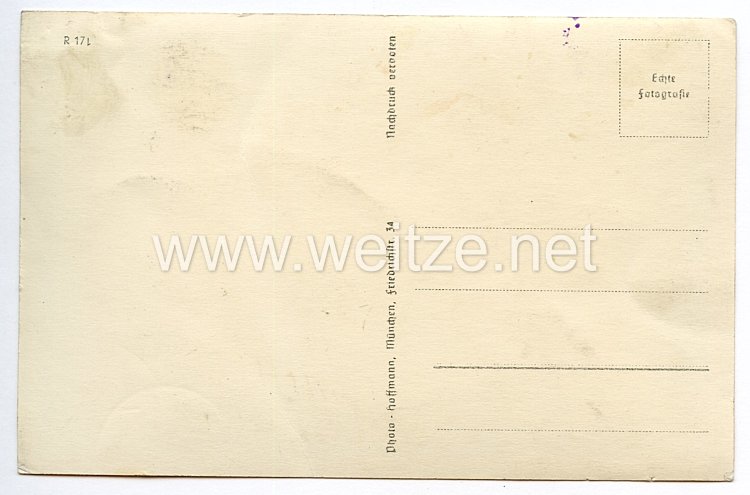
on his Hoffmann postcard R 171, with very fine ink signature "Ekkehard Kylling-Schmidt", unmailed, condition 2/2-.
303867
140,00

Army - Original Signature of Knight's Cross Recipient Oberleutnant Ekkehard Kylling-Schmidt

This Hoffmann postcard R 171 bearing the original signature of Knight's Cross recipient Oberleutnant Ekkehard Kylling-Schmidt represents a significant historical document from the German Wehrmacht during World War II. Such signed propaganda postcards formed an essential component of military public relations and hero worship in Nazi Germany.

The Heinrich Hoffmann Publishing Company was the most important publisher of military propaganda postcards in the Third Reich. Heinrich Hoffmann, Adolf Hitler's personal photographer, built an extensive publishing empire that produced millions of postcards featuring portraits of war heroes, Knight's Cross recipients, and successful soldiers. The numbering “R 171” refers to the systematic cataloging within the Knight's Cross recipient series, which specifically honored highly decorated officers and soldiers.

Ekkehard Kylling-Schmidt served as an officer in the German Army during World War II. The award of the Knight's Cross of the Iron Cross represented one of the highest military decorations that the German Reich could bestow. Introduced on September 1, 1939, by Adolf Hitler, this decoration honored extraordinary bravery in combat or outstanding military leadership. Throughout the entire war, approximately 7,300 individuals received this prestigious award.

The practice of providing postcards with original signatures of Knight's Cross recipients evolved into a significant phenomenon of military propaganda and hero worship. Soldiers in the field, families on the home front, and collectors sought such signed cards, which were regarded as a personal connection to celebrated war heroes. Many Knight's Cross recipients spent time signing hundreds or thousands of such cards, sometimes during recovery periods in military hospitals, sometimes during propaganda appearances at home.

The ink signature on this card indicates personal signing, as opposed to printed or stamped signatures. The authenticity of such signatures and their historical context make these objects important primary sources for military history. The unmailed condition of the postcard – the fact that it was never sent through the postal system – increases its documentary value as a collectible item.

Hoffmann postcards followed a standardized format: typically, they showed a portrait photograph of the decorated soldier in uniform, often with the Knight's Cross visible, accompanied by biographical information and a description of the military achievement that led to the decoration. The photographic quality was usually high-grade, as Hoffmann's publishing house could draw on professional studio photography.

Within the context of Nazi propaganda, these postcards fulfilled several functions: they were intended to strengthen fighting morale at the front and home front, glorify military successes, and present individual soldiers as role models. The systematic production and distribution of such materials was part of a comprehensive propaganda strategy coordinated by Joseph Goebbels' Reich Ministry for Public Enlightenment and Propaganda.

After 1945, a specialized collector's market developed for military memorabilia, including signed Knight's Cross recipient postcards. Historians use such objects to research propaganda mechanisms, military culture, and individual biographies. The scholarly evaluation of these objects always requires critical contextualization within the criminal character of the Nazi regime and its warfare.

The condition rating “2/2-” in philatelic and militaria collecting terminology indicates a very good to good state of preservation, with possibly minimal signs of use. This is remarkable for an object that has survived over eight decades.

Today, such documents serve in reputable collections and museums as educational tools for conveying the history of the Nazi period, the propaganda mechanisms of totalitarian regimes, and the personal fates of war participants. Their preservation and scholarly examination contributes to historical education and critical engagement with Germany's past.

r