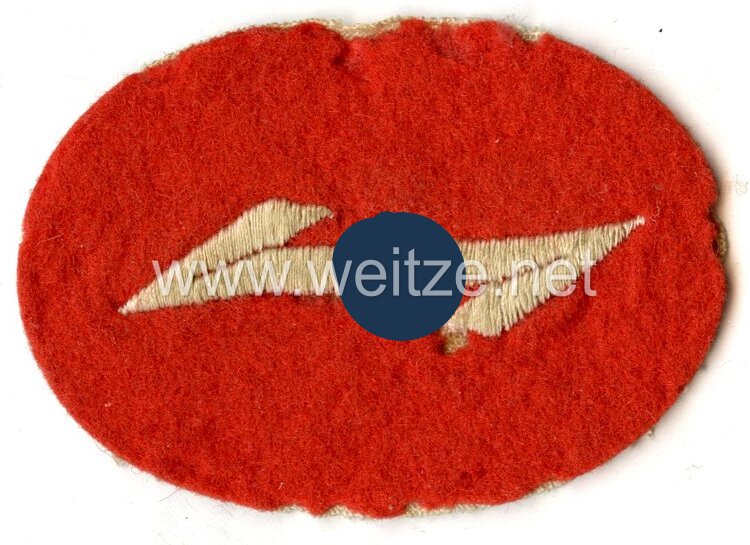
HJ - Sleeve Insignia for Adjutants
The sleeve insignia for adjutants of the Hitler Youth (HJ) represents a significant example of the complex uniforming practices and hierarchical structure of the National Socialist youth organization. This particular badge, displaying a white Wolfsangel (wolf's hook) on a bright red background, served to identify adjutants within the HJ leadership structure.
The Hitler Youth was founded on July 4, 1926, and developed into the state youth organization of the German Reich after the Nazi seizure of power in 1933. With the Law concerning the Hitler Youth of December 1, 1936, membership became effectively compulsory, and the organization eventually encompassed nearly all German youth. The HJ was structured according to military models and possessed an elaborate system of rank insignia, functional badges, and special distinctions.
The Wolfsangel as a symbol possesses a long historical tradition and was widely used during National Socialism. Originally a medieval hunting device for catching wolves, the symbol evolved into a heraldic sign for various regions and municipalities. During the NS era, it found broad application as a runic symbol, including use by the 2nd SS Panzer Division “Das Reich” and as a functional badge in the Hitler Youth.
The present badge was manufactured in machine-embroidered execution, which was typical for the mass production of HJ equipment. The uniforms and badges of the HJ were produced according to precise regulations laid down in the clothing regulations of the Reich Youth Leadership. The bright red base color corresponded to the official colors of the HJ and symbolized ideological unity with the NSDAP.
Adjutants in the Hitler Youth were staff members assigned to higher-ranking leaders. They had to fulfill administrative and organizational tasks, were responsible for transmitting orders, and functioned as liaisons between different hierarchical levels. The sleeve badge served the immediate recognition of this function and was an expression of the strict military organization.
The manner of wearing such sleeve badges was precisely regulated in the uniform regulations. They were typically attached to the left upper arm of the uniform and complemented the system of shoulder boards, collar patches, and other rank insignia. The combination of various badges made it possible to recognize at a glance the rank, function, and affiliation of an HJ member.
The condition of the described specimen with moth damage is characteristic of textile artifacts from this period. Decades of storage under often non-optimal conditions led many uniform items and badges to suffer damage from insect infestation, moisture, or light exposure. Such signs of wear are important witnesses to the material history and transmission paths of historical objects.
The scholarly examination of such objects today occurs from various perspectives. Uniformology investigates technical aspects such as manufacturing methods, materials, and wearing regulations. Symbol research analyzes the ideological charging of the symbols used. Social history inquires into the significance of such rank badges for identity formation and the hierarchical structuring of youth.
Particularly significant is the role of such badges in the context of the militarization of youth in National Socialism. The HJ served pre-military training and ideological indoctrination. The system of uniforms and badges was not only functional but fulfilled important psychological and social functions: it created identity, established hierarchies, and conveyed a sense of belonging to a supposed elite.
Today, such objects are found in museum collections and serve historical education and research. They are material witnesses to a dark chapter of German history and enable concrete understanding of the mechanisms of totalitarian rule and youth manipulation. Proper handling of such artifacts requires historical contextualization and critical classification to prevent their instrumentalization for neo-Nazi propaganda.
The study of these insignia contributes to our understanding of how the Nazi regime created a comprehensive system of control and indoctrination that extended even to the visual identification of administrative functions within youth organizations. The attention to detail in rank and function distinctions reflects the regime's obsession with hierarchy and order, imposed from the earliest ages through organizations like the Hitler Youth.