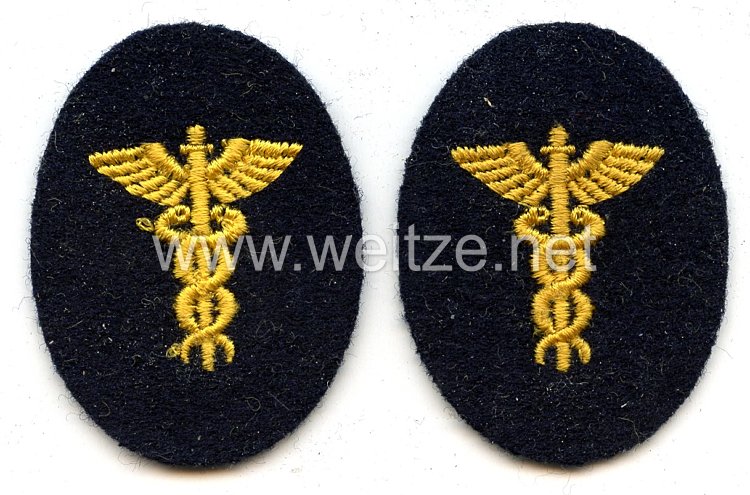
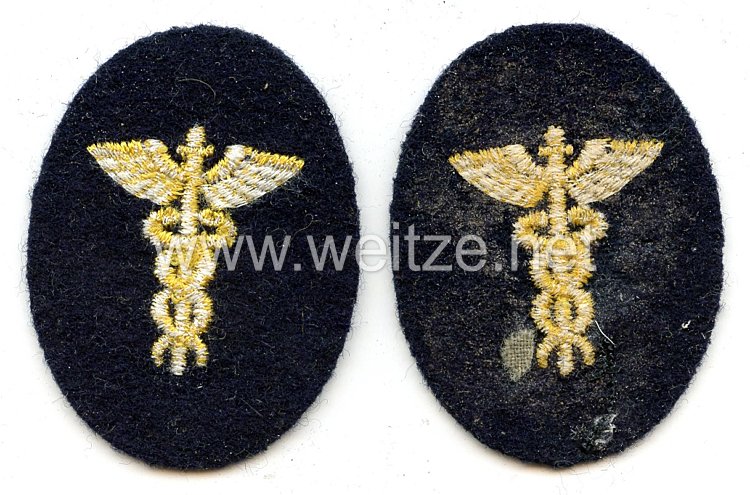
Kriegsmarine Pair of Sleeve Insignia for an Administration Officer

machine-embroidered execution, condition 2.
441066
45,00

Kriegsmarine Pair of Sleeve Insignia for an Administration Officer

The Kriegsmarine sleeve insignia for administration officers represent a fascinating example of the complex rank identification systems used in the German Navy during World War II. These specific insignia served to identify officers of the Administrative Service, who played an essential role in the logistical and administrative infrastructure of the Kriegsmarine.

The Kriegsmarine, the official designation of the German Navy from 1935 to 1945, introduced a detailed system of uniform insignia based on the traditions of the Imperial Navy, but modified according to the provisions of the Treaty of Versailles and the requirements of the Nazi regime. With rearmament under Adolf Hitler and the official establishment of the Wehrmacht in 1935, the Reichsmarine was renamed Kriegsmarine and significantly expanded.

The Administration Officers belonged to the special officer groups of the Kriegsmarine, which also included engineers, physicians, pharmacists, and other specialist officers. These officers wore special markings that distinguished them from line officers. Administration officers were responsible for material supply, provisions, pay, and other administrative duties – functions that were indispensable for the fleet's operational readiness.

The machine-embroidered execution of the sleeve insignia was common during the war and represented a more cost-effective alternative to the more elaborate hand-embroidered variants. Machine embroidery enabled faster production while maintaining acceptable quality, which was of great importance given the enormous demand for uniform components during the war.

The sleeve insignia for administration officers typically consisted of gold-yellow or silver-colored braids on dark blue cloth, with the specific arrangement and width of the braids indicating the respective rank. In addition to rank markings, administration officers wore characteristic career insignia in the form of stylized letters or symbols that identified their special assignment. For administration officers, this was usually cornflower blue or dark green cloth between the rank stripes.

The uniform regulations of the Kriegsmarine were precisely defined in various service regulations and dress codes. The most important regulations were found in the Dress Regulations for the Navy (M.Dv. Nr. 53) and supplementary provisions. These regulations specified precisely which insignia were to be worn on which uniform parts and on which occasions.

A pair of sleeve insignia was necessary because these were worn on both sleeves of the various uniform jackets. Officers of the Kriegsmarine had several uniform variants: the Full Dress Uniform, the Service Dress, the Mess Dress, and various duty uniforms. Appropriate sleeve insignia were required for each of these uniforms.

The manufacture of such insignia was carried out by specialized companies licensed as military suppliers. Well-known manufacturers included companies such as BEVO (Barmer Verbandstofffabrik Wuppertal-Barmen) or various passementerie workshops in traditional textile centers such as Wuppertal, Berlin, or Hamburg. Quality could vary depending on the manufacturer and production period, with early wartime productions generally being of higher quality than later examples.

In the historical context, these sleeve insignia reflect the highly structured and hierarchical nature of the German armed forces. The complex system of rank and career insignia enabled immediate recognition of the rank, function, and responsibility of each officer. This was crucial in military organization for the chain of command and efficient communication.

Today, such sleeve insignia are sought-after military-historical collectibles that represent important material evidence of German naval history. They document not only the history of uniforms but also the organizational structure and self-image of the Kriegsmarine. For collectors and historians, they offer valuable insights into the everyday reality and appearance of officers of that era. The preservation and scientific documentation of such objects contributes to the understanding of this historical period.