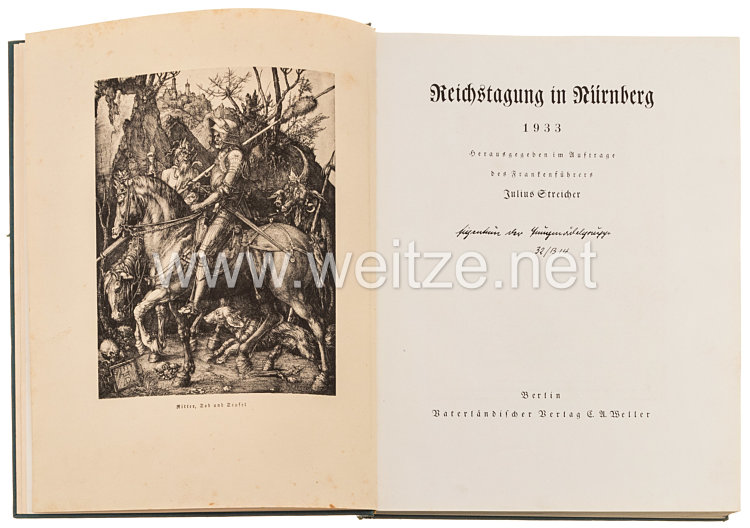
Julius Streicher - Reich Rally in Nuremberg 1933 (Reich Party Rally 1933)

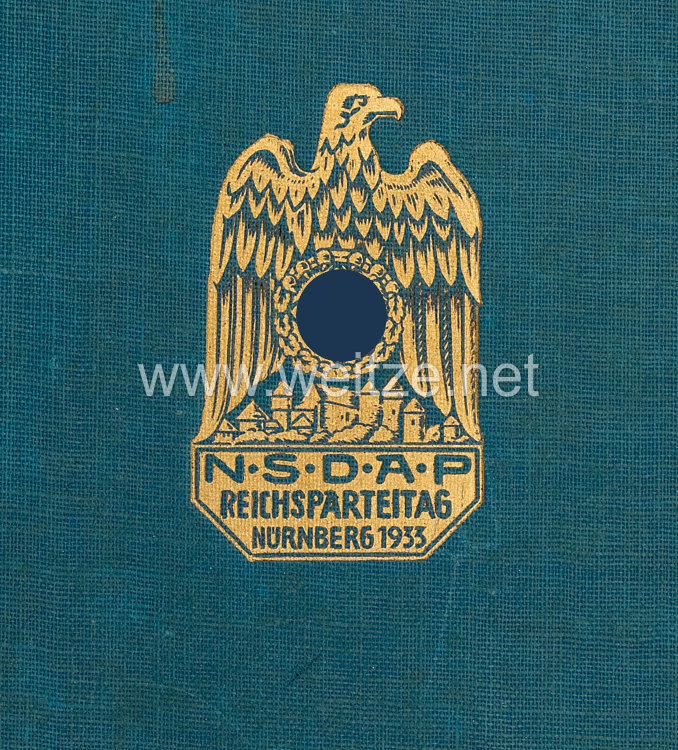
Berlin, Verlag Weller, 1933, full cloth binding, large format, 262 pages, with illustrations, condition 2.
373866
200,00

Julius Streicher - Reich Rally in Nuremberg 1933 (Reich Party Rally 1933)

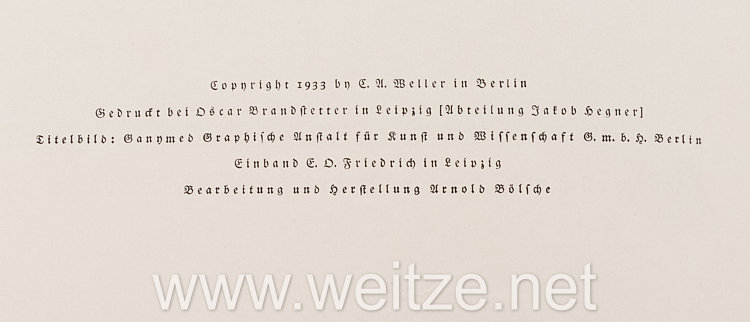
The object in question is a documentation volume of the 1933 Nuremberg Rally, edited by Julius Streicher and published by Verlag Weller in Berlin in 1933. With 262 pages and numerous illustrations in large format, this work represents a significant example of National Socialist propaganda literature.

The 1933 Reich Party Rally, officially designated as the “Rally of Victory,” took place from August 30 to September 3, 1933, in Nuremberg. It was the first party rally following the Nazi seizure of power in January 1933 and marked a decisive turning point in the NSDAP's presentation as the now state-supporting party. The event was deliberately staged as a triumphant demonstration of the new power structure and differed significantly from earlier rallies during the Weimar period.

Julius Streicher (1885-1946) was one of the most controversial figures of the Nazi regime. As Gauleiter of Franconia and publisher of the antisemitic propaganda newspaper “Der Stürmer,” he played a central role in the regime's antisemitic propaganda. His position as “Frankenführer” made him the principal organizer of the Nuremberg Rallies, which were held annually in his Gau capital until 1938. Streicher used these mass events to demonstrate his political influence and spread his antisemitic ideology.

Verlag Weller in Berlin was among numerous publishing houses that specialized in National Socialist literature. Such documentation volumes were produced in large numbers and served multiple purposes: they documented the party rallies for posterity, disseminated the staged productions of party events, and served as propaganda tools. The elaborate large-format design with numerous photographic illustrations was typical of these types of publications, which fulfilled both representative and propagandistic functions.

The 262 pages of the volume likely contain photographs of marches, speeches, flag consecrations, and other ritual acts that characterized the Reich Party Rally. The 1933 rally involved approximately 500,000 participants and was marked by massive parades of SA, SS, and other Nazi organizations. The photographic documentation of such events followed a deliberate aesthetic designed to visualize power, order, and mass loyalty.

From a historical perspective, such documentation volumes are today important sources for researching Nazi propaganda and the visual staging of power in the Third Reich. They demonstrate how the regime used visual media to spread its ideology and construct a particular image of strength and unity. At the same time, they are testimonies to the regime's systematic self-presentation and its efforts to control and shape its own history.

The full linen binding indicates high-quality execution typical of official publications of this type. Such volumes were often distributed as gifts to party functionaries, state offices, and foreign diplomats, or offered for sale to a broader public. The production quality was intended to underscore the regime's claim to modernity and professionalism.

After World War II, such publications were initially confiscated by the Allies in Germany. Today, copies can be found in scholarly libraries, archives, and contemporary history collections. Their value lies exclusively in their historical-documentary significance as sources for researching the Nazi period. In Germany, such materials are not subject to a general ban but are treated within the context of historical-political education and research.

The preservation in condition 2 indicates a well-preserved copy, which is not self-evident for publications from the 1930s. Many such works were destroyed after 1945 or lost through wartime effects. Surviving copies are therefore important material witnesses to a dark epoch of German history. These volumes serve today as sobering reminders of how totalitarian regimes employed sophisticated propaganda techniques to manufacture consent and document their own mythology.