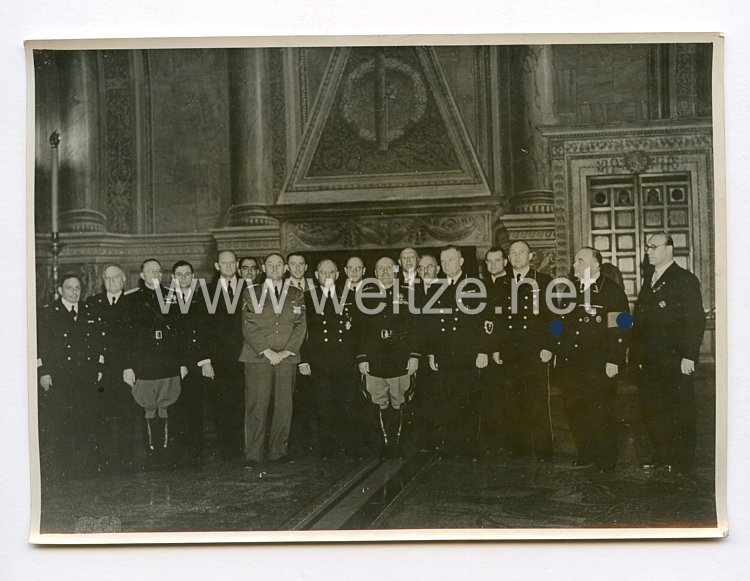
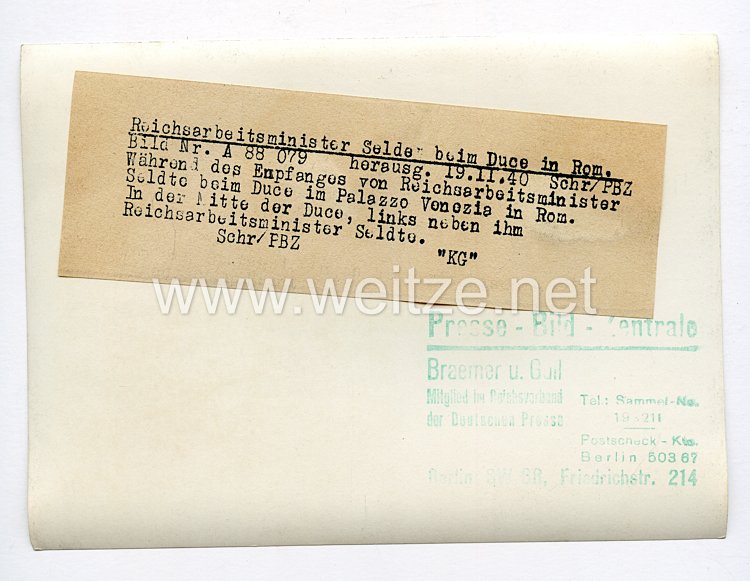
Third Reich Press Photograph. Reich Labor Minister Seldte with the Duce in Rome. 19.11.1940.
This press photograph from the Third Reich documents a significant moment in German-Italian relations during World War II: the visit of Reich Labor Minister Franz Seldte to the Italian dictator Benito Mussolini, the Duce, in Rome on November 19, 1940.
Franz Seldte (1882-1947) was an important figure in the National Socialist regime. As co-founder of the Stahlhelm, Bund der Frontsoldaten (Steel Helmet, League of Front Soldiers), one of the largest paramilitary organizations of the Weimar Republic, he was appointed Reich Labor Minister after the Nazi seizure of power in 1933. He held this position until the end of the war in 1945, making him one of the few non-National Socialist conservatives who remained in high positions within the Nazi regime.
The timing of this visit in November 1940 is of particular historical significance. At this point, World War II was in a critical phase. The German Blitzkrieg against France had been successfully concluded in June 1940, and Germany dominated large parts of Western Europe. Italy had entered the war on Germany's side in June 1940. The Axis Powers appeared to be at the height of their power.
German-Italian relations had been formalized through the Pact of Steel in May 1939, a military alliance between the German Reich and the Kingdom of Italy. High-level visits and diplomatic missions between Berlin and Rome were frequent during this period and served to coordinate military and political strategies as well as to demonstrate the unity of the fascist powers.
Press photographs played a central role in Third Reich propaganda. The Reich Ministry of Public Enlightenment and Propaganda under Joseph Goebbels strictly controlled all media, including photography. Official press photographs were systematically distributed to convey specific political messages. Images of diplomatic meetings were meant to demonstrate the regime's international recognition and the strength of its alliances.
These photographs were typically taken by authorized photographers, often from the Presse-Hoffmann publishing house or other official photo agencies. The reverse side of such photos usually contained detailed descriptions of the depicted event, dates, individuals involved, and sometimes censorship stamps or release marks. These inscriptions are invaluable to historians today as they provide authentic contemporary documentation.
The format of approximately 13 x 18 cm was a standard size for press photographs of this era. This size allowed for easy handling, archiving, and reproduction in newspapers and magazines. The photographs were produced in large editions and distributed to various media organizations.
Seldte's visit to Rome in November 1940 took place in a context where labor policy was of central importance to the war effort. The mobilization of labor, both domestically and in occupied territories, was crucial for the German war economy. International agreements on labor and economic cooperation were important topics at such diplomatic encounters.
From today's perspective, such press photographs are important historical documents. They offer not only visual evidence of historical events but also insights into the propaganda mechanisms of totalitarian regimes. Collectors and museums preserve these materials as part of historical record. The “used condition” of such photographs - with possible creases, stamps, or handwritten notes - can provide additional information about their original use.
Scholarly engagement with such objects requires critical distance. They are products of a criminal regime and must be understood in this context. At the same time, they are indispensable sources for understanding this dark period of history.