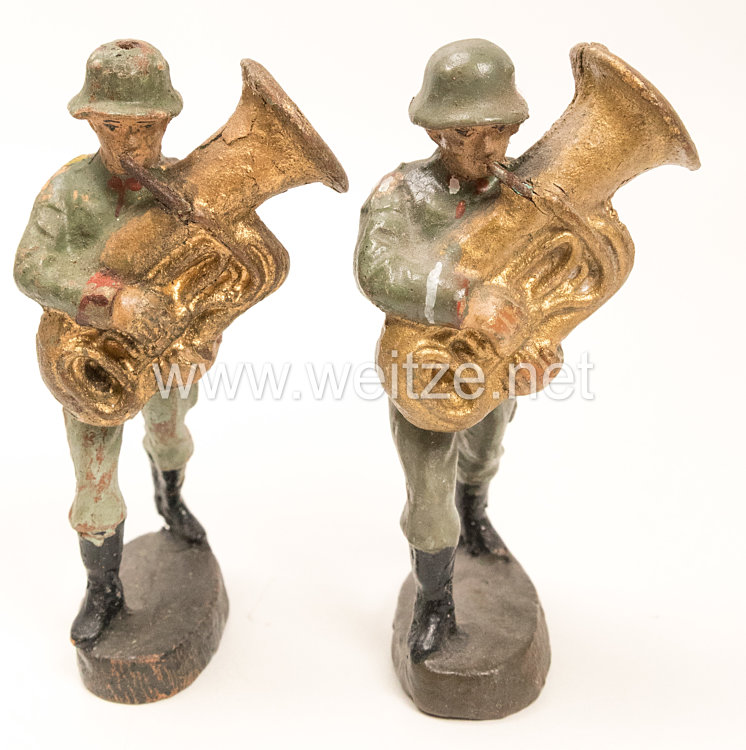
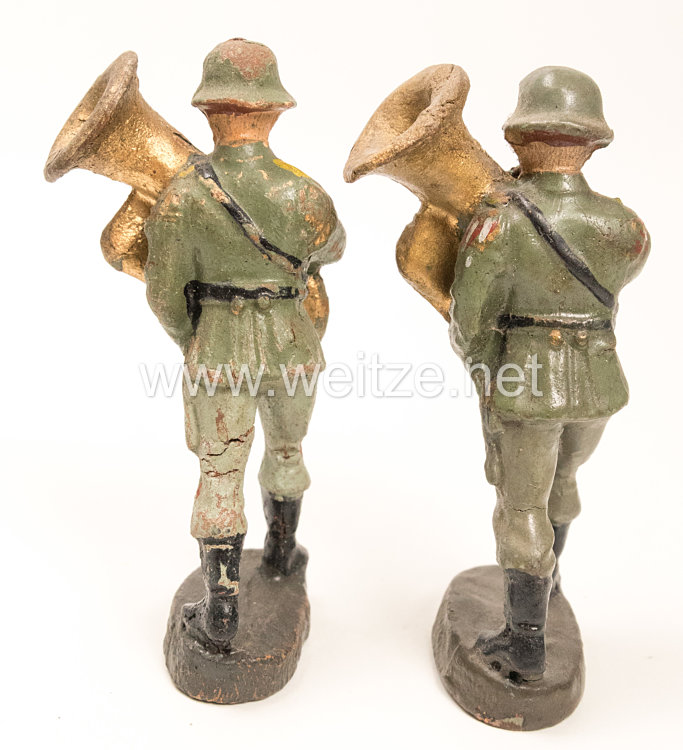
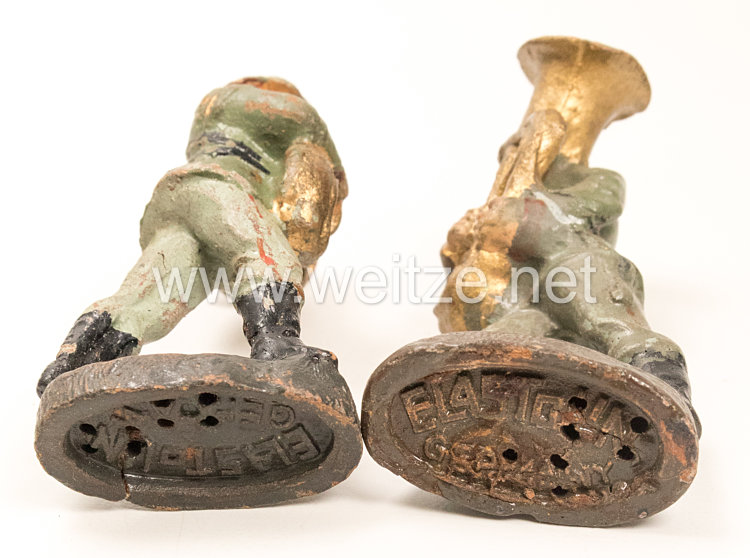
Elastolin - Army 2 Horn Players Marching with Large Bass Drum
Elastolin Army Musician Figures: Military Toys in Historical Context
The described Elastolin figures of two marching brass players with large bass represent a fascinating chapter in German toy history and military everyday culture. Standing 6.5 cm tall, these figures belong to the classic size of Hausser-Elastolin production, which experienced its golden age between the 1920s and the end of World War II.
The Elastolin Company and Its History
O. & M. Hausser GmbH was founded in 1904 in Ludwigsburg and developed into one of Germany's most significant manufacturers of composition figures. The company name “Elastolin” designated the patented material, a mixture of casein, chalk, glycerin, glue, and other additives applied to a wire frame. This composition was non-toxic, unlike the lead figures common at the time, and allowed finer modeling. The figures were hand-painted and achieved a high level of detail that distinguished them from industrially manufactured competing products.
Military Music in German Army Tradition
The depicted musician figures reflect the long tradition of military music in the German army. Since the 18th century, music corps were an integral part of military unit structures. Each regiment had its own music corps that performed at parades, roll calls, and official occasions. The Army Service Regulation (H.Dv.) 471 regulated in detail the composition and deployment of these musical units. A typical infantry music corps consisted of 40 to 50 musicians and included various brass instruments, including trumpets, trombones, horns, and of course the distinctive bass (tuba).
The large bass, as depicted in the described Elastolin figure, was an indispensable component of the music corps. The E-flat tuba or B-flat tuba provided the bass foundation and gave the ensemble its characteristic fullness. Musicians carrying this heavy instrument required special physical endurance, particularly during long marches.
The Significance of Toy Figures for Society
Military toys like Elastolin figures served several social functions in the first half of the 20th century. On one hand, they served to playfully replicate military reality and conveyed contemporary values to children. On the other hand, they were collector's items for adults who recreated historical scenes and military formations. The high quality of Elastolin products made them coveted objects in middle-class households.
The Weimar Republic and the Third Reich also used such toys to socially normalize military presence. After World War I, despite the restrictions of the Treaty of Versailles, the military remained an important part of public life. The depiction of musicians was less martial than that of combat troops and emphasized rather the cultural and ceremonial side of the military.
Collector Aspects and Condition
The stated condition 2 according to the common collector's scale (which typically ranges from 1 for mint condition to 6 for heavily damaged) indicates figures with light signs of use but overall good preservation. This is remarkable, as Elastolin figures were susceptible to cracks, paint flaking, and moisture damage due to their material. Well-preserved examples from the pre-war period are rare today and correspondingly sought after by collectors.
Historical Classification and Cultural Heritage
After 1945, Elastolin production was initially banned under American military administration, as military toys were considered part of the militarization of German society. The company then initially produced civilian figures before military figures were produced again in the 1950s, now in a different context.
Today, Elastolin figures are important documents of everyday and cultural history. They show not only military details such as uniforms and equipment, but also social attitudes of their time of origin. Musician figures like the described brass players with bass represent the less combative aspect of the military and recall the cultural role that military music played in German society.
For collectors and historians, such figures offer valuable insights into the craftsmanship quality of German toy production and the visual culture of the interwar and war periods. They are testimonies of an era in which the boundaries between play, propaganda, and cultural identity were fluid.