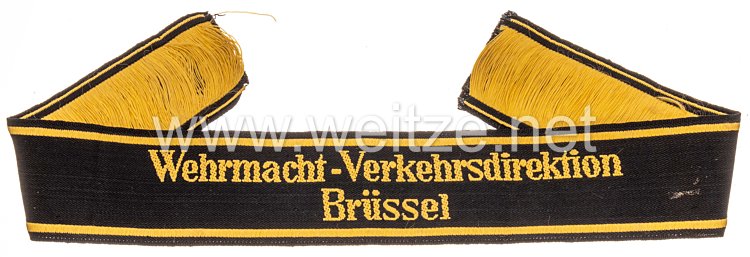
German Reichsbahn Armband “Wehrmacht-Verkehrsdirektion Brüssel”
The Wehrmacht-Verkehrsdirektion Brussels armband represents a fascinating testament to the complex administrative structures that the German Reich established in occupied territories during World War II. This particular armband, manufactured using Bevo weaving technique, represents the connection between military occupation and civil railway administration in Belgium.
The Deutsche Reichsbahn (German State Railway) played a central role in Nazi warfare and occupation policy. Following Belgium's capitulation in May 1940, German authorities assumed control over the Belgian railway network. The Wehrmacht-Verkehrsdirektionen (Wehrmacht Transportation Directorates) were created as specialized administrative units to coordinate military transport needs with existing civil infrastructure.
The Transportation Directorate Brussels was responsible for organizing and supervising all railway traffic in militarily occupied Belgium. Their tasks included the transport of troops, military equipment, supplies, and also the tragic role in deportations. The personnel of these offices consisted of Reichsbahn officials, Wehrmacht members, and technical staff.
The Bevo weaving technique, named after the company Bandfabrik Ewald Vorsteher from Wuppertal-Barmen, was the preferred manufacturing method for high-quality textile insignia of the Wehrmacht. This technique enabled the production of detailed, durable insignia with sharp contours and precise lettering. Unlike embroidered or printed variants, Bevo-woven armbands were more resistant to wear and weather conditions.
Armbands served in the German military to identify special affiliations, functions, or deployment areas. They were typically worn on the left forearm of the uniform and were part of the official service dress. The use of such identifications was regulated by various Heeres-Verordnungsblätter (Army Regulation Gazettes) and service regulations.
The organization of the Transportation Directorates followed the principle of war economy, in which civilian and military structures were closely intertwined. Reichsbahn employees frequently wore military rank insignia and were integrated into the Wehrmacht hierarchy while maintaining their status as Reichsbahn officials. The armband identified them as part of this specialized unit.
Brussels as the location of a Transportation Directorate was of strategic importance. The city was an important railway hub in Western Europe and served as a turntable for transports between Germany, France, and the Channel coast ports. The Transportation Directorate coordinated not only military transports but also had to maintain reduced civilian traffic.
Preserved examples of such armbands are today rare documents of occupation history. An unworn piece in good condition testifies to the original production quality and provides insights into the uniforming practices of the time. The typical length of approximately 43-44 cm corresponded to the standardized measurements for Wehrmacht armbands.
After the liberation of Belgium in September 1944, the activities of the Wehrmacht-Verkehrsdirektion Brussels ended. The Belgian railway administration SNCB/NMBS again assumed full control over the national rail network. Many documents and materials of the German occupation administration were destroyed or lost, making preserved uniform parts and insignia important historical sources.
From a historical science perspective, such objects document the bureaucratic penetration of occupied territories and the systematic exploitation of their infrastructure for German war objectives. They remind us of a dark period in European history and of the role that even seemingly civilian institutions like the Reichsbahn played in the National Socialist apparatus of oppression and destruction.