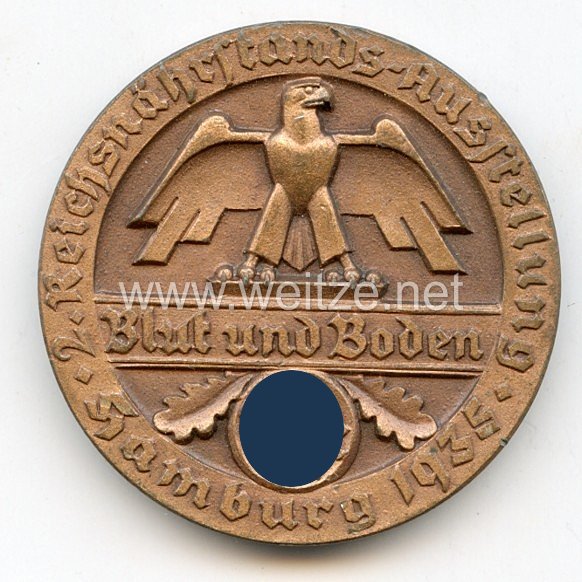
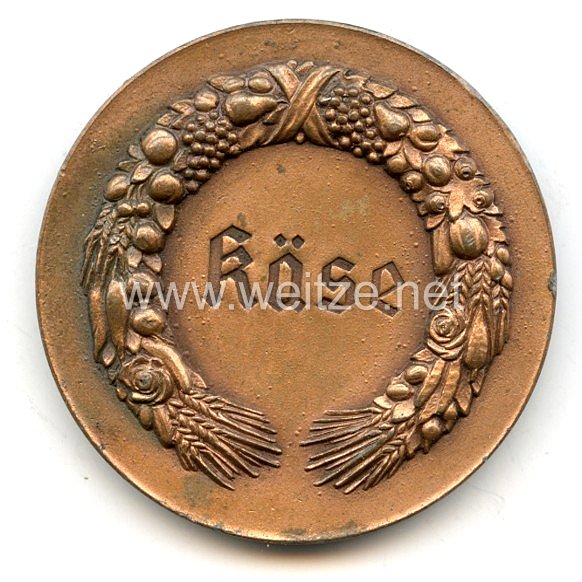
Reichsnährstand - “3rd Reichsnährstand Exhibition Frankfurt am Main 1936”

small bronze winner's medal “Cheese”, 38 mm, condition 2.
434564
100,00

Reichsnährstand - “3rd Reichsnährstand Exhibition Frankfurt am Main 1936”

The Reichsnährstand Exhibition in Frankfurt am Main in 1936 represents a fascinating chapter in National Socialist agricultural policy and propaganda efforts during the Third Reich. The small bronze victor's medal described here for the “Cheese” category, measuring 38 mm in diameter, is an authentic testament to the comprehensive state control and direction of agriculture during this period.

The Reichsnährstand was established on September 13, 1933, through the Reich Food Estate Law and represented the central organization for registering and controlling all persons and businesses involved in German agriculture and food economy. Under the leadership of Reich Farmers' Leader Richard Walther Darré, this organization was intended to put the ideology of “Blood and Soil” into practice and ensure the German Reich's autarky in food matters.

The 3rd Reichsnährstand Exhibition in Frankfurt am Main in 1936 was one of several large-scale agricultural shows organized by the Reichsnährstand to demonstrate the achievements of National Socialist agricultural policy. These exhibitions served multiple purposes: they were meant to highlight the quality of German agricultural products, promote farmers' dedication to performance, and propagate the connection between city and countryside. Frankfurt am Main, as an important trade and exhibition center, offered an ideal venue for such major events.

The awarding of medals and honors at these exhibitions followed a systematic evaluation system. Various product categories were assessed, including dairy products like cheese, grain, livestock, fruits, and vegetables. Judges evaluated quality, taste, appearance, and production techniques. A victor's medal in the cheese category was a significant recognition for a producer, bringing not only prestige but also economic advantages through increased demand and better marketing opportunities.

Cheese production in 1930s Germany had a long tradition, with different regions known for various cheese varieties. The Reichsnährstand endeavored to establish quality standards and increase production to reduce dependency on imports. The recognition of excellent products was intended to create incentives for continuous quality improvements.

The bronze material for such awards was common during this period and gave the medals a dignified, lasting character. The 38 mm size corresponds to a standard format for exhibition medals and awards of this era. Such medals were typically manufactured by state-commissioned medallists and minting facilities, with designs often incorporating agricultural symbols, swastikas, and ideologically charged motifs.

From a historical perspective, such objects today are significant sources for understanding the National Socialist penetration of all areas of life. The Reichsnährstand was more than an agricultural policy organization – it was an instrument for the ideological formation of the rural population and for implementing racial ideological concepts in agriculture. The exhibitions and awards served propaganda purposes and mobilization for the regime's goals.

For collectors and historians, such medals offer insights into the everyday history of the Third Reich beyond purely military aspects. They document the organization of economy and society, the aesthetics of the time, and the mechanisms of state recognition and control. The condition grade 2 (very good) of this medal shows that it has been carefully preserved over the decades, which underscores its significance as a historical document.

r