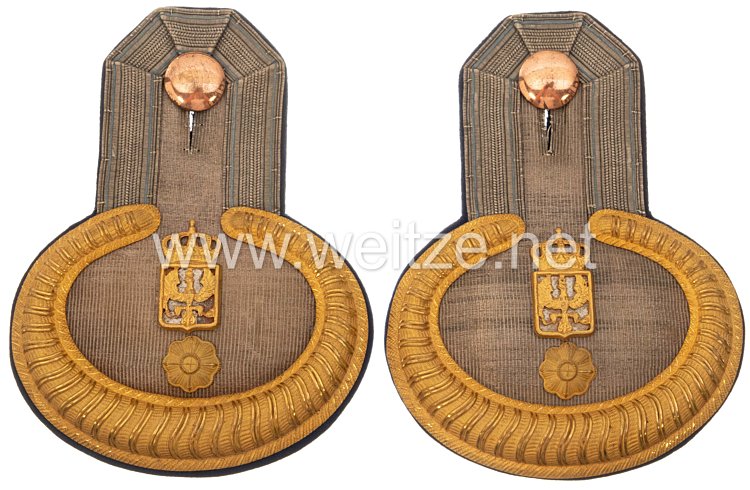
Prussia Pair of Epaulettes for a Calculator/Secret Chancellery Secretary in the War Ministry

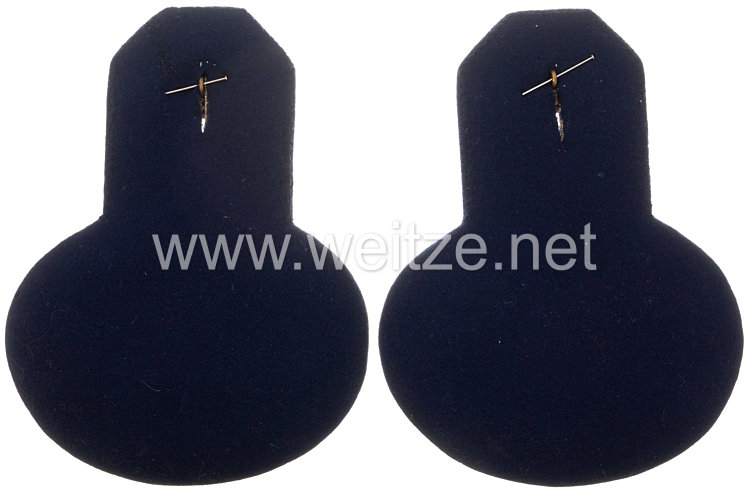
Circa 1910. Small form. Silver fields, silver braids with blue inlays, gold crescents and metal fittings, blue cloth underlays. Condition 2.
398864
450,00

Prussia Pair of Epaulettes for a Calculator/Secret Chancellery Secretary in the War Ministry

These epaulettes represent a fascinating aspect of Prussian military administration around 1910, namely the rank insignia for civil servants in the War Ministry. These shoulder pieces for a Calculator or Privy Chancellery Secretary document the complex hierarchical structure of the imperial military bureaucracy in the final years of the German Empire.

The Prussian War Ministry, officially established as an independent authority since 1808, had developed into an enormous administrative organization by the turn of the century. Besides military officers, the ministry employed a large number of civil servants responsible for the administrative, financial, and organizational handling of army affairs. These officials, although not belonging to the military estate, wore uniform-like official dress with specific rank insignia.

The position of Calculator designated a middle-ranking official in the accounting and financial administration of the War Ministry. These officials were responsible for calculating and verifying military expenditures, salaries, and procurement costs. The Privy Chancellery Secretary also belonged to the middle bureaucratic hierarchy and was entrusted with confidential administrative tasks. Both ranks required commercial or legal qualifications as well as absolute reliability.

The epaulettes described here in small form correspond to the regulations for middle-ranking officials. The silver fields and silver braids with blue inlays identify membership in the military administration, while the golden crescents indicate the specific rank. The blue cloth backing was characteristic of the Prussian military administration and distinguished these officials from other departments.

The rank order of military officials was detailed in various Prussian ordinances. The Supreme Cabinet Order of February 17, 1843, had created the first comprehensive regulation for the uniforming of military officials. This was further developed through numerous supplements and modifications into the early 20th century. The uniform regulations of 1899 and the adjustments of 1910 specified exactly which rank insignia were assigned to which official rank.

The manufacture of such epaulettes was carried out by specialized military equipment manufacturers who had to comply with the exact regulations of the army administration. The combination of different materials – silver for the basic design, gold for the crescents, metal for the appliqués, and high-quality cloth for the backing – required craftsmanship and precise knowledge of the regulations.

The epaulettes were worn on the shoulder strap of the uniform, which typically consisted of dark blue cloth with corresponding cuffs. The officials of the War Ministry wore their uniforms on official occasions, parades, and during service in the ministry. This emphasized their semi-military status and their integration into the military hierarchy.

The period around 1910 marks a phase of intense armament and expansion of the German armed forces. The War Ministry had to manage enormous logistical and administrative challenges. The number of officials grew continuously, and their role became increasingly important for the functionality of the military apparatus.

After the end of World War I and the dissolution of the Prussian monarchy in 1918, these rank insignia lost their official function. The War Ministry was dissolved, and the Reichswehr of the Weimar Republic organized its administration according to new principles. The preserved epaulettes became historical witnesses to a vanished order.

Today, such epaulettes for civil military officials are much rarer than the rank insignia of regular officers. They document an often-overlooked aspect of military history: the extensive bureaucratic machinery that stood behind the fighting troops. For collectors and historians, they offer insights into the administrative structures of the Empire and the social position of military officials.

r