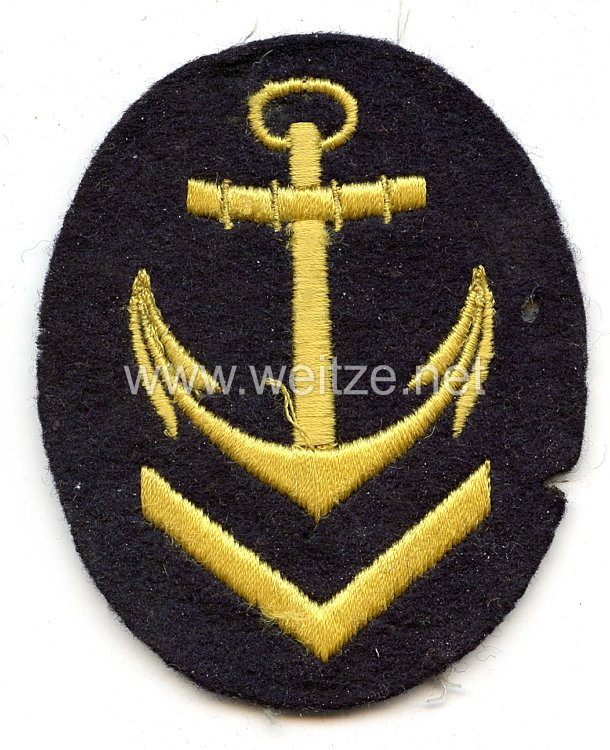
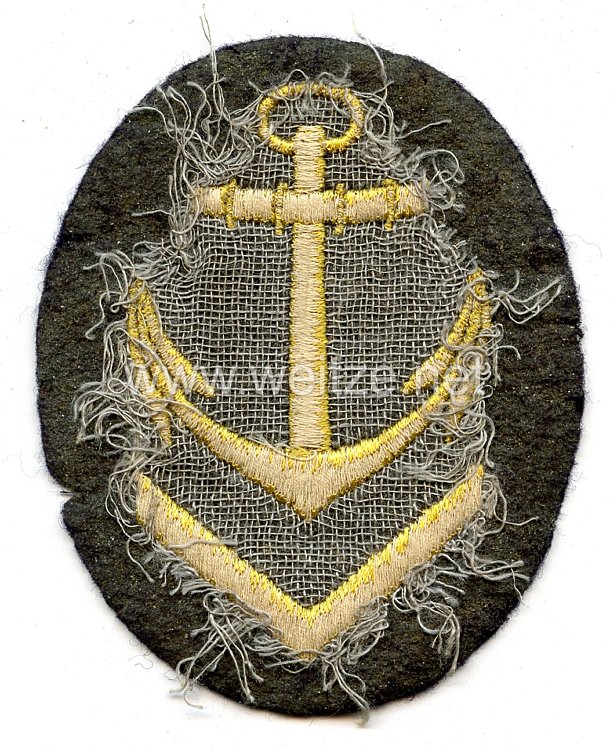
Kriegsmarine Sleeve Insignia Obermaat Wehrersatzwesen
The Kriegsmarine sleeve insignia for Obermaat (Petty Officer Second Class) in the Replacement System (Wehrersatzwesen) represents a significant artifact of the complex rank structure and administrative organization of the German Navy during World War II. This machine-embroidered badge, designed for the blue shirt of the uniform, embodies the special functional designation within the naval replacement and recruitment system.
The rank of Obermaat in the Kriegsmarine was a non-commissioned officer grade positioned between Maat (Petty Officer Third Class) and Bootsmann (Boatswain). The Kriegsmarine's rank structure followed a long maritime tradition dating back to the Imperial German Navy. The Obermaat was integrated into the pay system through the Military Pay Regulation of 1939 and corresponding implementation provisions, playing an important role as an experienced non-commissioned officer in ship's crews or land-based units.
The Wehrersatzwesen (Military Replacement System) formed a central component of the German Reich's military organization. It was responsible for registration, medical examination, conscription, and distribution of recruits, as well as for the administration of reservists. The Kriegsmarine maintained its own replacement service offices, called Marine-Ersatzabteilungen (Naval Replacement Departments) and Küstenbefehlshaber (Coastal Commanders), which were organized within the various Naval High Commands.
The sleeve insignia of the Replacement System differed from regular rank badges through special markings. They were worn according to the Uniform Regulations for the Kriegsmarine (A.A.O.), first introduced in 1933 and updated several times. The blue shirt for which this badge was intended belonged to the working uniform, worn by enlisted men and non-commissioned officers aboard ship and in certain shore-based assignments.
The machine embroidery technique was a production method increasingly used for military insignia from the 1930s onward. It enabled standardized production while maintaining acceptable quality. Unlike hand-embroidered badges, which were primarily used by officers, machine-embroidered versions were common for non-commissioned officers and enlisted personnel. The embroidery was typically executed on a dark blue cloth backing that was sewn onto the upper sleeve.
The structure of the Replacement System was regulated by various decrees and ordinances, particularly through the Defense Law of May 21, 1935 and its implementing regulations. Specific instructions for the Kriegsmarine were issued by the High Command of the Navy (OKM), regulating the organization of replacement units, training facilities, and administrative departments.
Personnel in the Replacement System had diverse responsibilities: from conducting medical examinations to processing military appeals and organizing convalescent and leave management. An Obermaat in this assignment might work in a Naval Replacement Department, a Basic Training Regiment, or a training unit, where he could be responsible for training new recruits or personnel administration.
The wearing of sleeve insignia in the Navy was precisely regulated. They were attached to the left upper sleeve, with the exact position specified in the uniform regulations. Replacement System insignia typically contained special symbols or letter combinations identifying affiliation with this branch.
During the course of the war, the Replacement System gained increasing importance as high casualties and the constant expansion of the Wehrmacht required a continuous supply of personnel. The Kriegsmarine had to increase its strength from approximately 50,000 men in 1935 to over 700,000 by 1944, representing an enormous logistical and administrative challenge.
After the war's end in 1945, all Wehrmacht insignia and uniform items, including those of the Kriegsmarine, were prohibited by Allied Control Council laws. Today, such objects represent important historical sources providing insight into the organization, hierarchy, and administrative structures of that era. They are preserved in military history collections and serve scientific research and historical education.