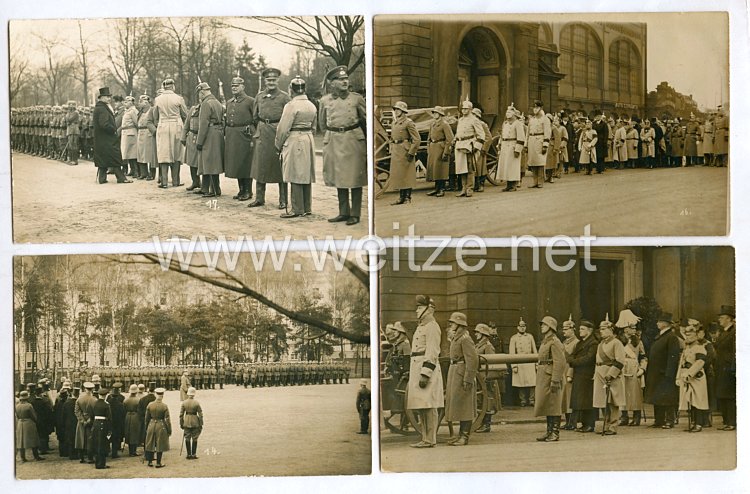
Weimar Republic Photographs, Paul von Hindenburg at a State Funeral

Postcard size. 4 photographs. Used condition.
332563
40,00

Weimar Republic Photographs, Paul von Hindenburg at a State Funeral

This collection of four photographs in postcard format documents Paul von Hindenburg at a state funeral during the Weimar Republic (1919-1933). Such photographs represent important historical documents that provide insight into the state rituals and political culture of Germany's first democracy.

Paul von Hindenburg (1847-1934) was one of the dominant figures in German history of the early 20th century. As Field Marshal, he had commanded the Supreme Army Command during World War I together with Erich Ludendorff. His military successes, particularly the victory at Tannenberg in August 1914, made him a legendary figure in the German Empire. After the defeat in 1918 and the collapse of the monarchy, Hindenburg initially retired to private life.

In 1925, Hindenburg was elected the second Reich President of the Weimar Republic at the age of 77. His candidacy was supported by conservative and monarchist circles who hoped to preserve continuity with the Imperial era through his person. For many Germans, Hindenburg embodied the lost greatness of the Empire and symbolically represented Prussian-military traditions.

As Reich President, Hindenburg played a central role in state functions and official ceremonies. State funerals were particularly important occasions where the Republic displayed its dignity and continuity. Several significant state funerals took place during the Weimar Republic, with Hindenburg as head of state presiding over the ceremonies. Among the most prominent deceased of this era were leading politicians, high-ranking military officers, and distinguished statesmen.

The photographic documentation of such events held special significance in the Weimar Republic. The new democracy systematically used images for political communication and to legitimize state authority. Press photographs and postcards disseminated these images to the general public. The postcard format was particularly popular as it was both collectible and mailable, thus contributing to the spread of political imagery.

State funerals in the Weimar Republic followed an established ceremonial protocol that combined elements of imperial traditions with republican forms. They typically included a funeral service, a state ceremony with speeches and military honors, and the burial with military escort. Hindenburg usually appeared at such occasions in his Field Marshal's uniform, which emphasized his military past and symbolized the connection to Prussian-German military tradition.

The years of Hindenburg's presidency (1925-1934) were marked by increasing political crises. Particularly after 1930, when the Presidential Cabinets effectively suspended parliamentary democracy, Hindenburg's political power grew. He appointed and dismissed Reich Chancellors and increasingly used his constitutional emergency decree powers under Article 48 of the Weimar Constitution.

The collection of four photographs from a state funeral allows conclusions about the visual staging of state power in the Weimar Republic. Such images typically showed Hindenburg in a central, dignified position, surrounded by other dignitaries, military officers, and clergy. The pictorial composition emphasized his authority as head of state and his role as a symbol of state continuity.

The “used condition” of the photographs suggests they were actually utilized – possibly pasted in albums, sent through the mail, or otherwise employed. This underscores their character as everyday objects of political culture, not merely official propaganda materials.

For historical research, such photographic documents are of considerable value. They document not only the concrete event but also the manner in which the Weimar Republic presented and legitimized itself. Hindenburg's presence at state functions was part of a conscious strategy to connect the young democracy with the authority and prestige of the old military establishment.

After 1933, when Hindenburg appointed Adolf Hitler as Reich Chancellor, he increasingly lost influence. His death on August 2, 1934, marked the definitive end of the Weimar Republic. Hitler used Hindenburg's passing to merge the offices of Reich President and Reich Chancellor and consolidate his dictatorship.

Photographs like these four images are today important sources for understanding the visual and ceremonial culture of the Weimar Republic. They show how Germany's first democracy attempted to gain authority and legitimacy through traditional state rituals, and how Hindenburg's person functioned as a bridge between monarchy and republic.

r