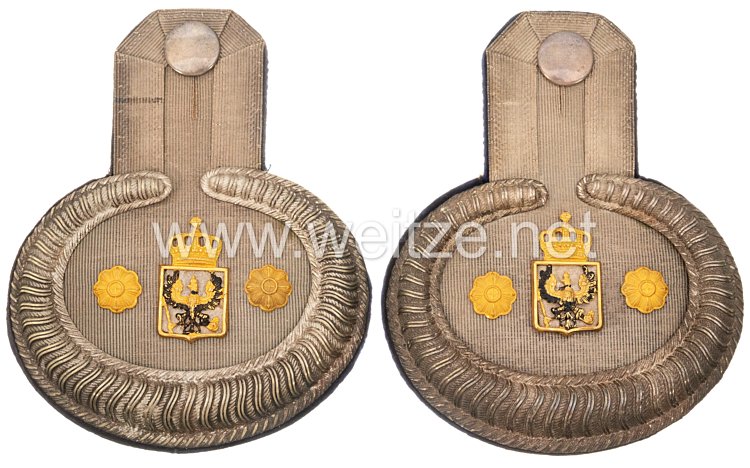
Prussia Pair of Epaulettes for a Senior Military Intendantur Secretary

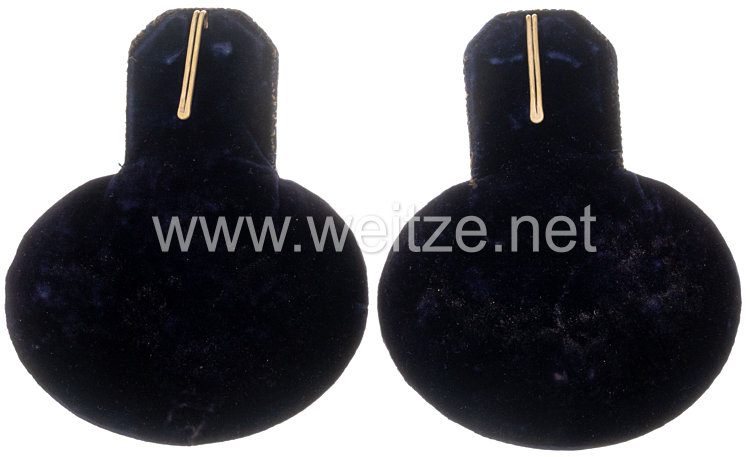
Circa 1885. Large pattern. Silver fields, silver bullion lace (until 1889 still without blue stripes), silver crescents, gold rank stars and civil service emblem, dark blue velvet base. Condition 2.
398663
450,00

Prussia Pair of Epaulettes for a Senior Military Intendantur Secretary

These epaulettes of a Senior Military Intendancy Secretary from the Kingdom of Prussia represent a fascinating example of military rank insignia from the late 19th century. Manufactured around 1885, these shoulder boards document the complex hierarchy and organizational structure of the Prussian military administration during the era of the German Empire.

The Military Intendancy formed an indispensable component of the Prussian Army and was responsible for the entire administration, supply, and economic organization of the armed forces. The Intendancy comprised various categories of officials, among which the secretaries formed an important middle administrative level. The rank of Senior Military Intendancy Secretary represented an elevated position within this administrative structure.

The technical execution of these epaulettes corresponds exactly to Prussian uniform regulations of the 1880s. The silver fields and silver braids identify membership in the Intendancy's civil service corps. A particularly important detail is the absence of blue stripes in the braids, which clearly dates these epaulettes to before 1889. With the uniform reform of 1889, blue stripes were introduced into the silver braids, significantly changing the appearance of the epaulettes.

The combination of golden rank stars and the golden civil service emblem on a silver background was characteristic of higher administrative officials in the Prussian Army. The dark blue velvet underlay corresponded to the branch color of the Intendancy and administration. This color combination enabled immediate visual identification of the wearer's affiliation with the administrative service, which was of great importance in the strictly hierarchical Prussian Army.

The form described here as “large execution” refers to the dimensions of the epaulettes, which were prescribed for higher official ranks. Prussian uniform regulations meticulously distinguished between various sizes and designs, depending on the exact rank and service position of the wearer.

The silver crescents attached as decorative elements to the epaulettes represented a traditional heraldic element that had been used in various forms on military rank insignia since the 18th century. They served not only for decoration but also for further differentiation within the rank structure.

The historical context of these epaulettes is closely linked to the reform of the Prussian military administration under War Minister Albrecht von Roon and later under his successors. In the 1860s and 1870s, the Intendancy was fundamentally reorganized and professionalized. The officials received clearly defined rank structures that were reflected in their uniforms and insignia.

The manufacture of such epaulettes was carried out by specialized military effects manufacturers, often court suppliers. The quality of workmanship had to meet the highest standards, as these insignia not only served for rank identification but also represented the status and dignity of the Prussian civil service. The use of genuine silver and gold, as well as elaborate handcraftsmanship, made such epaulettes valuable possessions of their wearers.

The civil service emblem prominently displayed on these epaulettes distinguished administrative officials from combat troop officers, who wore different rank insignia. This clear differentiation was part of the Prussian system that strictly distinguished between military leadership positions and administrative functions, even though both areas worked closely together.

After 1889, regulations changed, and epaulettes of this type were no longer manufactured in this form. This makes specimens from the period 1871-1889 important historical documents that illustrate the development of Prussian military administration during the height of the German Empire. They bear witness to an era in which military tradition, bureaucratic precision, and artisanal excellence formed a characteristic connection.

r