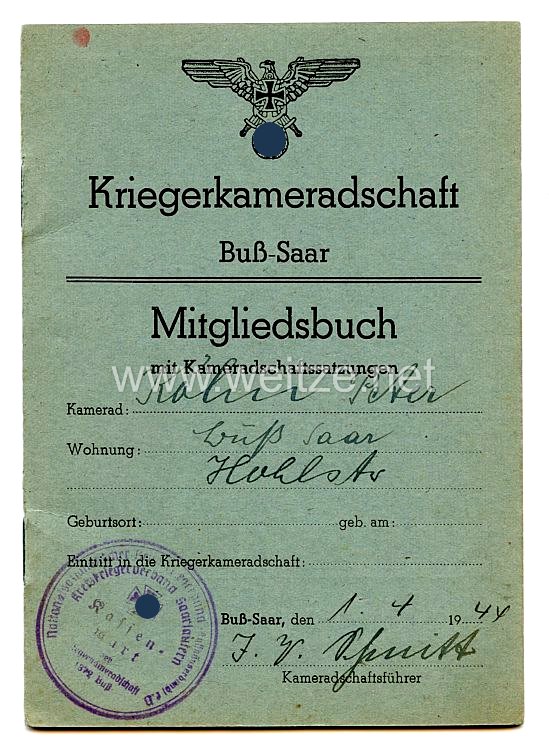
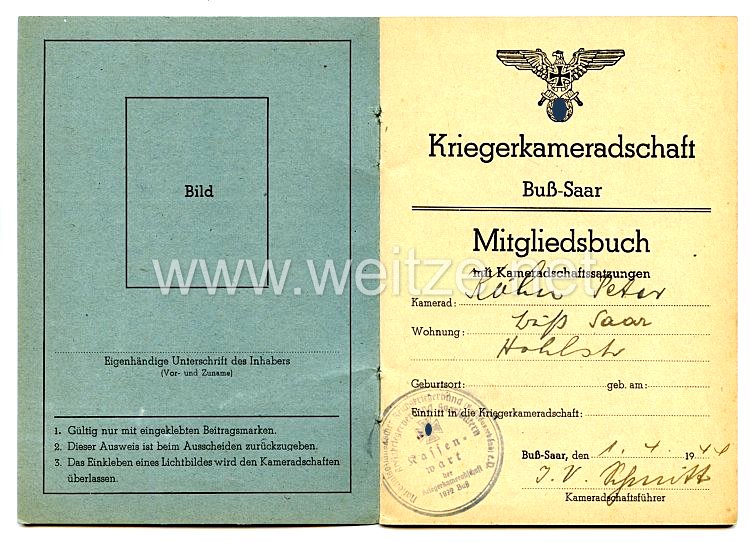
Third Reich War Veterans Association - Membership Book Buß - Saar
This membership book of a Kriegskameradschaft (War Comradeship Association) from the Third Reich represents a significant historical document that provides insight into the organization and control of veterans' associations during the National Socialist regime. Issued on April 1, 1944 in Buß-Saar (today part of the Saarland), this membership book documents membership in one of the numerous war comradeship associations that played an important role in the social penetration of National Socialist Germany.
The Kriegskameradschaften had a complex and multifaceted function in the Third Reich. While such associations had already emerged after the First World War, they were systematically coordinated (Gleichschaltung) after the Nazi seizure of power in 1933 and integrated into the NS organizational structure. These associations no longer served exclusively for comradely fellowship among former soldiers but were transformed into instruments of political indoctrination and military preparation.
The coordination of military veterans' associations occurred in the first years after 1933. The Reichskriegerbund Kyffhäuser, the largest umbrella organization of veterans' associations in the Weimar Republic, was dissolved and replaced by the NS-Reichskriegerbund (NSRKB) under the leadership of Wilhelm Reinhard. This organization later became part of the Nationalsozialistischer Reichskriegerbund (NSRKB), which was directly subordinate to the NSDAP. All local war comradeship associations had to submit to this central control and adapt their statutes to National Socialist directives.
The date of issue of this membership book, April 1, 1944, falls during a critical phase of the Second World War. At this time, the German Reich had already suffered severe military setbacks: the Battle of Stalingrad had ended in catastrophic defeat in February 1943, the Allies had landed in Italy, and invasion preparations in Western Europe were in full swing. The home front was increasingly affected by Allied bombing raids.
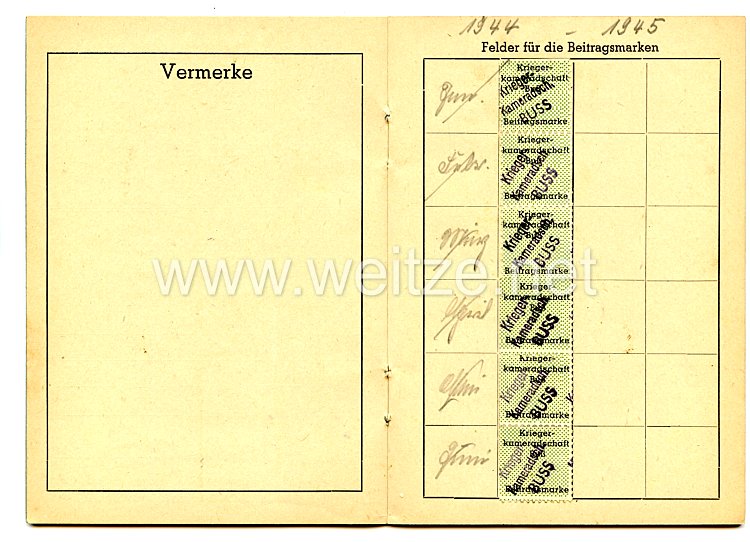
In this situation, the Kriegskameradschaften gained even greater importance for the Nazi regime. They served to maintain morale on the home front, disseminate propaganda of perseverance, and organize relief measures for wounded soldiers and their families. The membership books with their contribution stamps documented not only the financial support of the organization but also the member's ongoing commitment to the National Socialist community.
The Saar region, where this membership book was issued, had particular historical significance for the Nazi regime. After the First World War, the Saar territory had been placed under League of Nations administration. The Saar plebiscite of January 13, 1935 led to the region's return to the German Reich, which was celebrated by the National Socialists as a great propaganda success. The region was intensively integrated into the Nazi system, and organizations such as the war comradeship associations played an important role in this process.
The membership books themselves were carefully designed documents that recorded the member's personal data, military career, and achievements. The contribution stamps, which were pasted in at regular intervals, served as proof of continuous membership and financial support. These stamps were often emblazoned with National Socialist symbols and contributed to visual propaganda.
In the context of 1944, this membership book also reflects the desperate situation of the German Reich. The war comradeship associations were increasingly integrated into the Volkssturm organization, which was officially founded in October 1944. Older men, who were often members of the war comradeship associations, were to be called upon as a last reserve for the defense of the Reich.
From a scholarly perspective, such membership books are important sources for researching Nazi society, military history, and everyday life in the Third Reich. They document the penetration of society by National Socialist organizations and show how even traditional veterans' associations were instrumentalized for the purposes of the regime.
The used condition of this document underscores its authenticity and suggests that it was actually utilized. Such documents are today important historical witnesses that help historians understand the organization and functioning of Nazi society. They also serve as reminders of the dangers of militarizing society and the political appropriation of civil organizations.