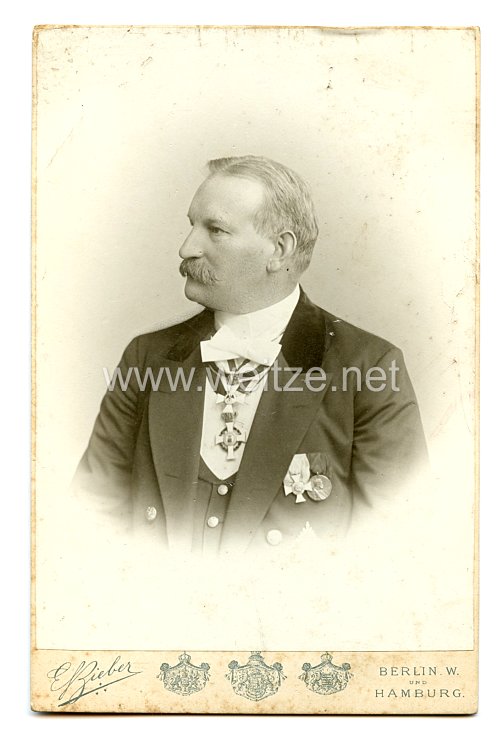
German Empire Photograph, Prussian Official with Order of the Red Eagle Cross 2nd Class with Oak Leaves and Order of Albrecht Commander with Breast Star

Cabinet photograph, dimensions approx. 10.5 x 16 cm, condition 2.
422863
100,00

German Empire Photograph, Prussian Official with Order of the Red Eagle Cross 2nd Class with Oak Leaves and Order of Albrecht Commander with Breast Star

This cabinet photograph from the era of the German Empire (1871-1918) documents a high-ranking Prussian civil servant who was decorated with two significant orders: the Order of the Red Eagle, 2nd Class with Oak Leaves and the Albrecht Order as Commander with Breast Star. Such photographs served not only as personal mementos but also as status symbols in the strictly hierarchical social system of Imperial Germany.

The Order of the Red Eagle was among Prussia's most prestigious decorations and was founded in 1705 by Margrave Georg Wilhelm of Brandenburg-Bayreuth as the Ordre de la Sincérité. After the extinction of the Franconian line of the Hohenzollerns in 1791, the order passed to the royal Prussian line. King Frederick William III renewed it in 1810 as the Royal Prussian Order of the Red Eagle. The order was divided into four classes, with the second class already representing a very high distinction.

The 2nd Class of the Order of the Red Eagle was worn as a neck cross and was reserved for high-ranking state officials, officers, and dignitaries. The additional award with Oak Leaves represented a special honor and was granted for exceptional service. The oak leaves were attached to the ribbon between the cross and the neck loop, signaling enhanced appreciation for services rendered. This enhancement grade was frequently awarded to civil servants who distinguished themselves through decades of faithful duty.

The second order visible in the photograph, the Albrecht Order, was a Saxon decoration founded in 1850 by King Frederick Augustus II of Saxony. It was named in honor of his father, the art-loving Prince Albert of Saxony. The order was awarded in five classes, with the Commander Class with Breast Star representing the second-highest grade. The Albrecht Order was particularly significant as it could be awarded for both military and civil merit.

The fact that this official wore both a Prussian and a Saxon order indicates his supra-regional importance in the German Reich. After the founding of the Empire in 1871, it was common for high-ranking officials who worked on Reich-wide matters or performed diplomatic functions to receive decorations from various German federal states. This reflected the federal structure of the Empire, in which the individual states retained their sovereignty in certain areas.

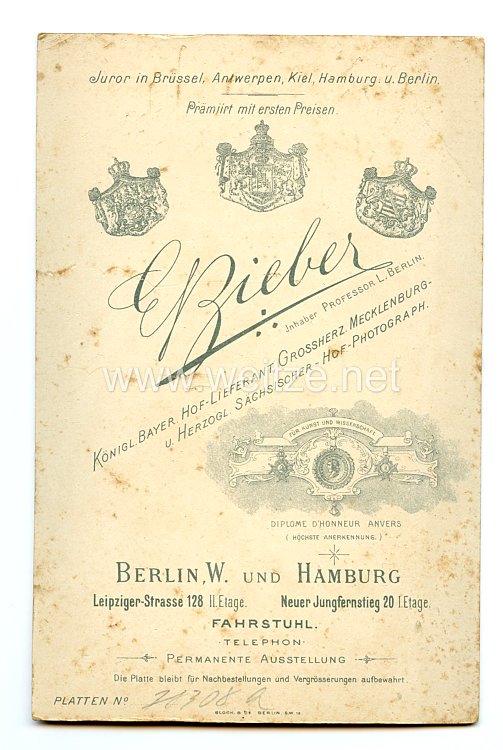
The cabinet format of the photograph (approximately 10.5 x 16 cm) was the standard portrait format in the second half of the 19th century. It replaced the smaller carte-de-visite format and offered more space for detailed representations. Photographs in this format were typically produced in professional studios, whose names were often noted on the back of the card. The images were carefully staged, with orders and decorations deliberately displayed.

The wearing of order decorations in the German Empire was subject to strict order statutes and regulations. The Statute of the Order of the Red Eagle of 1810, revised several times, precisely regulated who could wear the decoration and on what occasions. Generally, orders were to be worn at official occasions, at court, and for special celebrations. Photographs with order decorations were therefore special events that documented the wearer's social status for posterity.

The Prussian civil service formed the backbone of the German administrative state. High-ranking officials with such decorations typically held positions as Privy Councillors, Ministerial Directors, or Chief Presidents. They were often lawyers or had completed administrative training and served the state for decades. The Prussian civil service was known for its sense of duty, integrity, and efficiency – qualities publicly recognized through such orders.

Such historical photographs are today valuable contemporary historical documents that provide insight into the hierarchies, value systems, and visual forms of representation of the German Empire. They complement our understanding of an era in which social standing and state recognition were expressed through visible symbols. For collectors and historians, they are important sources for researching the practice of orders, the history of civil service, and the photographic culture of the 19th century.