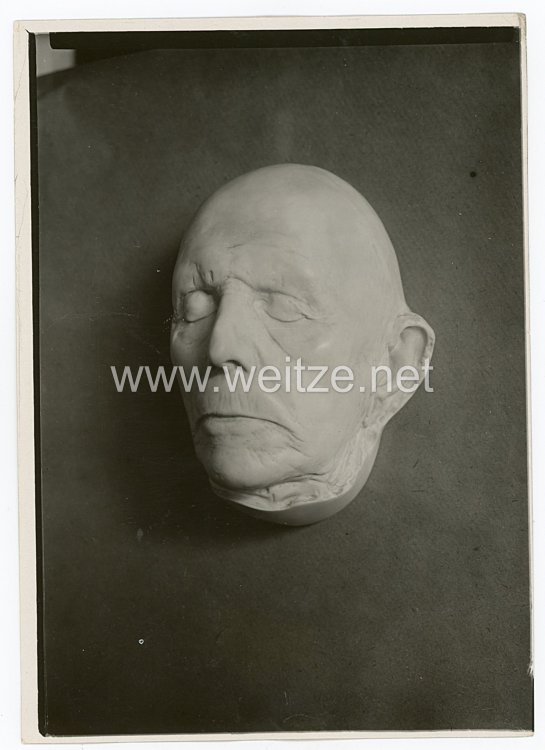
Weimar Republic Press Photograph, 40th Anniversary of the Death of Field Marshal Count Moltke, April 24, 1931

Dimensions approximately 13 x 18 cm, used condition.
310562
10,00

Weimar Republic Press Photograph, 40th Anniversary of the Death of Field Marshal Count Moltke, April 24, 1931

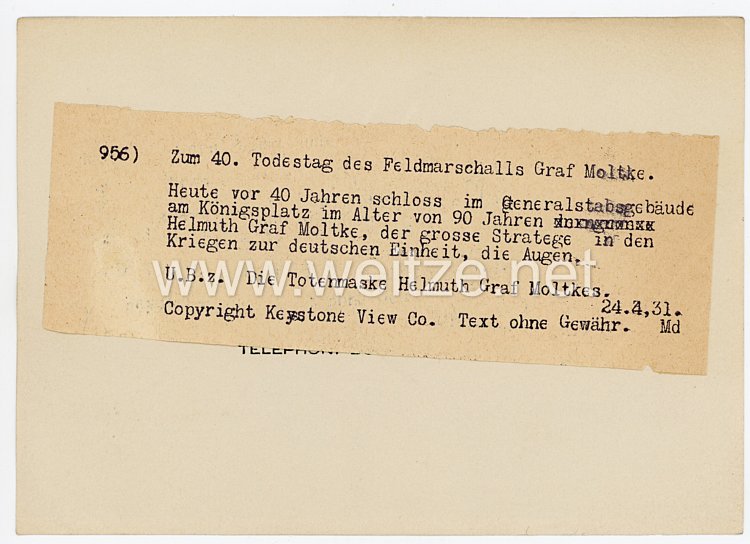
This press photograph from the Weimar Republic documents a significant commemorative event marking the 40th anniversary of the death of Field Marshal Helmuth Graf von Moltke on April 24, 1931. With dimensions of approximately 13 x 18 cm, it corresponds to the standard formats used by press agencies of the era for publication in newspapers and illustrated magazines.

Helmuth Karl Bernhard Graf von Moltke (1800-1891), known as “Moltke the Elder,” was one of the most influential military figures of the 19th century and the chief architect of Prussian and German warfare. As Chief of the General Staff from 1857 to 1888, he fundamentally reformed military organization and strategy. Under his leadership, Prussia achieved victory in the Second Schleswig War (1864), the Austro-Prussian War (1866), and the Franco-Prussian War (1870-71), which led to the founding of the German Empire.

Press photography in the Weimar Republic experienced its golden age during the 1920s and early 1930s. Technical innovations such as more portable cameras and improved printing processes enabled the rapid distribution of photographic material. Press agencies like Scherl, Ullstein, and the Deutsche Photographische Gesellschaft supplied editorial offices throughout the Reich with current images. Photographs were typically marked on the reverse with stamps, handwritten notes, and often pre-printed captions.

The year 1931, when this photograph was taken, marked a crisis period for the Weimar Republic. The Great Depression had struck Germany with full force, mass unemployment characterized society, and political radicalization was increasing alarmingly. In this context, memories of past greatness and military successes gained particular significance. The veneration of military leaders like Moltke served conservative and nationalist circles as a reference point for their criticism of the democratic order.

The cult of Moltke had been deeply rooted in Germany since the Imperial era. Numerous monuments, street names, and barracks bore his name. After his death in 1891, he received a state funeral, and Kaiser Wilhelm II commissioned the imposing Moltke Monument in Berlin's Großer Tiergarten in his honor. The Reichswehr of the Weimar Republic, although limited to 100,000 men by the Treaty of Versailles, deliberately maintained the traditions of the old Prussian-German army.

Commemorative events marking round anniversaries of military personalities were common in the Weimar Republic and were instrumentalized by various groups. The Stahlhelm, the Kyffhäuserbund, and other veterans' associations organized celebrations that often struck revanchist and anti-republican tones. The Reichswehr itself also observed such memorial days with military honors.

The photographic documentation of such events served multiple functions: current reporting, historical memory, and not least political positioning. Photographers commissioned by press agencies were present at all significant public events. The images were developed, printed, captioned, and then sent to newspaper editorial offices or offered for sale.

The format of 13 x 18 cm was one of the standard formats for press photography of that era. It was large enough for detail but manageable for archiving and shipping. Many of these photographs bore stamps from photographers or agencies on the reverse, date notations, captions, and sometimes censorship marks. The “used condition” of such photos is typical: they show signs of use such as creases, stamp impressions, inscriptions, and sometimes adhesive residue from use in editorial offices.

The memory of Moltke remained present after 1933 under National Socialism, but was adapted to the ideological needs of the regime. After 1945, the veneration of Moltke lost significance in the Federal Republic, while in the GDR, Prussian-German military tradition was fundamentally viewed critically.

Today, such press photographs are important historical sources. They document not only the respective event but also how history was staged and medially conveyed. They reveal which persons and events were considered worthy of remembrance and how political movements exploited historical traditions for their purposes. For collectors and historians, they offer insight into the visual culture of the Weimar Republic and the mechanisms of the contemporary media landscape.

r