Waffen-SS - Latvian Volunteer Legion - Waffen-SS Identity Card "Ostland"
Historical Context: Waffen-SS "Ostland" Identity Card for the Latvian Volunteer Legion
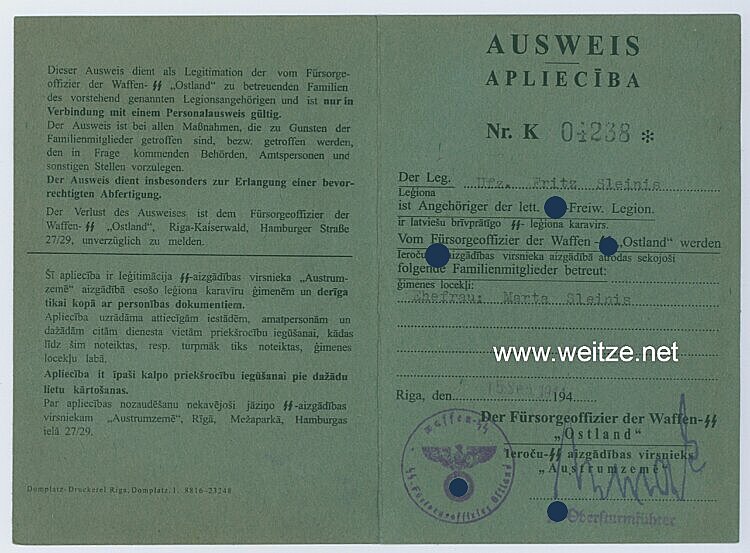
This identity card issued by the Waffen-SS "Ostland" represents a significant document from the complex and tragic history of the Latvian Volunteer Legion during World War II. Issued on September 15, 1944 in Riga, this bilingual document (Latvian and German) documented a Latvian NCO's membership in the Legion and the care provided to his family members by the welfare officer of the Waffen-SS "Ostland".
The Latvian Legion in Historical Context
The Latvian Legion of the Waffen-SS was formed in 1943 as part of German occupation policy in the Baltic region. Following the Soviet occupation of Latvia in 1940-1941 and the subsequent German invasion in summer 1941, Latvia fell under the administration of Reichskommissariat Ostland. This administrative territory encompassed the Baltic states and parts of Belarus, governed by Reich Commissioner Hinrich Lohse.
The recruitment of Latvian soldiers initially began with the establishment of police battalions and auxiliary units. In February 1943, however, Heinrich Himmler ordered the formation of a Latvian SS Volunteer Legion. The term "volunteer" was often euphemistic, as recruitment encompassed both voluntary elements and various forms of coercion.
Organizational Structure and Military Units
The Latvian Legion consisted primarily of two divisions: the 15th Waffen Grenadier Division of the SS (Latvian No. 1) and the 19th Waffen Grenadier Division of the SS (Latvian No. 2). At its peak, the Legion comprised approximately 85,000 to 110,000 men. The soldiers wore German uniforms with special Latvian insignia and the characteristic red-white-red coat of arms badge on the sleeve.
The Welfare Officer and Social Support
The Welfare Officer of the Waffen-SS "Ostland" mentioned on this identity card was part of a comprehensive system for supporting legionnaires and their families. This institution was intended to maintain troop morale by addressing the social and economic concerns of soldiers' families. In the difficult situation of 1944, as the Soviet Army was already advancing westward, this welfare gained particular importance.
The welfare system included support services for family members, regulation of supply claims, and administrative assistance. Such identity cards served as official proof of membership in the Legion and entitled families to certain benefits and protective measures.
The Situation in September 1944
The issuance date of this document, September 1944, falls during a critical phase of the war in the Baltic region. Operation Bagration launched by the Red Army in summer 1944 had resulted in the virtual destruction of German Army Group Center. Latvia was under increasing Soviet pressure, and Riga, the capital and place of issuance for this card, would be captured by the Red Army in October 1944.
During this phase, Latvian units fought both on the Narva Front in Estonia and in the defense of Latvia against the advancing Soviet Army. The Battle of Courland, which would continue until the war's end in May 1945, tied down considerable Latvian and German forces in what became known as the Courland Pocket.
Document Characteristics and Administrative Practice
The bilingual nature of the document (Latvian and German) reflects the administrative practice in Reichskommissariat Ostland. German authorities recognized the necessity of communicating in local languages to facilitate administration and foster cooperation with the indigenous population.
Such identity cards were created using standardized forms and typically contained personal data of the legionnaire, information about family members, rank and unit, as well as official stamps and signatures. They served as important identification documents in an area under wartime administration.
Post-War Period and Historical Assessment
After the war, many members of the Latvian Legion fled westward to escape Soviet captivity. The historical assessment of the Legion remains complex: while it was part of the Waffen-SS, it was treated differently after the war by Allied commissions than German SS units, as its members primarily served as conscripts under German occupation.
Documents such as this identity card are today important historical sources for understanding the Baltic experience during World War II and the complex situation between Soviet and German occupation. They provide insight into the administrative structures, social support systems, and the daily realities faced by those caught between competing totalitarian regimes.