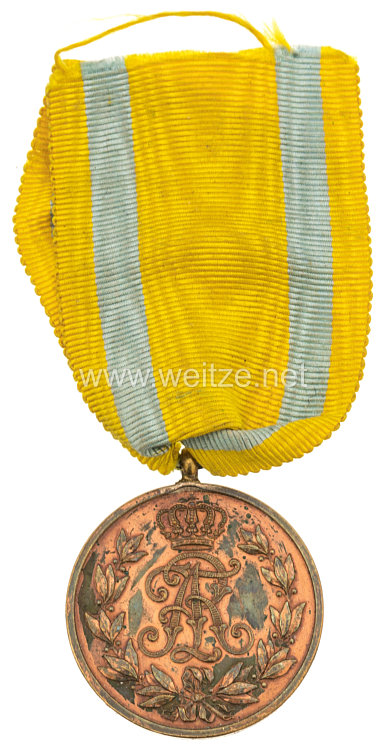
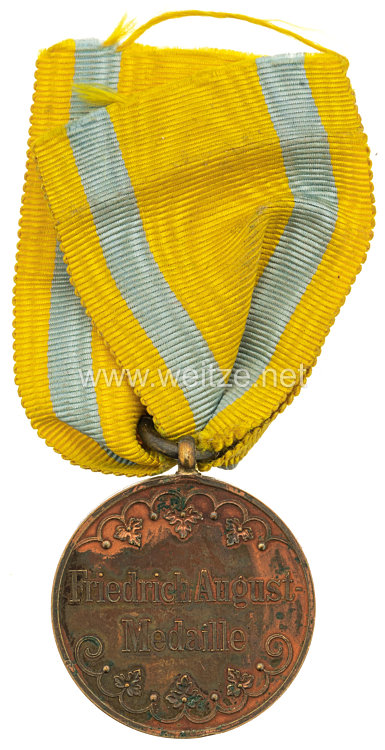
Kingdom of Saxony Friedrich August Medal in Bronze

on original ribbon, condition 2.
419462
45,00

Kingdom of Saxony Friedrich August Medal in Bronze

The Friedrich August Medal of the Kingdom of Saxony

The Friedrich August Medal ranks among the most significant decorations of the Kingdom of Saxony and represents an important epoch of Saxon military and civil awards during the 19th and early 20th centuries. This bronze medal was awarded during the reigns of various Saxon kings named Friedrich August and documents the long tradition of the House of Wettin in bestowing honors.

The Kingdom of Saxony existed as a sovereign German federal state from 1806 to 1918 and was a member of the German Confederation and later the German Empire. The Saxon rulers maintained a distinctive tradition of honors and decorations that recognized both military merit and civil achievements. The Friedrich August Medal could be awarded for various occasions, including jubilees, special merit in military or state service, and to commemorate significant historical events.

Historical Context and Foundation

Several Saxon kings bore the name Friedrich August, leading to various medal foundations. King Friedrich August I (r. 1806-1827), initially Frederick Augustus III, Elector of Saxony, assumed the royal title after Saxony's elevation to kingdom status. His successor King Friedrich August II (r. 1836-1854) and finally King Friedrich August III (r. 1904-1918), the last Saxon king, each established various decorations and medals.

The medals were frequently manufactured from different materials: gold for the highest merit, silver for medium merit, and bronze for basic recognition or for larger distributions to participants in specific events. The bronze version was often the most widely distributed variant and was issued to a broader circle of recipients.

Design and Iconography

Saxon medals of this era followed the classical design principles of the 19th century. Typically, they displayed the profile portrait of the ruling monarch on the obverse, surrounded by an inscription with names and titles. The reverse usually contained inscriptions documenting the occasion for award, or symbolic representations such as coats of arms, laurel wreaths, or patriotic emblems.

The Saxon crown and the coat of arms with crossed swords were recurring motifs symbolizing royal authority and the historical significance of the Electorate of Saxony. The craftsmanship quality of Saxon medals was consistently high, as Saxony possessed a long tradition in metalworking and coin minting.

The Ribbon and Its Significance

Each Saxon decoration was associated with a specific ribbon whose colors and patterns identified the type of award. Saxon ribbons frequently employed the national colors white and green in various combinations. The “old ribbon” refers to the original, contemporary ribbon from the award period, which underscores the authenticity and historical integrity of the piece.

The preservation of the original ribbon is of particular importance to collectors and historians, as it provides additional information about origin, period, and authenticity of the medal. Ribbons were subject to natural wear over time, making well-preserved original ribbons rare today.

Award Practice and Recipients

The Friedrich August Medal in bronze was awarded to a broad circle of recipients, including soldiers, non-commissioned officers, officials, and civilians. Award occasions included:

- Military campaigns and wars (especially the Napoleonic Wars, the Austro-Prussian War of 1866, and the Franco-Prussian War of 1870/71)
- Royal jubilees of the kings
- Service anniversaries of military and civil personnel
- Special merit in state service
- Participation in historical events

Historical Significance and Collecting

After the end of the monarchy in 1918 and the abdication of King Friedrich August III, Saxon orders and medals lost their official significance. However, they remain important historical documents of German history and Saxon state tradition. For collectors of military historical objects, they represent tangible connections to the past and document the complex system of honor, loyalty, and recognition in the German Empire.

The bronze version is relatively common in today's collector market, reflecting its wide distribution during the award period. The condition, completeness with original ribbon, and identifiability of the specific award occasion significantly influence the historical and collector value.

Conclusion

The Friedrich August Medal of the Kingdom of Saxony in bronze is more than just a military or civil decoration. It embodies the monarchical tradition of one of the most significant German states and offers insights into the honor system, social hierarchy, and historical events of a bygone era. As a collectible object, it connects material heritage with historical memory and remains a valuable testament to Saxon and German history.

r