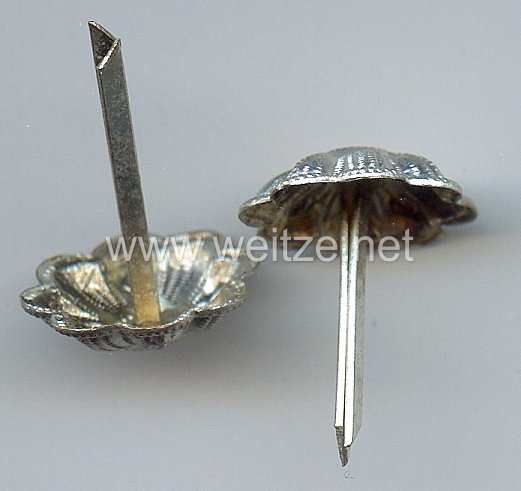
Third Reich - Pair of Rank Stars for Officials of the Reichsbahn, Justice Administration, etc.
The presented rank stars for officials of the Reichsbahn and judicial administration from the era of the Third Reich represent an important chapter in German administrative history between 1933 and 1945. These silver-plated, unused rank insignia illustrate the hierarchical system that permeated not only the military but also the civil administrative structures of National Socialist Germany.
After the seizure of power in 1933, a comprehensive coordination of all state institutions took place. The Deutsche Reichsbahn, which had existed as a unified state enterprise since 1920, was gradually integrated into the National Socialist structure. Simultaneously, the judicial administration was adapted to the new political circumstances. Uniform rank insignia were introduced for both areas, modeled on military examples.
The rank stars served as shoulder insignia to identify the service rank of officials in the upper and senior civil service. Unlike military rank insignia, which were often mounted on cloth backing, these civil rank stars were frequently sewn or slipped directly onto the shoulder boards of service uniforms. The silver plating indicates a higher-quality execution, typically used for officials of the upper service grades.
At the Reichsbahn, a comprehensive reform of service clothing regulations took place in 1935. Officials were divided into various career groups: lower, intermediate, upper, and senior service. Each of these groups had specific rank insignia. The number of stars on the shoulder boards indicated the respective service rank within the hierarchy. One star could denote a Reichsbahnamtmann, two stars a Reichsbahnoberamtmann, for example.
Similar systems were introduced in the judicial administration. Judicial officials who did not belong to the judiciary but performed administrative tasks – such as judicial secretaries, judicial inspectors, or judicial officers – also wore uniforms with rank insignia. This uniformization served to display state authority and fit into the National Socialist principle of hierarchical order.
The manufacture of such rank insignia was carried out by specialized companies that produced military and official effects. Silver plating was achieved through various processes, usually coating a base metal alloy with a thin layer of silver. Craftsmanship quality varied depending on the manufacturer and production period. Towards the end of the war, inferior materials were often used due to material shortages.
The unused condition of these rank stars is remarkable. Many such insignia were produced during the war but never issued or worn. This could have various causes: they might have been stored as replacement insignia in depots, the intended wearer might not have taken up service, or they were recovered from stocks after the war before being deployed.
After the collapse in 1945, many of these uniform effects were destroyed or confiscated by the occupation forces. The Allies prohibited the wearing of National Socialist insignia through Control Council Law No. 1 of September 20, 1945. Surviving examples were either kept by former wearers as memorabilia or found their way into private collections through various channels.
From a historical perspective, such objects are important witnesses to the administrative structures of the Third Reich. They document the penetration of all state sectors with hierarchical, militarily inspired structures. The Reichsbahn played a particularly tragic role in the implementation of the Holocaust by organizing deportation trains. The judicial administration was involved in enforcing National Socialist injustice.
For collectors and museums, such objects represent important study items that help understand the everyday reality of NS administration. They are part of the material culture of a dictatorial regime and contribute to documenting this era. At the same time, they require responsible handling and critical historical classification.