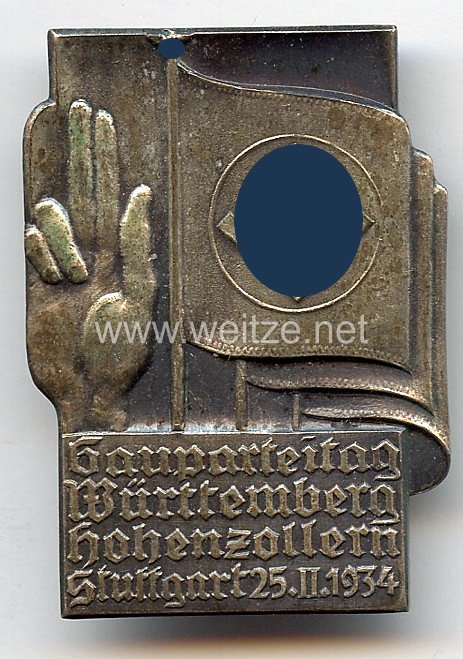
Third Reich - Gau Party Rally Württemberg Hohenzollern - Stuttgart 25.2.1934

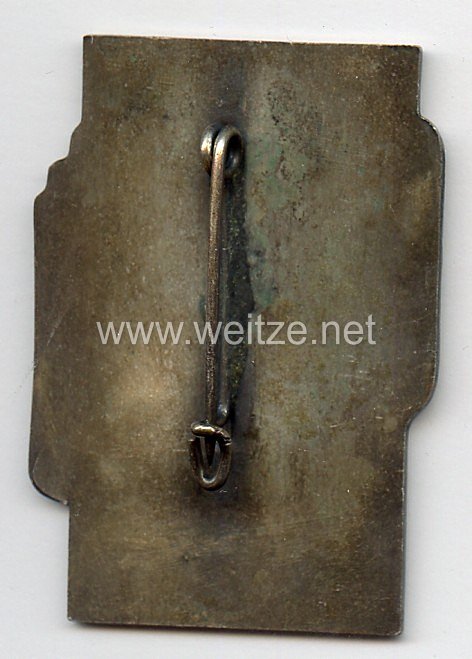
solid non-ferrous metal badge, with pin, condition 2.
306362
80,00

Third Reich - Gau Party Rally Württemberg Hohenzollern - Stuttgart 25.2.1934

The Gau Party Rally Badge Württemberg-Hohenzollern from February 25, 1934, in Stuttgart represents a significant artifact documenting the early organizational structure of the NSDAP (National Socialist German Workers' Party). Such badges document the intensive party activity during the phase of power consolidation immediately following the Nazi seizure of power in January 1933.

The Gau Württemberg-Hohenzollern was one of the regional administrative units of the NSDAP. The Gau structure formed the organizational backbone of the party and was largely oriented toward historical territorial boundaries, although not always identical to the existing administrative borders of the Weimar Republic. The Gau Württemberg-Hohenzollern essentially comprised the territory of the former Kingdom of Württemberg as well as the Prussian Hohenzollern lands.

The Gau Party Rallies (Gauparteitage) were central events in National Socialist party life. They served multiple purposes: demonstrating power and unity, mobilizing the party base, announcing political directives, and staging the cult of leadership. In February 1934, at the time of this party rally, the NS regime was in a critical transitional phase. The coordination (Gleichschaltung) of the federal states was largely completed, but internal tensions, particularly with the SA under Ernst Röhm, would culminate a few months later in the so-called Night of the Long Knives at the end of June 1934.

The present badge is manufactured from solid base metal (Buntmetall), which was typical for party rally badges of this early period. Base metal, a copper alloy, offered the advantage of relative cost-effectiveness while maintaining an appealing appearance. The production of such badges was carried out by specialized metalware companies that were increasingly integrated into the National Socialist economic order. The use of a pin fastening on the reverse was standard for lapel badges of this period and allowed wearing on civilian clothing or party uniforms.

Such badges were typically issued to participants, functionaries, or deserving party members. They served as commemorative pieces, credentials, and not least as instruments of binding loyalty to the party. Collecting and wearing party badges became part of National Socialist symbolic culture, which increasingly permeated public life.

The venue Stuttgart, as the capital of Württemberg, was a natural location for a Gau party rally. The city possessed the necessary infrastructure for mass events and had a significant NSDAP organization. In the Württemberg region, the NSDAP had already established itself before 1933, albeit with regionally varying success.

The year 1934 marked a turning point in the consolidation of NS rule. The so-called Gleichschaltung (coordination) of social institutions had been largely accomplished. In this context, the Gau party rallies served to demonstrate the achieved power position and further mobilize supporters for the regime's upcoming tasks.

From a collecting-historical perspective, such Gau party rally badges are today important contemporary historical documents. They illustrate the organizational structure, propaganda methods, and material culture of National Socialism. The indicated condition 2 (according to common collector grading) suggests a well-preserved specimen with minimal signs of wear, which increases its significance as a historical object.

Academic engagement with such objects requires critical contextualization. They are testimonies of a criminal regime whose ideology and actions led to war, genocide, and unspeakable suffering. At the same time, they are indispensable as historical sources for understanding the functioning of totalitarian systems, their symbolic politics, and techniques of domination.