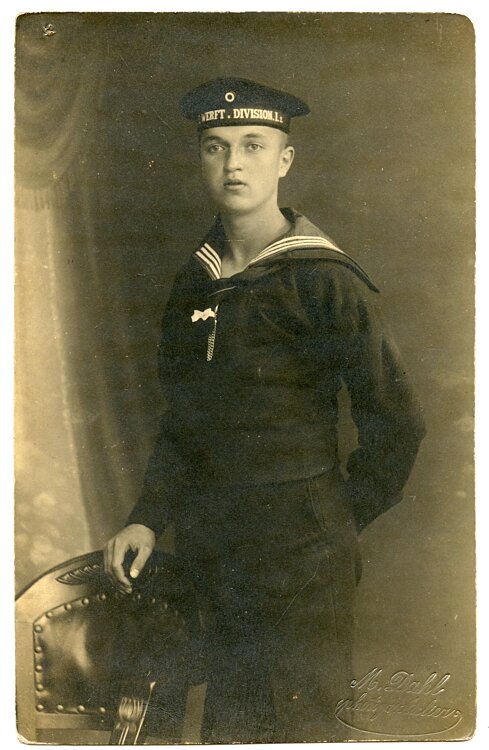
World War I Photograph, Member of the Imperial Navy Shipyard Division I
This photographic object depicts a member of the Imperial Navy Werft-Division I (Shipyard Division I) from the period of World War I (1914-1918). Photographs of this type in postcard format were a widespread medium during the war, serving both to document military identity and to create personal mementos for family members.
The Imperial German Navy (Kaiserliche Marine) encompassed not only the fighting ship crews but also an extensive support system of shipyard divisions responsible for the construction, maintenance, and repair of warships. The Werft-Divisionen (Shipyard Divisions) were specialized units consisting of highly qualified craftsmen, engineers, and technicians. These men were crucial to the operational capability of the Imperial Fleet.
The designation “Werft-Division I” indicates one of the first and possibly most significant shipyard units. Such divisions were typically stationed at the major naval shipyards, such as Wilhelmshaven, Kiel, or Danzig. These locations formed the backbone of German naval armament and were of strategic importance throughout the war.
Members of the Werft-Divisionen wore special uniforms that identified them as Navy personnel, though these often differed from those worn by ship crews. The naval uniform of this period was characterized by distinctive elements: the sailor collar with three white stripes, the cap with a ribbon frequently bearing the name of the ship or unit, and various badges indicating the wearer's rank and specialty.
Postcard-sized photographs, such as the specimen described here, were mass-produced during this era. Soldiers and sailors frequently had their portraits taken in professional photo studios that established themselves near barracks and naval bases. These photographers often had standardized backgrounds and props to create an atmosphere of military dignity and patriotic sentiment. The images were then printed in postcard format, facilitating their dispatch to the home front.
The Imperial Navy expanded dramatically in the years before World War I. Under the leadership of Grand Admiral Alfred von Tirpitz and with the support of Kaiser Wilhelm II, the German fleet was massively expanded between 1898 and 1912 through several naval laws. This expansion required a corresponding increase in shipyard capacity and technical personnel. The Werft-Divisionen grew accordingly and became complex organizations employing thousands of workers.
During World War I, the shipyard divisions played a critical role in maintaining the fleet's combat readiness. After the Battle of Jutland (May 31 to June 1, 1916), the largest naval battle of the war, extensive repair work was necessary. The German shipyards demonstrated their efficiency by returning damaged ships to operational status in remarkably short periods.
Members of the Werft-Divisionen had a specific military status. Although they did not serve at sea, they were subject to military discipline and wore uniforms. Many of them were reservists or civilians with special technical skills conscripted for naval service. Their work was often dangerous: accidents in shipyards were not uncommon, and during the war, some shipyards were targets of sabotage or – though rarely – enemy attacks.
Morale in the shipyard divisions deteriorated significantly toward the end of the war. Increasing war weariness, supply shortages, and the revolutionary mood that gripped Germany in 1918 did not spare the naval bases. The Sailors' Mutiny began on October 29, 1918, in Wilhelmshaven and quickly spread to Kiel and other naval bases. These uprisings marked the beginning of the November Revolution, which led to the end of the monarchy and the proclamation of the Republic.
Photographs such as the one described here are valuable historical documents today. They convey not only visual information about uniforms and military identity but also about the social significance of military affiliation in Wilhelmine society. For families, such photographs were often the only visual memory of their relatives serving in the war. The preservation condition described as “Zustand 2” (Condition 2) indicates a well-preserved specimen, which is not a given for photographs from this period.