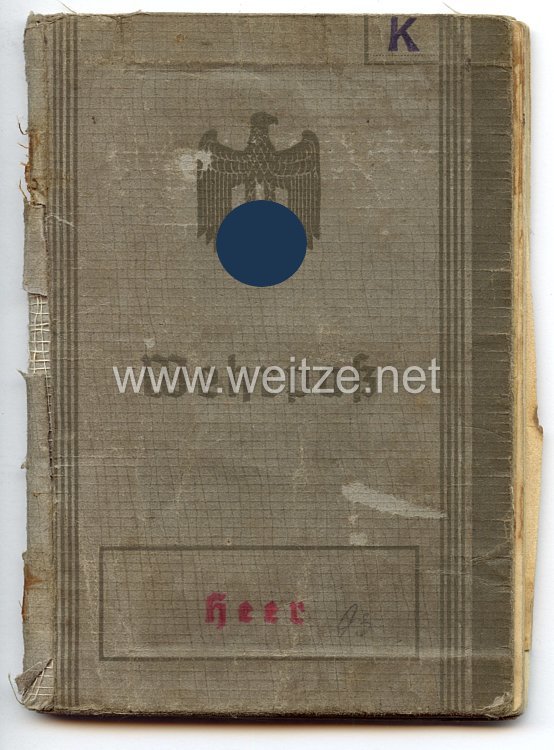
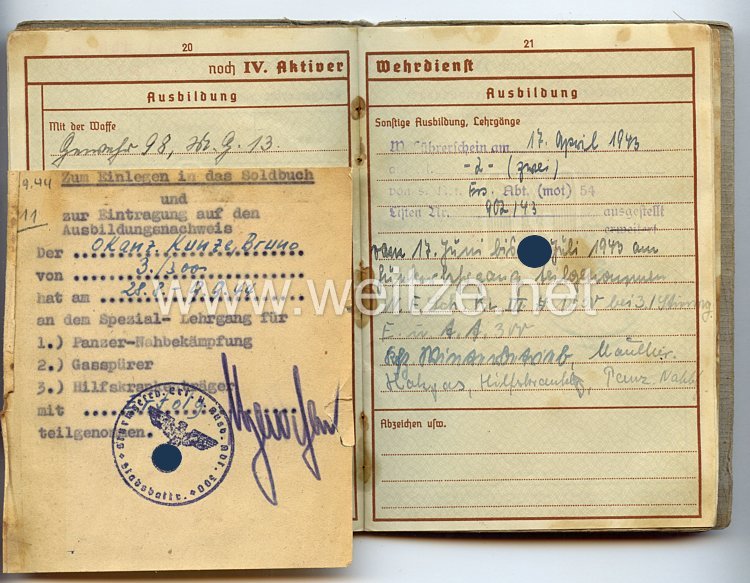
Wehrpass for a later Private First Class of the Stabsbattr./4./Sturmgeschütz-Brigade 311
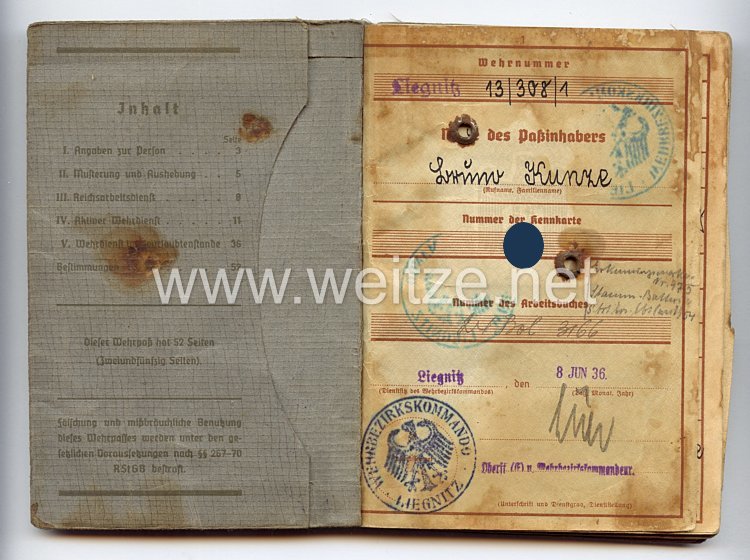
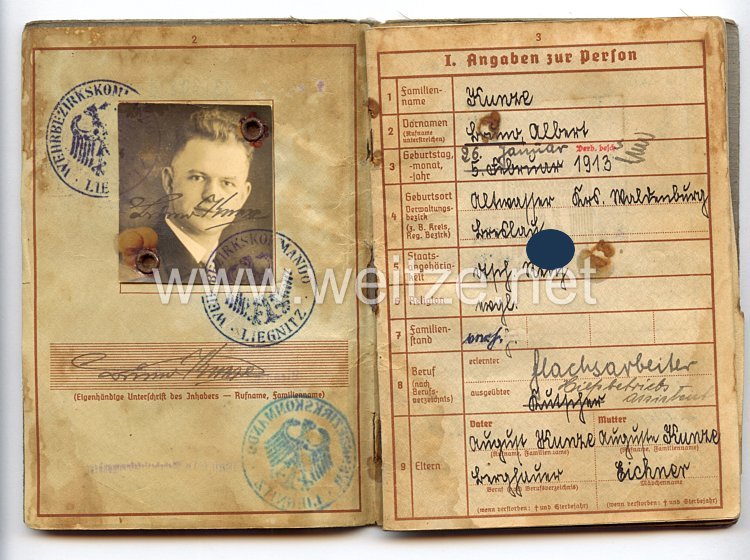
This Wehrpass (military service book) documents the military career of a German soldier, issued on June 8, 1936, in Liegnitz (now Legnica, Poland). This document provides a fascinating insight into the training and service of a soldier during the Third Reich, particularly within the Wehrmacht's assault gun units.
The Wehrpass had been the central military personnel document of the Wehrmacht since 1935, replacing the earlier Militärpass system of the Reichswehr. Every German man liable for military service received such a pass, which documented his entire military career, including medical examination, conscription, units, promotions, training courses, and decorations. The document had to be kept current at all times and served as official proof of military service status.
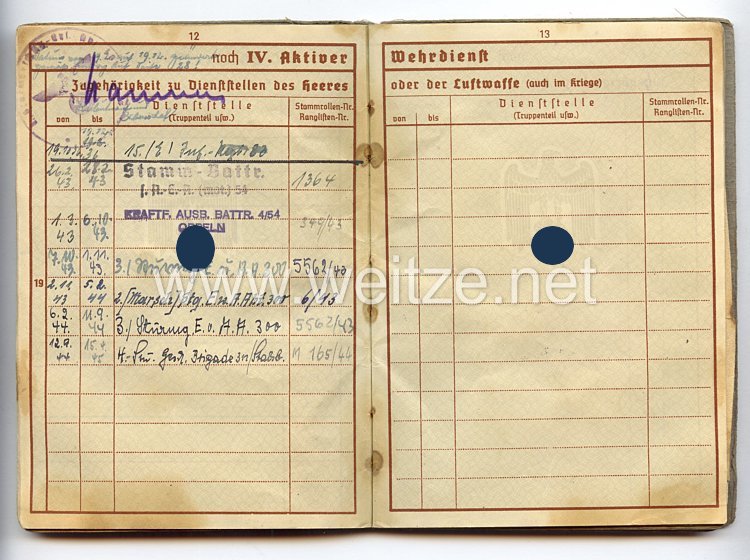
The holder of this pass was initially classified as k.v. (kriegsverwendungsfähig - fit for war service) for Reserve II, meaning he was deemed suitable for military service. His military career began on October 19, 1936, with the 15th (Replacement)/Infantry Regiment 83, a replacement unit responsible for basic training and supplementing the regular troops.
Particularly noteworthy is the soldier's assignment to various assault gun units. The Sturmgeschütz-Brigade 311 was an independent brigade equipped with armored self-propelled guns. Assault guns were originally conceived as infantry support weapons and evolved during the war to become an important component of the German armored forces. Brigade 311 was established in September 1943 and fought on various fronts.
His assignment to the Stamm-Batterie/I.Artillerie-Ersatz-Abteilung (motorized) 54 and the Kraftfahrer-Ausbildungs-Batterie 4/54 (Driver Training Battery) indicates specialized training in motorized operations. These units were responsible for training personnel for motorized and mechanized formations, which was of great importance in the increasingly mechanized Wehrmacht.
The training courses documented in the Wehrpass are characteristic of a soldier in assault gun units. The driver's license for Maultier (Mule) may seem unusual today, but was an official qualification for operating heavy tracked vehicles of the Wehrmacht. The special course in anti-tank close combat was important tactical training that enabled soldiers to engage enemy tanks with close-combat weapons such as Panzerfausts, magnetic hollow charges, or Teller mines. This training was particularly intensified from 1943 onwards as the Wehrmacht increasingly went on the defensive.
The fact that no decorations and combat actions are recorded can have various reasons. The Wehrpass may not have been completely maintained, the soldier may have served mainly in training units, or the document may have been taken out of service before extensive combat experience was gained. It is also possible that the holder served in reserve units or rear-area services.
The Sturmgeschütz-Ersatz- und Ausbildungs-Abteilung 300 (Assault Gun Replacement and Training Battalion 300), in whose various companies the soldier served, was responsible for training and providing replacement personnel for assault gun units. These replacement and training units played a central role in the Wehrmacht's personnel system, as they had to ensure the continuous supply of trained soldiers for front-line units.
The heavily used condition of the document indicates that it was actually carried during service time, as was required. Wehrpässe had to be presented during call-ups, transfers, and demobilization and were therefore frequently used.
From a historical perspective, this Wehrpass exemplifies the development of the Wehrmacht from rearmament beginning in 1935 through the period of World War II. The progression from infantry to specialized assault gun units reflects the increasing mechanization and specialization of the German armed forces. Such documents are today important sources for military historical research and provide insights into individual military careers as well as the organization and structure of the Wehrmacht.
Documents like this Wehrpass serve as tangible connections to individual experiences within the larger historical narrative. They contain not only administrative data but also represent personal histories of soldiers who served during one of history's most devastating conflicts. For researchers and collectors, these documents provide invaluable primary source material for understanding the everyday realities of military service in the Wehrmacht.