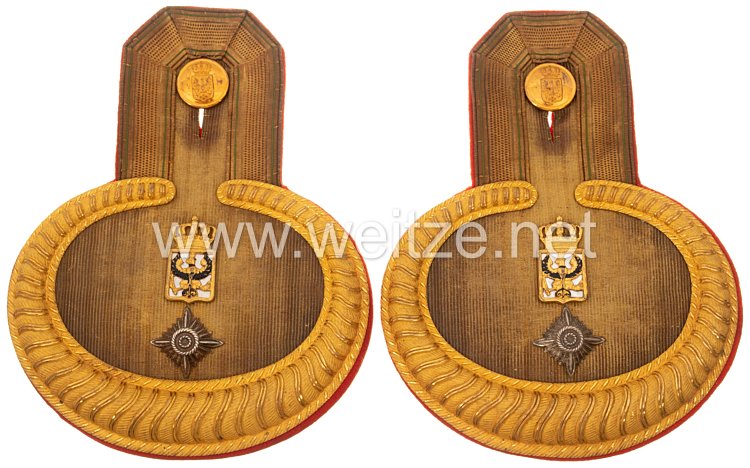
Prussia Customs Pair of Epaulettes for a Packhof Superintendent

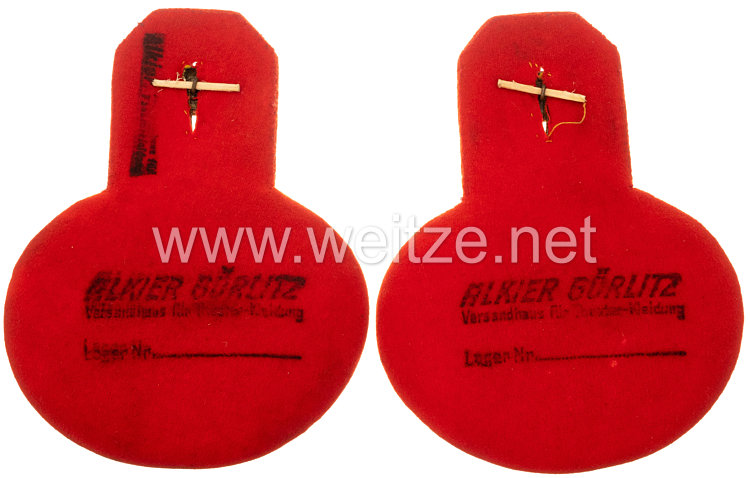
Circa 1910. Gold fields, gold braids with green stripes, gold crescents, red cloth backing, metal fittings. Condition 2.
398861
450,00

Prussia Customs Pair of Epaulettes for a Packhof Superintendent

These epaulettes of a Prussian Packhofvorsteher (customs warehouse supervisor) dating from around 1910 represent a remarkable testament to the complex hierarchy of rank insignia within the German customs service during the late Imperial period. These shoulder pieces combine military formal language with civil administrative function and illustrate the characteristic permeation of state institutions with military symbols and structures in the German Empire.

The Prussian customs administration developed during the 19th century into a highly organized agency whose uniforming and rank insignia were strictly regulated. After the founding of the Reich in 1871, the customs system was standardized throughout the empire, yet retained certain peculiarities in the various federal states. The Prussian customs administration was the largest and most influential within the German Empire.

The Packhofvorsteher was a middle to senior-ranking official of the customs administration who supervised a Packhof – those facilities where customs-cleared goods were stored, inspected, and packaged. This position required both administrative abilities and practical knowledge of customs and trade matters. The Packhofvorsteher was responsible for the proper processing of customs procedures, supervision of personnel, and security of stored goods.

The design of the epaulettes followed precise regulations of Prussian uniform regulations. The golden fields and braids with green threads were characteristic of the customs uniform. The color green had a long history in Prussian uniforming tradition and symbolized, among other things, forestry, hunting, and financial administrations. The golden crescents on the epaulettes were a traditional element adopted from the military sphere and indicated the rank and dignity of the wearer.

The red cloth backing formed a characteristic contrast to the golden elements and likewise followed established regulations. The combination of gold and red held elevated significance in Prussian uniforming and was typical for middle and senior civil service ranks. The metal attachments not only reinforced the durability of the epaulettes but also served a representative effect.

Around 1910, when these epaulettes were created, the German Empire was at the height of its power. The customs administration played a central role in the Reich's economic policy. Customs revenues were one of the most important sources of state income, and accordingly high was the prestige of customs officials. Uniforming served not only for recognition but also for the representation of state authority.

The wearing of epaulettes was strictly regulated. They were worn on parade uniform, at ceremonial occasions and official duties. The careful maintenance and upkeep of these precious rank insignia was the duty of the wearer. The golden braids and embroidery were manufactured by specialized craft workshops, often in family tradition over generations.

The epaulettes differed according to rank through the number and arrangement of crescents, the type of braids, and the design of fringes. A Packhofvorsteher stood in the hierarchy between simple customs officers and higher administrative officials. His epaulettes reflected this middle position and enabled immediate recognition of his rank.

With the end of World War I and the collapse of the monarchy in 1918, these magnificent rank insignia lost their official function. The Weimar Republic introduced simpler uniforming that oriented itself more strongly to civilian models. The imperial epaulettes became historical memorabilia that today represent important sources for uniform studies and the history of German administration.

The condition “Zustand 2” (condition 2) of these epaulettes indicates good preservation with only minor signs of wear. This is remarkable, as the fine gold threads and embroidery are susceptible to damage from aging and improper storage. Such well-preserved examples are today sought-after collector's items that offer an authentic insight into the uniform culture of the Empire.

These epaulettes impressively document the connection between civil administration and military tradition that was so characteristic of Wilhelmine Germany. They bear witness to a time when uniform, rank, and hierarchy held central social significance and in which even civil servants appeared in military-style splendor.

r