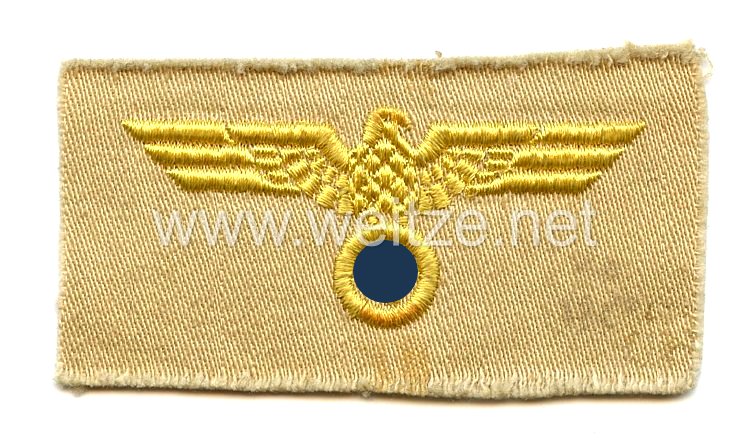
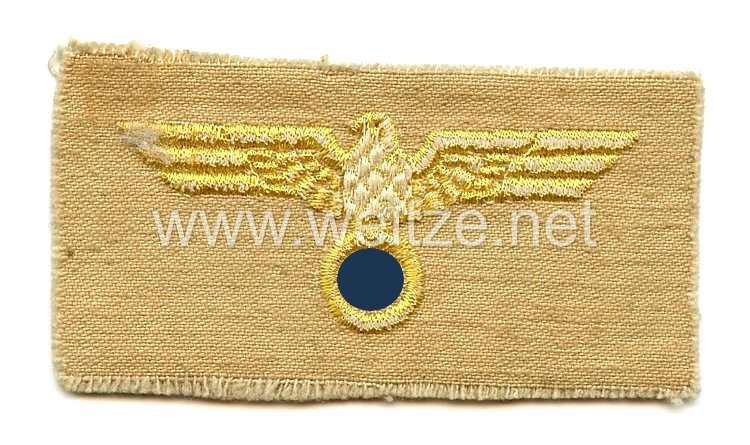
Kriegsmarine Tropical Overseas Cap Eagle for Enlisted Personnel
The Kriegsmarine Ship Cap Eagle for Enlisted Personnel for the Tropical Ship Cap represents a characteristic example of the special uniform equipment developed for German naval personnel serving in tropical and subtropical deployment areas during World War II.
The Kriegsmarine, the official designation of the German Navy from 1935 to 1945, maintained extensive operations not only in European waters but also in tropical regions, particularly in the Mediterranean, off the African coast, in the Indian Ocean, and in the Pacific. This geographical expansion of operations necessitated the development of special tropical uniforms adapted to the climatic conditions of these regions.
The tropical ship cap (Tropen-Schiffchen) was part of the tropical dress regulations and differed from the regular side cap through its sand-colored or khaki coloring, which was better suited for hot climates than the traditional dark blue naval clothing. This headgear was typically manufactured from lighter material to reduce heat stress for the wearers.
The ship cap eagle (Schiffchenadler) itself was the official national emblem of the Kriegsmarine and had to be worn on various headgear according to the Dress Regulations for the Kriegsmarine. For enlisted personnel (sailors and non-commissioned officers without sword knot), the execution in machine-embroidered form was prescribed. The badge depicted the stylized German Reich eagle with spread wings, holding a swastika in its talons - the official state symbol of National Socialist Germany.
The version described here in yellow embroidery on sand-colored background was specifically designed for tropical uniforms. While the regular ship cap eagles for the side cap were executed in white on dark blue background, a contrasting color scheme had to be chosen for the lighter tropical uniforms. The yellow or golden-yellow embroidery provided the necessary visual contrast to the sandy or khaki-colored base fabric.
The machine production of these badges was standard for enlisted ranks during the war. In contrast to the often hand-embroidered or metal versions for officers, the enlisted badges were machine-manufactured in large quantities, enabling more cost-effective and faster production. Various manufacturers throughout the German Reich produced these badges according to standardized specifications.
The use of tropical uniforms by the Kriegsmarine was particularly relevant for units deployed in North Africa, the Mediterranean region, or during submarine operations in southern waters. The German Afrika Korps and associated naval contingents, as well as crews of ships and submarines operating in tropical waters, were the main wearers of these special uniform items.
The fact that the described specimen is designated as unworn indicates that it is a stock piece or an unissued example. Such unworn pieces are today of particular historical and collector interest, as they have preserved the original condition without the wear of military service.
The production quality of such badges varied depending on the time of manufacture. Early war productions often showed higher quality in material and workmanship, while later productions often suffered qualitative losses due to material shortages and time pressure. However, machine embroidery enabled relatively consistent quality over longer production periods.
Today, such Kriegsmarine badges are important study objects for military history and uniform studies. They document not only the technical aspects of uniform production but also the logistical challenges of a globally operating navy and the necessity of adaptation to different climatic conditions. As historical artifacts, they help to understand and preserve the material culture of World War II.
The sand-colored tropical uniforms of the Kriegsmarine were introduced as the war expanded into warmer regions. The regulations specified exact color tones and manufacturing standards to ensure uniformity across the service. These tropical variants included not only the ship cap but also complete uniform sets including tunics, trousers, and shirts in appropriate light colors.
The preservation of such items today serves as an important reminder of the global scope of the conflict and the detailed organizational structure of the German military forces. Each insignia and uniform piece tells part of the larger story of World War II naval operations and the experiences of the men who served in these far-flung theaters of war.