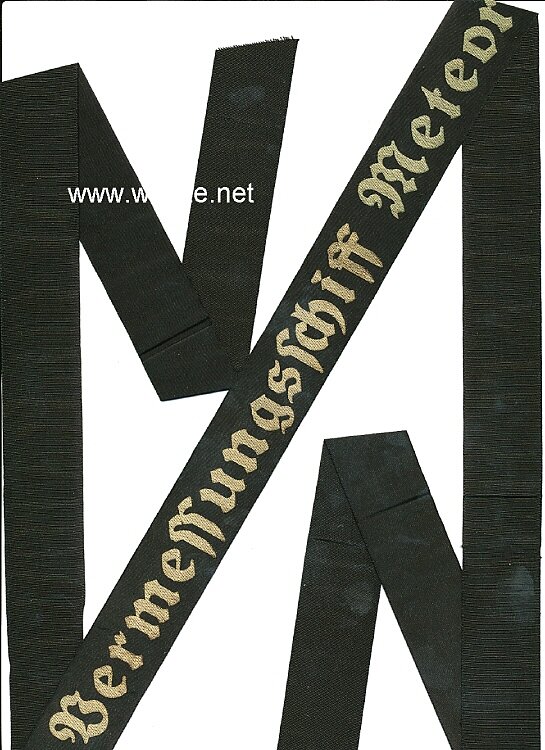
Kriegsmarine Cap Tally "Vermessungsschiff Meteor"
Kriegsmarine Cap Tally from the Survey Ship Meteor
This Kriegsmarine cap tally represents an authentic piece of German naval history from World War II. It bears the inscription “Vermessungsschiff Meteor” (Survey Ship Meteor) and is manufactured in the high-quality metal thread weave characteristic of Kriegsmarine units.
Historical Background of the Ship
The Meteor was originally a civilian German research vessel built in 1924-1925 that conducted oceanographic expeditions under the direction of the Emergency Association of German Science. The famous German Atlantic Expedition (1925-1927), led by Professor Alfred Merz and, after his death, Georg Wüst, made the ship world-renowned in scientific circles. This expedition conducted systematic surveys of the Atlantic Ocean, collecting valuable data on ocean currents, temperatures, and seafloor topography.
With the outbreak of World War II, the Meteor, like many other vessels, was requisitioned by the Kriegsmarine and commissioned as a survey ship. Survey ships played an important, though often overlooked, role in naval warfare. They were responsible for charting coastal waters, surveying shipping channels, identifying shallow areas, and creating navigational aids for the war fleet.
Kriegsmarine Cap Tallies
The tradition of cap tallies in the German Navy dates back to the 19th century. During the Kriegsmarine period (1935-1945), cap tallies were an essential part of the uniform for ratings and petty officers. They were worn on the characteristic peaked cap (Tellermütze).
The design followed strict regulations. The bands typically bore the designation of the unit, ship, or formation in gold-yellow lettering on a black background. The metal thread weave version presented here was the higher-quality variant, in which the lettering was woven from actual metal thread. This version was more elaborate to produce and generally more durable than the simpler variant with printed or embroidered lettering.
Technical Characteristics
The band, measuring 150 cm in length, corresponds to the standard Kriegsmarine dimensions. This length allowed the band to be wrapped around the cap with two hanging ends at the back, which were secured with a knot and bow.
Metal thread weaving was a specialized craft. Various manufacturers produced these bands, with quality varying. The use of metal threads provided a special luster and clear legibility of the ship's name.
Significance and Collector Value
Cap tallies from survey ships are relatively rare, as these vessels existed in significantly smaller numbers than destroyers, torpedo boats, or other combat ships. The Meteor, as a well-known research and survey vessel, has additional historical significance due to its scientific past.
For collectors of maritime militaria, such cap tallies represent important historical documents. They document not only the military organization but also individual ships and their crews. Each band tells the story of a ship and the men who served on it.
Condition and Authenticity
The indicated condition grade of 2 suggests a well-preserved specimen. For metal thread bands, particular attention should be paid to the condition of the weave, the presence of all lettering elements, and the absence of severe corrosion or discoloration. Original bands often show signs of use such as slight creases or minimal wear, which can actually underscore their authenticity.
Historical Context
Objects like this cap tally are important testimonies to a complex era of German history. They remind us of the technical and organizational aspects of the Kriegsmarine, beyond pure combat operations. Survey ships and their crews performed important work for navigation and maritime safety, even though these activities took place within the context of wartime operations.
Collection and Preservation
The preservation of such artifacts serves historical research and education. They provide tangible connections to the past and help us understand the daily life and organization of naval forces during World War II. Museums, archives, and private collectors play an important role in maintaining these objects for future generations, ensuring that this aspect of naval history is not forgotten.