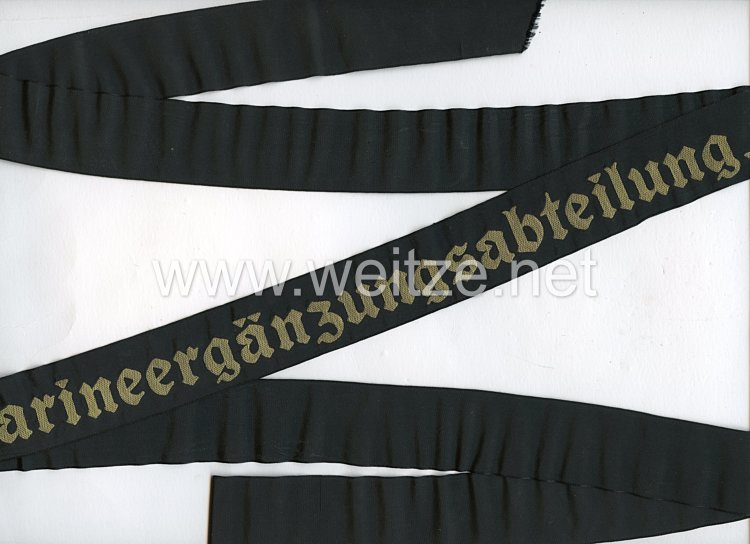
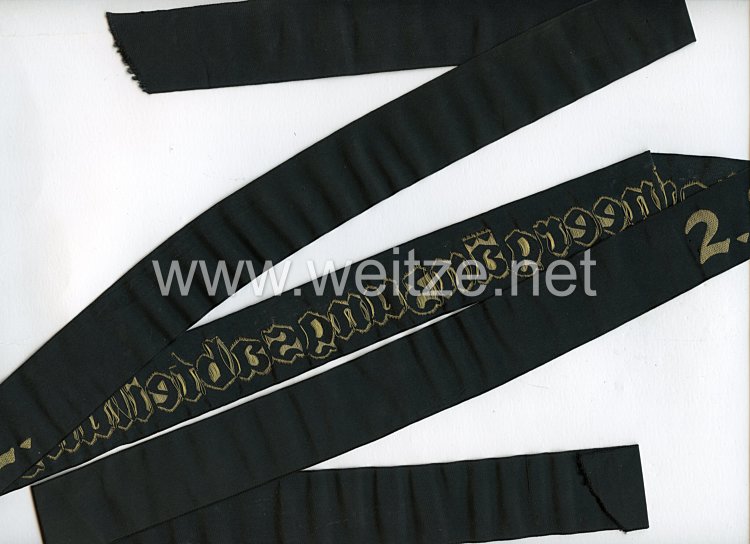
Kriegsmarine Cap Tally "2. Marineergänzungsabteilung 2."

Metal thread, length 150 cm, condition 2
412161
70,00

Kriegsmarine Cap Tally "2. Marineergänzungsabteilung 2."

The cap tally of the 2nd Marine Replacement Battalion (2. Marineergänzungsabteilung) represents a fascinating chapter in German naval history during World War II. These cap tallies, worn by sailors and enlisted ranks of the Kriegsmarine, served not only as practical uniform elements but also as important identifying markers of their respective units.

The Marine Replacement Battalions (Marineergänzungsabteilungen) were established as part of the Kriegsmarine's training and replacement system. Their primary mission was to train recruits and transfer trained personnel to frontline units. The numbering of these battalions followed a systematic scheme, with the 2nd Marine Replacement Battalion being one of several such units distributed throughout the German Reich.

The present cap tally is made of metal thread, indicating high-quality manufacture. The use of metal threads, typically gold or silver-plated wires wrapped with cotton or silk, was characteristic of Kriegsmarine cap tallies. The length of 150 cm corresponds to standardized measurements that allowed the tally to be wrapped around the cap with both ends hanging down at the back.

The tradition of cap tallies in the German Navy dates back to the 19th century. During the Imperial Navy, sailors already wore ribbons bearing ship names or unit designations. This tradition was continued by the Reichsmarine of the Weimar Republic and eventually adopted by the Kriegsmarine. According to Kriegsmarine uniform regulations, cap tallies were mandatory components of service caps for enlisted ranks.

The inscriptions on cap tallies followed strict guidelines. Text was typically executed in Gothic script, with gold lettering on a black background representing the standard. For training units such as the Marine Replacement Battalions, the complete unit designation was customary to clearly indicate organizational affiliation.

The organizational structure of the Marine Replacement Battalions was complex. These units were subordinate to respective naval stations and responsible for various aspects of personnel administration. They conducted basic training, provided specialized instruction, and supplied replacement personnel for ships and shore-based facilities. The geographical distribution of these battalions enabled efficient recruitment and training in different regions of the Reich.

Cap tallies were manufactured by specialized textile companies, often with decades of experience producing naval supplies. The quality of workmanship varied considerably during the course of the war. Early examples were characterized by excellent material quality and precise weaving techniques, while later productions increasingly showed quality deterioration due to wartime conditions. The present example with its metal thread suggests manufacture from the earlier war period.

For collectors and historians, such cap tallies are of considerable interest as they establish direct connections to specific Kriegsmarine units. Research into the Marine Replacement Battalions contributes to understanding the logistical and organizational structures necessary for maintaining the Kriegsmarine. Each cap tally tells the story of a unit and the men who passed through it.

The preservation condition of such historical textiles is an important factor in their evaluation. Classification as condition 2 indicates a well-preserved example that has survived the decades without major damage. This is remarkable, as textiles are particularly susceptible to wear, light exposure, and pest infestation.

In the context of naval history, such objects document not only the formal aspects of uniform regulations but also the human dimension of military service. Every sailor who wore such a cap tally was part of a larger system and contributed to the Navy's functionality, whether serving at sea or in training facilities.

Today, these cap tallies serve as tangible links to a significant period in naval history. They remind us of the thousands of young men who underwent training in these replacement battalions before being assigned to ships, submarines, coastal batteries, or other naval installations. The 2nd Marine Replacement Battalion, like its counterparts, played a crucial role in maintaining the Kriegsmarine's operational capability throughout the war years.