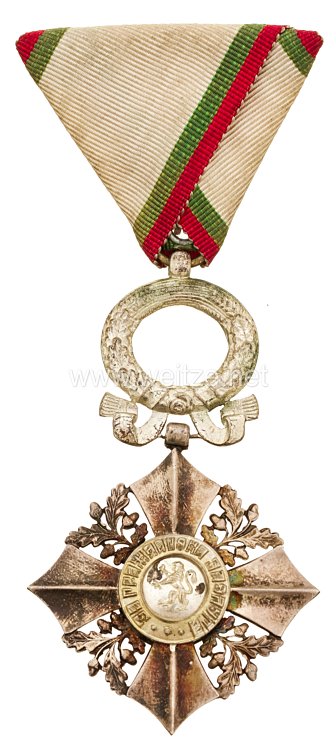
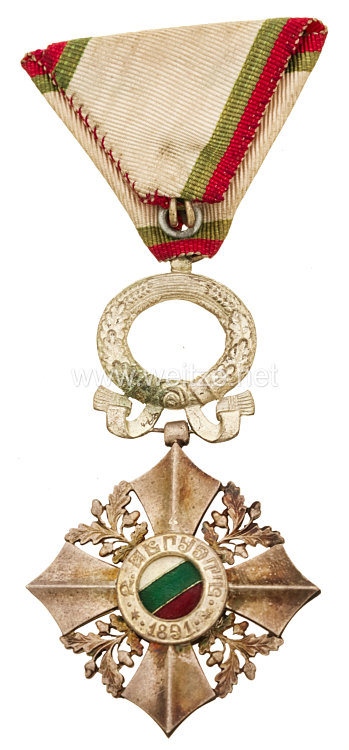
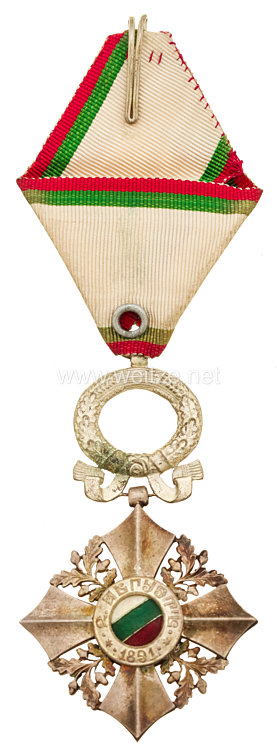
Bulgaria Order of Civil Merit 1944-1946 6th Class Silver Merit Cross with Oak Leaf Wreath
In the 1944-1946 model, the monogram on the reverse was replaced by the national colors.
The Bulgarian Order of Civil Merit ranks among the most significant decorations of the Bulgarian state and was awarded in recognition of distinguished services in the civilian sphere. The 6th Class described here, the Silver Cross of Merit with Oak Leaf Wreath, represents an important category within this order system and reflects a particular historical period in Bulgarian history.
The order was originally established in the 19th century under Prince Alexander I of Bulgaria and underwent several modifications during its existence. The version from 1944-1946 marks a significant transitional period in Bulgarian history, encompassing the end of World War II and profound political changes.
The characteristic feature of this specific variant is the modification of the reverse side: while earlier models bore the royal monogram, this was replaced in the 1944-1946 version with the Bulgarian national colors (white, green, and red). This modification reflects the political upheavals that Bulgaria experienced after September 9, 1944, when a coalition of communists and other left-wing forces seized power and the country underwent a drastic political reorientation.
The 6th Class of the Order was one of the lower ranks within the hierarchy, which does not diminish its significance. The Bulgarian order system was structured following the model of other European states, with each grade recognizing specific merits. The Silver Cross of Merit with Oak Leaf Wreath was typically awarded to individuals who distinguished themselves through special achievements in service to the state, in administration, economy, or other civilian areas.
The material execution as a silver-plated cross corresponds to the standards of that time. Silver plating was a common technique for military and civilian decorations of middle ranks. The triangular ribbon is a characteristic feature of Bulgarian orders and differs from the rectangular ribbons of many other European order systems.
The temporal classification 1944-1946 is of particular historical significance. After the overthrow of the government on September 9, 1944, Bulgaria found itself in a transitional phase. The monarchy formally still existed until the referendum of September 1946, when Bulgaria was declared a People's Republic. During this period, decorations were still awarded according to traditional patterns, albeit with the mentioned modifications reflecting the changed political situation.
The oak leaf wreath as a decorative element has a long tradition in European orders and decorations. The oak has symbolized strength, permanence, and honor since antiquity. In Bulgarian heraldry and phalерistics, this symbol was adopted to emphasize the significance of the awarded decoration.
After 1946 and the establishment of the communist People's Republic, the entire order system was reformed and largely replaced by new, Soviet-inspired decorations. This makes orders from the transitional period of 1944-1946 particularly interesting collector's items, as they document a brief but significant period of Bulgarian history.
The awarding practice during this time was complex. On one hand, traditional merits were still being recognized; on the other hand, the reorientation of state honors policy had already begun. Recipients of such decorations were often civil servants, business leaders, cultural figures, or other civilians who had rendered service to the Bulgarian state.
From a collector's and historical perspective, these orders are of considerable interest. They document not only the craftsmanship quality of Bulgarian order manufacturers but are also important witnesses to a period of upheaval. The preservation of such pieces enables historians and collectors to trace the development of state honor systems and the associated political changes.
The condition and characteristics of surviving examples provide valuable insights into the manufacturing techniques and materials used during this specific period. The silver plating, the design of the cross, and the distinctive triangular ribbon all contribute to our understanding of Bulgarian decorative arts and state symbolism during this crucial historical moment.