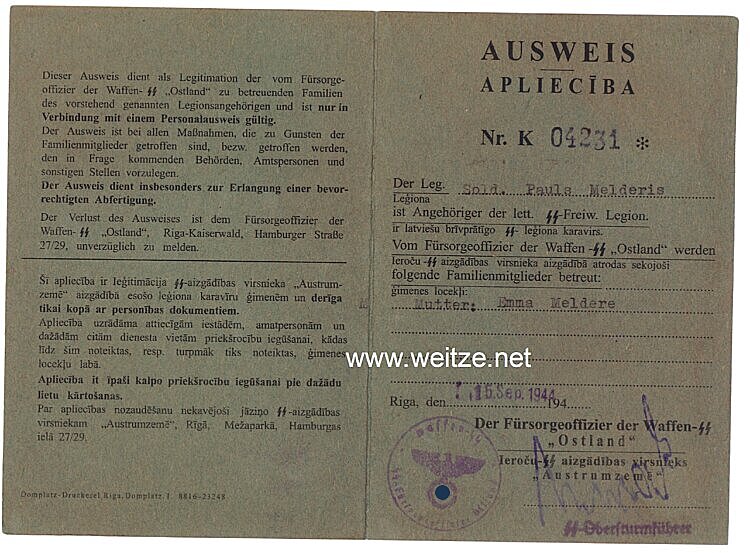
Waffen-SS - Lettische Freiwilligen-Legion - Waffen-SS Identity Card "Ostland"
This Waffen-SS “Ostland” identification document for a member of the Latvian Volunteer Legion represents a significant historical artifact from the final phase of World War II. Issued on September 15, 1944 in Riga, this bilingual document (Latvian and German) certifies the membership of a legion soldier and the welfare support provided to his family members by the welfare officer of the Waffen-SS “Ostland.”
The Latvian Legion of the Waffen-SS emerged in the context of the German occupation of the Baltic states following the invasion of the Soviet Union in 1941. After the Soviet annexation of Latvia in 1940 and subsequent repression, parts of the Latvian population initially viewed the German occupation as liberation. The German leadership exploited this sentiment and anti-communist resentment to recruit Latvian units for combat on the Eastern Front.
The official establishment of the Latvian SS Volunteer Legion began in January 1943. The designation “Volunteer Legion” was misleading, as both actual volunteers and conscripted men served in its ranks. The Legion primarily consisted of two divisions: the 15th Waffen Grenadier Division of the SS (Latvian No. 1) and the 19th Waffen Grenadier Division of the SS (Latvian No. 2). By war's end, an estimated 110,000 to 115,000 Latvians served in various German military formations.
The Reichskommissariat Ostland was the German civil administration for the occupied Baltic states and parts of Belarus, headquartered in Riga. The Waffen-SS welfare organization in Ostland was tasked with addressing the social concerns of soldiers and their families. This included financial support, provision of food and other goods, and administrative matters.
The present document records this welfare function. The registration of family members eligible for support was of practical importance, as it established entitlement to assistance benefits. During the critical war phase of autumn 1944, when the Red Army was already advancing deep into the Baltic states, this welfare support was particularly significant.
The issuance date of September 15, 1944 falls within a dramatic phase of the war. By this time, the Red Army had already recaptured large portions of the Baltic states. Operation Bagration, the Soviet summer offensive of 1944, had devastatingly defeated Army Group Center. Estonia was largely occupied by Soviet troops in September 1944, and Latvia was also on the verge of reconquest. The issuance of such a document at this late stage demonstrates that the German administration still attempted to maintain administrative normalcy, despite the already hopeless military situation.
The Latvian legionnaires found themselves in a complex situation. Many fought not primarily for Nazi ideology, but against renewed Soviet occupation, which they had experienced as brutal in 1940/41. After 1945, the legal assessment of the Latvian Legion remained controversial. The Nuremberg Trials established that members of the Waffen-SS were generally to be regarded as members of a criminal organization, with exceptions for conscripts and the Baltic legions, which were considered separate cases.
Documents such as this identification card are today important sources for researching the complex history of German occupation in the Baltic states and collaboration. They enable historians to reconstruct administrative structures, the living conditions of soldiers and their families, and the final months of the war. The bilingual format of the document reflects the German occupation authorities' efforts to achieve a degree of acceptance among the local population.
The good condition of the document with only minimal entries might suggest that it was actually used for only a short period due to the rapidly unfolding events of autumn 1944. Many such documents were lost or deliberately destroyed during the chaotic final months of the war.
This artifact serves as a tangible reminder of the difficult choices faced by occupied populations during World War II and the complex legacy of collaboration, resistance, and survival in the Baltic region.