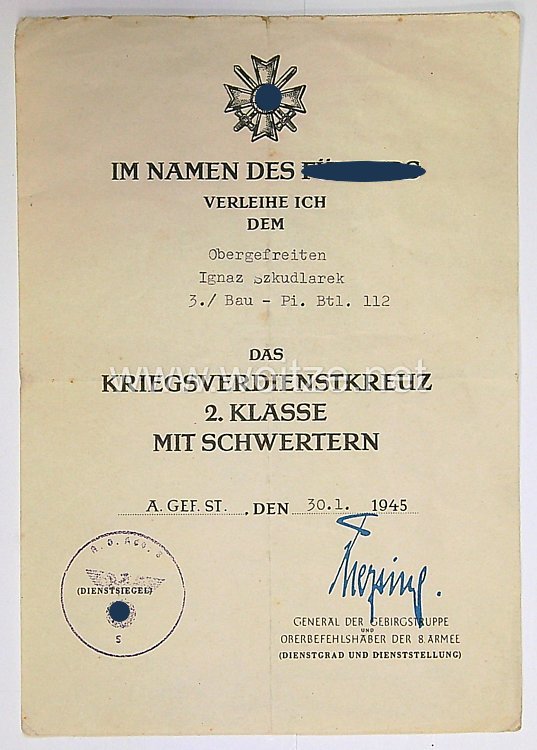
Award Document - War Merit Cross 2nd Class with Swords - 3./Bau-Pionier Bataillon 112 /RAD

for an Obergefreiter of 3./Bau Pionier Bataillon 112, issued on January 30, 1945, signed by General der Gebirgstruppe and Commander-in-Chief of 8. Armee, Hans Kreysing, recipient of the Knight's Cross with Oak Leaves and Swords, folded multiple times, condition 2
437560
220,00

Award Document - War Merit Cross 2nd Class with Swords - 3./Bau-Pionier Bataillon 112 /RAD

This award certificate for the War Merit Cross 2nd Class with Swords represents a significant document from the final phase of World War II. Issued on January 30, 1945, just months before the German capitulation, it documents the award of this decoration to a Lance Corporal (Obergefreiter) of the 3rd Company, Construction Pioneer Battalion 112.

The War Merit Cross (Kriegsverdienstkreuz) was instituted on October 18, 1939, by Adolf Hitler to recognize wartime merit not directly earned in combat. The decoration existed in two classes and could be awarded with or without swords. The version with swords was intended for services directly connected to combat operations, while the version without swords was meant for achievements in rear areas.

The certificate bears the signature of Colonel General Hans Kreysing, who at this time served as General of Mountain Troops and Commander-in-Chief of the 8th Army. Kreysing was a highly decorated officer who had been awarded the Knight's Cross of the Iron Cross with Oak Leaves and Swords. In January 1945, the 8th Army was positioned in Italy, fighting against Allied forces. Kreysing had assumed command of this army in December 1944 and led it through the final months of the war under increasingly difficult conditions.

The Construction Pioneer Battalion 112 belonged to the technical troops of the Wehrmacht and had diverse responsibilities. Construction pioneers were responsible for military construction projects, erection of fortifications, building and maintenance of bridges, and demolition work. In the context of the fighting retreat that the Wehrmacht conducted in early 1945, such units were crucial for delaying the Allied advance.

The connection to the Reich Labor Service (RAD) in the object description suggests that the recipient may have previously served in the RAD before being conscripted into the Wehrmacht. The RAD was a paramilitary organization introduced in 1935, whose members were frequently transferred to the Wehrmacht, particularly into technical units such as pioneer battalions.

The date of issue of the certificate is of particular historical significance. By late January 1945, the military situation of the German Reich was hopeless. In the East, the Red Army had reached the Oder River, in the West the Allies stood at the Rhine, and in Italy the Wehrmacht was forced onto the defensive. Nevertheless, the military awards system was maintained until the final days of the war, underscoring the importance of such honors for maintaining morale and discipline.

Award certificates for the War Merit Cross followed a standardized format established by the Reich Ministry. They typically contained the recipient's name, rank, unit, date of award, as well as the signature and rank of the awarding officer. The certificates were printed on high-quality paper and frequently featured the national emblem of the German Reich.

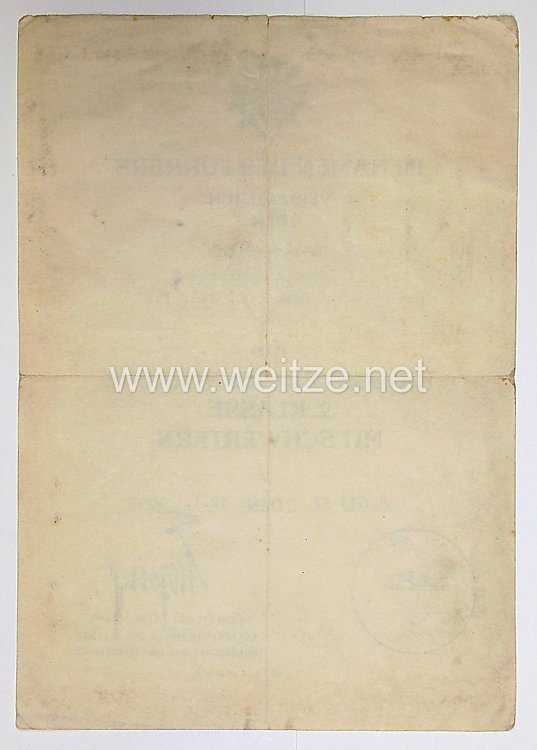
The documented condition grade 2 with multiple folds is typical for such documents. Soldiers frequently carried their award certificates with them or stored them under difficult field conditions, leading to signs of wear. The folds indicate that the document was transported folded, possibly in a breast pocket or pay book (Soldbuch).

From a historical perspective, such award certificates are important primary sources for military history research. They enable the reconstruction of troop structures, chains of command, and individual career trajectories. The signature of a high-ranking officer such as Kreysing gives the document additional historical significance and allows conclusions about command structures in the late war period.

The battalion's designation as a construction pioneer unit reflects the Wehrmacht's need for specialized engineering troops capable of performing complex tasks under combat conditions. These units combined traditional pioneer skills with construction expertise, making them invaluable during both offensive operations and defensive retreats.

Today, such documents are part of collective historical memory and serve as material witnesses to a dark period of German history. They are preserved by museums, archives, and private collectors, contributing to scholarly engagement with the history of World War II.