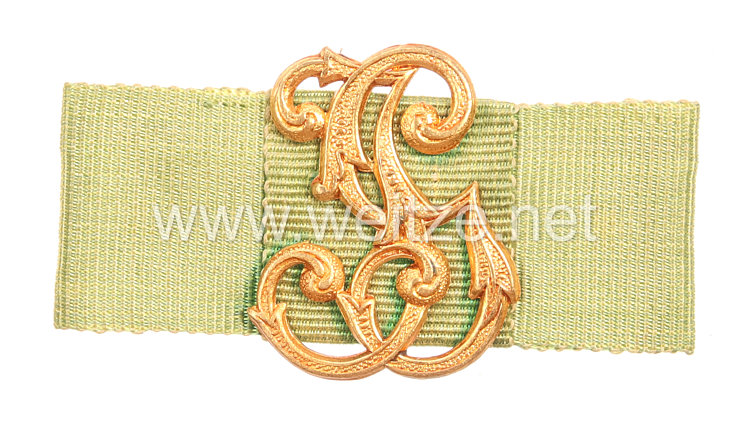
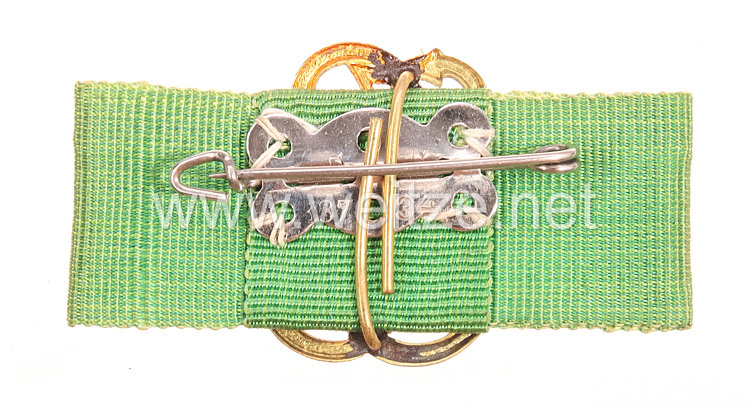
Saxon Shoulder Strap Bow with Cipher of the “Royal Saxon 8th Infantry Regiment Prinz Johann Georg Nr. 107”

Condition 2.
429760
40,00

Saxon Shoulder Strap Bow with Cipher of the “Royal Saxon 8th Infantry Regiment Prinz Johann Georg Nr. 107”

The shoulder loop with cipher of the Royal Saxon 8th Infantry Regiment Prince Johann Georg No. 107 represents a significant piece of military uniform history from the Kingdom of Saxony within the German Empire. These objects served as distinctive insignia and symbolized the connection between regiments and their royal patrons.

The 8th Infantry Regiment No. 107 belonged to the Saxon Army, which maintained a degree of autonomy within the Prussian-dominated German Army until 1918. The regiment bore the honorary name Prince Johann Georg, named after the Saxon Prince Johann Georg (1869-1938), a son of King George of Saxony. This naming practice was traditional in the German military system, where regiments were named after members of ruling houses to emphasize dynastic connections.

The shoulder loop as a military distinction has its roots in uniform development of the 18th and 19th centuries. It was typically worn on the shoulder or collar and consisted of braided or woven cords in regimental colors. The cipher – a stylized monogram or name sign – identified the royal or princely patron of the regiment. In the case of Regiment No. 107, this consisted of the initials of Prince Johann Georg.

The Saxon Army possessed a long and proud tradition dating back to the Middle Ages. In the 19th century, it was modernized following the Prussian model but retained its own uniform regulations and distinguishing insignia. The Saxon infantry regiments were known for their discipline and combat effectiveness and played significant roles in the German Wars of Unification (1864, 1866, 1870/71).

Regiment No. 107 was established during military reforms and expansion. The precise numbering followed the German Army system, whereby individual contingent armies (Prussian, Bavarian, Saxon, Württemberg) received their own number ranges. Numbers above 100 were generally assigned to non-Prussian contingents.

During World War I (1914-1918), Saxon regiments fought on various fronts. They were deployed both on the Western Front in France and Belgium and temporarily on the Eastern Front against Russia. Saxon troops suffered heavy casualties like all German units in the materially exhausting trench warfare.

The manufacture of such loops and insignia was carried out by specialized military equipment manufacturers. These companies produced according to precise regulations of the army administration, which were established in uniform regulations. Materials varied according to rank and unit – officers often wore higher-quality versions in silver or gold thread, while enlisted men received simpler versions in wool or cotton.

With the end of the monarchy in November 1918 and the dissolution of the German contingent armies, these insignia lost their official function. The newly founded Reichswehr of the Weimar Republic abolished monarchical symbols and designations. Regiment No. 107 was dissolved like all other units of the Imperial era.

Today, such loops with ciphers are sought-after military historical collectibles. They document uniform history, military organization, and the dynastic connections of the German states in the Empire. The stated condition 2 indicates a well-preserved example with minor signs of wear, which is quite typical for militaria over a hundred years old.

The scholarly significance of such objects lies in their function as material witnesses to military history. They enable conclusions about uniform regulations, manufacturing techniques, wearing practices, and the symbolic representation of military hierarchies. For museums and collectors, they are important documents of a bygone era of German history.

r