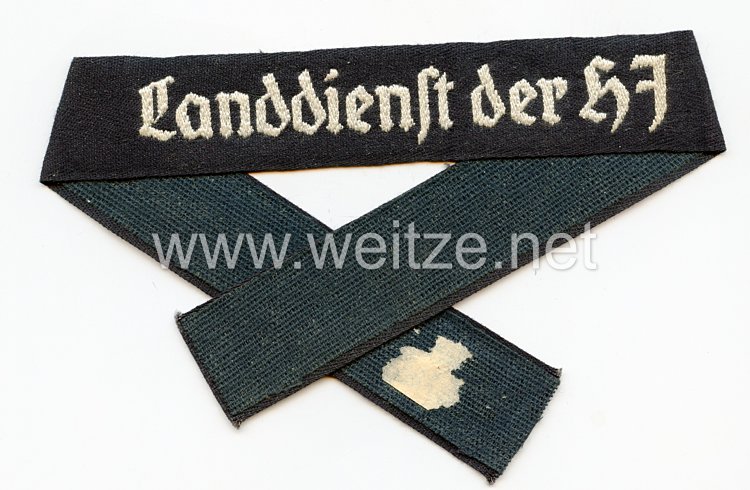
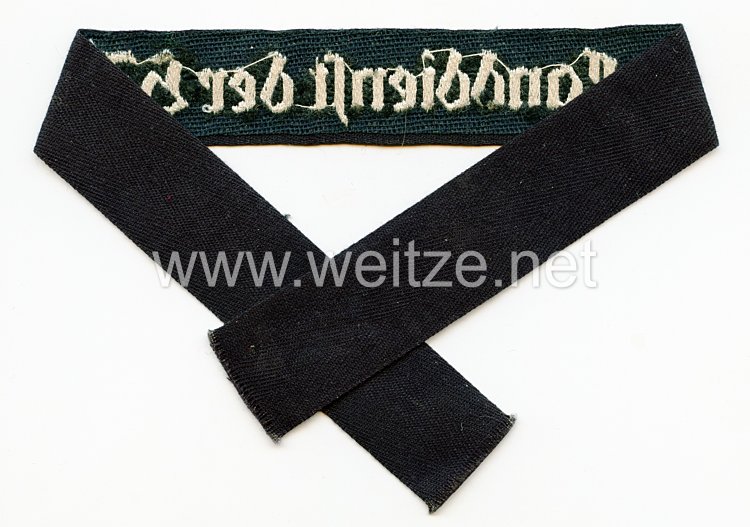
Hitler Youth (HJ) Armband "Landdienst der HJ"
The armband “Landdienst der HJ” (Rural Service of the Hitler Youth) represents a significant badge of the Nazi youth organization, closely connected to the ideological orientation and practical goals of the regime. This armband was worn by members of the Hitler Youth who participated in the Landdienst program, an initiative that sent young people from urban areas to work in rural agriculture.
The Landdienst of the Hitler Youth was officially established in 1934 and formed part of the broader National Socialist agricultural policy and the Blood and Soil ideology. This initiative aimed to achieve several goals simultaneously: supporting agriculture through youth labor, educating urban youth in the spirit of Nazi ideology through practical farm work, and strengthening the connection between the people and the land. Reich Youth Leader Baldur von Schirach actively promoted the program as a means of character formation for German youth.
This armband displays the typical execution as Bevo-woven fabric, a designation for machine-woven textiles manufactured by the company Bevo (Barmer Bandweberei Ewald Vorsteher). This technique enabled precise and durable representation of text and symbols. The white lettering on a black background corresponded to the color specifications of the HJ and created a strong contrast that clearly marked the wearers of this special service distinction.
The Landdienst program developed considerably between 1934 and 1945. Initially based on volunteerism, participation became increasingly mandatory. By 1939, several tens of thousands of young people had already participated in the Landdienst. The assignments typically lasted several weeks to months, with the youth housed on farms where they performed agricultural work. During World War II, the program gained additional significance as male workers were drafted into the Wehrmacht and food security became critical.
Participants in the Landdienst wore their regular HJ uniform, supplemented by the special armband that indicated their particular service position. Wearing this armband carried a certain prestige, as it symbolized commitment and dedication. Placement typically occurred on the left upper arm of the uniform jacket or shirt.
From a historical perspective, the Landdienst must be understood in its ideological context. It was not merely a practical measure for labor recruitment but an instrument of National Socialist education. The young people were meant to experience the supposed superiority of rural life and the peasant lifestyle, which was contrasted with urban culture considered “decadent.” Additionally, the program served physical conditioning and preparation for later military service.
The technical execution as silk fabric with Bevo technique was characteristic of higher-quality HJ insignia. The length of approximately 44 cm corresponded to standard measurements that allowed complete wrapping around the upper arm. Attachment was accomplished by sewing onto the uniform, with the ends frequently overlapped and sewn together.
After 1945, all Nazi symbols and insignia were prohibited in Germany. The collecting and preservation of such objects is today permitted exclusively for historical documentation and educational purposes. These armbands serve as material witnesses to a dark chapter of German history and remind us of the total appropriation of youth by the National Socialist regime.
The preservation of such historical objects in museums and collections is important for historical research and education. They enable subsequent generations to understand the mechanisms of totalitarian systems and recognize the methods by which authoritarian regimes instrumentalize young people. The Landdienst armband stands exemplary for the systematic indoctrination and mobilization of young people in the Third Reich.
Today, these artifacts are studied by historians to better understand the social mobilization strategies of the Nazi regime. The Landdienst program was part of a comprehensive system that encompassed all aspects of youth life, from ideological education to physical labor, serving the regime's goals of agricultural self-sufficiency and ideological conformity. The armband, as a visible symbol of participation, represented both the individual's integration into the Nazi system and the regime's control over German youth.