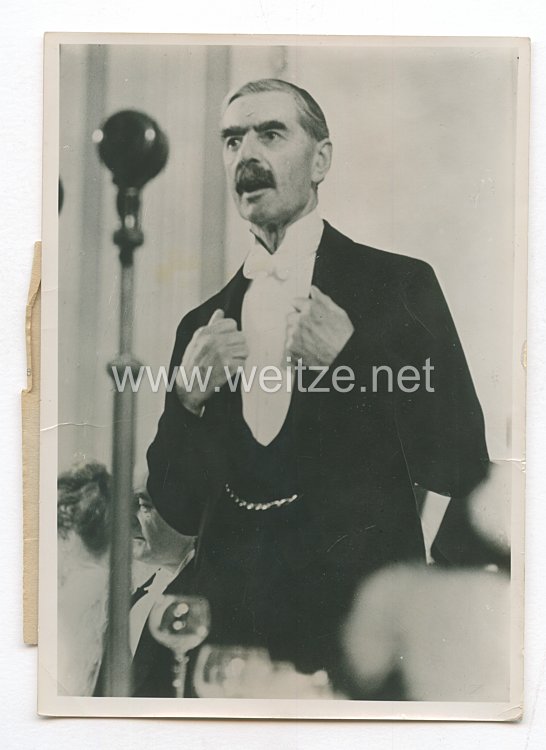
Third Reich Press Photo: Prime Minister Chamberlain Delivered an Ambiguous Speech December 14, 1938
This press photograph from the Third Reich documents a significant event from December 14, 1938, when British Prime Minister Neville Chamberlain delivered a speech characterized as “ambivalent” or “conflicted.” This photograph serves as an important testament to the intensive propaganda activities of the Nazi regime and the complex diplomatic relations between Britain and Germany in the pre-war period.
Historical Context
In December 1938, Europe found itself in an extremely tense political situation. Just a few months earlier, in September 1938, the Munich Agreement had taken place, where Chamberlain pursued his controversial appeasement policy. Upon his return from Munich, Chamberlain had famously proclaimed that he had achieved “peace for our time.” The annexation of the Sudetenland by the German Reich had been accomplished, and Czechoslovakia had been significantly weakened.
The speech described as “ambivalent” on December 14, 1938, occurred during a period when Chamberlain was coming under increasing pressure. In Britain, criticism of his appeasement policy was growing, while German expansionist ambitions continued unabated. The Kristallnacht pogrom of November 9-10, 1938, had caused international outrage and clearly revealed the true nature of the Nazi regime.
Press Photography in the Third Reich
Press photographs were a central instrument of National Socialist propaganda. The Reich Ministry of Public Enlightenment and Propaganda under Joseph Goebbels strictly controlled all media in the German Reich. Photographs of foreign statesmen were carefully selected and provided with appropriate captions to convey the desired message.
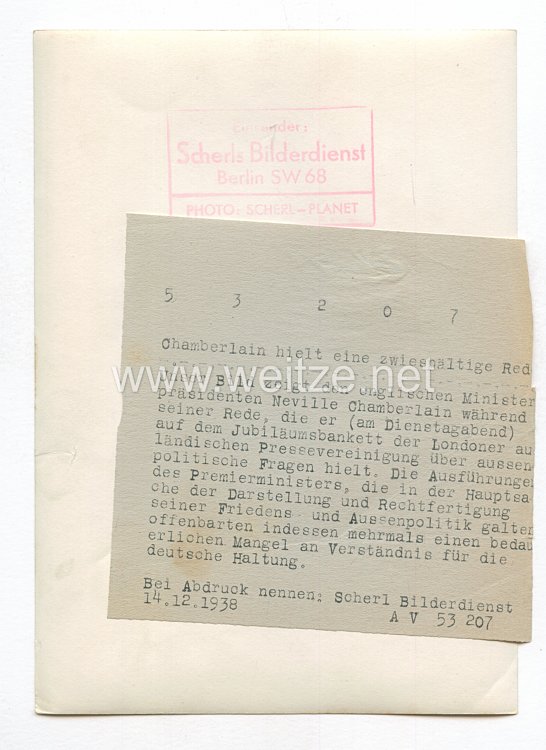
Press photos from this era, typically in the format of approximately 12 x 17 cm or similar, were distributed by official agencies such as the German News Bureau (Deutsches Nachrichtenbüro, DNB) or the Press Photo Center to newspapers and magazines throughout the Reich. The reverse side usually contained stamped or printed information, including date, caption, and sometimes publication guidelines.
The Portrayal of Chamberlain in the German Press
The characterization of Chamberlain's speech as “ambivalent” is revealing of the German propaganda strategy. The Nazi regime oscillated in its portrayal of the British Prime Minister between different narratives: on one hand, he was presented as a weak politician who had yielded to legitimate German demands; on the other hand, any critical statement was portrayed as a sign of British unreliability or hypocrisy.
By December 1938, the German leadership was already planning its next expansionist moves. The “destruction of the remainder of Czechoslovakia” would occur just a few months later, in March 1939. Every statement by Western politicians was therefore carefully analyzed and instrumentalized for propaganda purposes.
Significance as a Historical Document
Such press photographs are important sources for historians today. They document not only historical events but also how these events were presented and interpreted by Nazi propaganda. The inscriptions on the reverse often provide valuable insights into official language guidelines and the intended interpretation of the depicted persons and events.
The photograph from December 14, 1938, stands symbolically for the final months before the outbreak of World War II. It documents a time when diplomatic efforts were still taking place, but the course was already set toward war. Chamberlain's appeasement policy, documented in this and similar photographs, remains controversial to this day and is discussed as a cautionary example of the dangers of appeasing aggressive dictatorships.
Collector and Research Value
For collectors of military-historical documents and researchers of the Nazi era, such press photographs are of particular interest. They offer authentic contemporary perspectives and supplement written sources with a visual dimension. The condition, completeness of the reverse inscription, and rarity of the specific subject determine the historical and collector value of such objects.