Weimar Republic: Presentation Sidearm Bayonet of the Freikorps Petsch

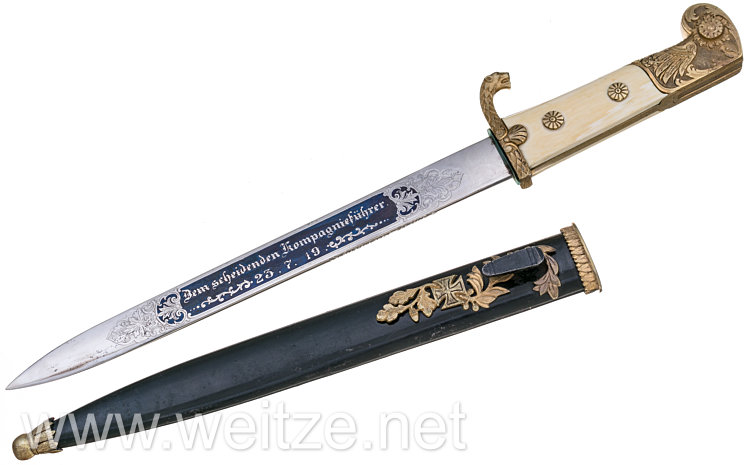
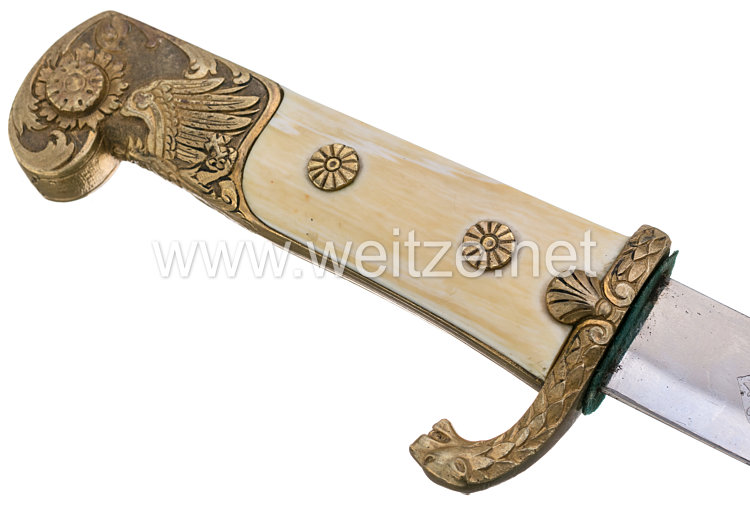
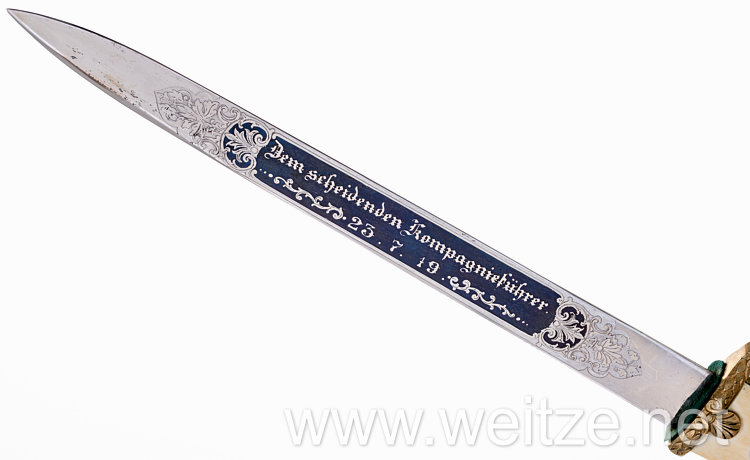
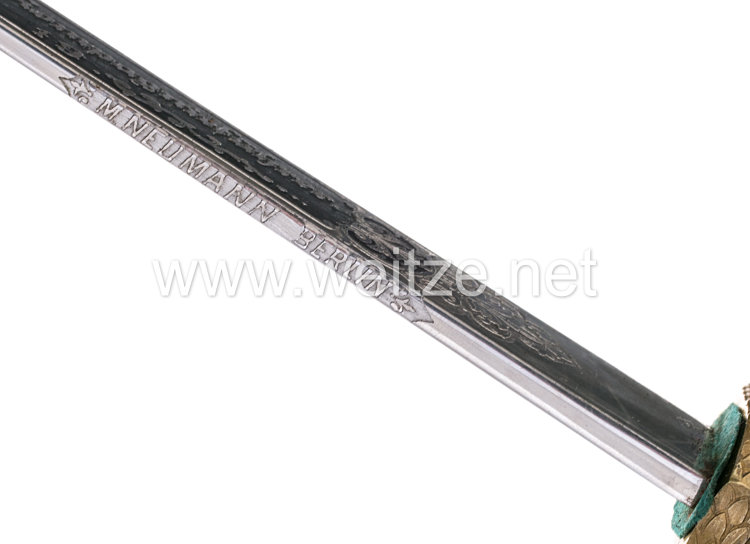
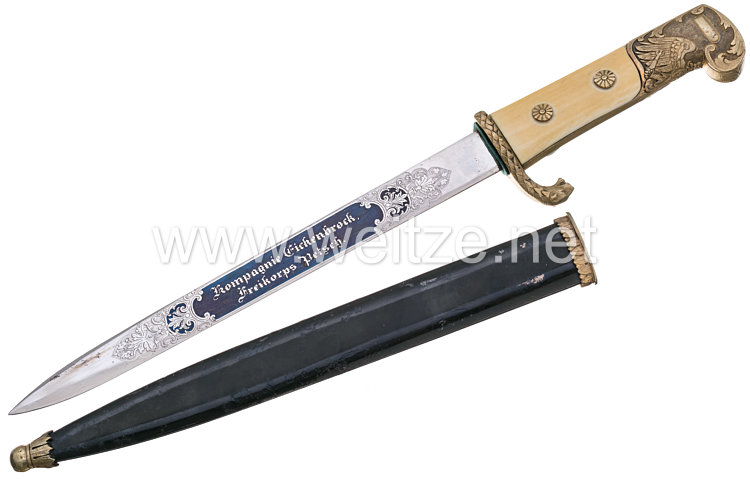
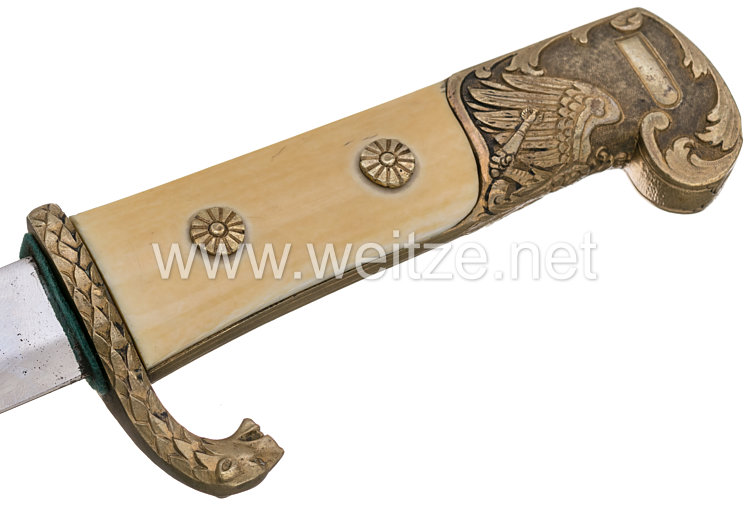
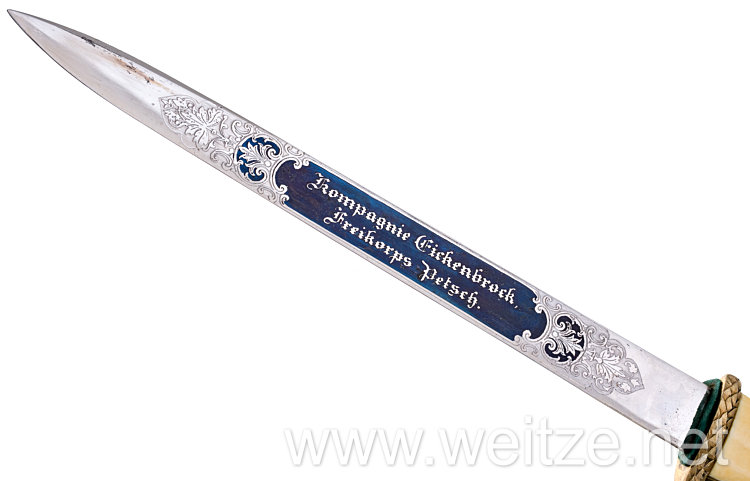
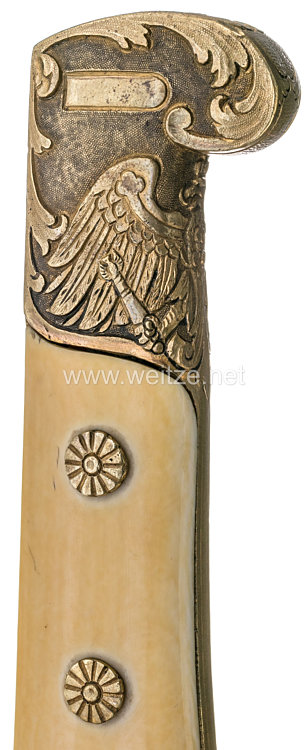
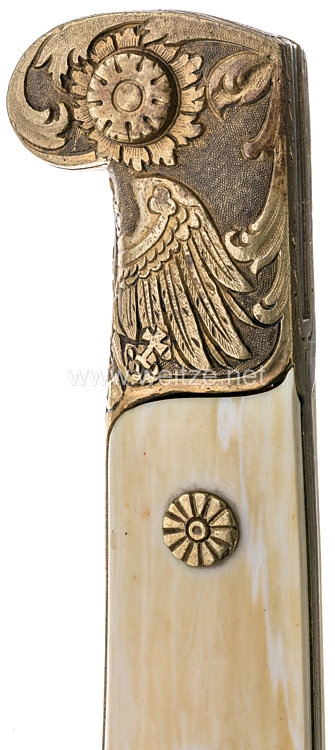
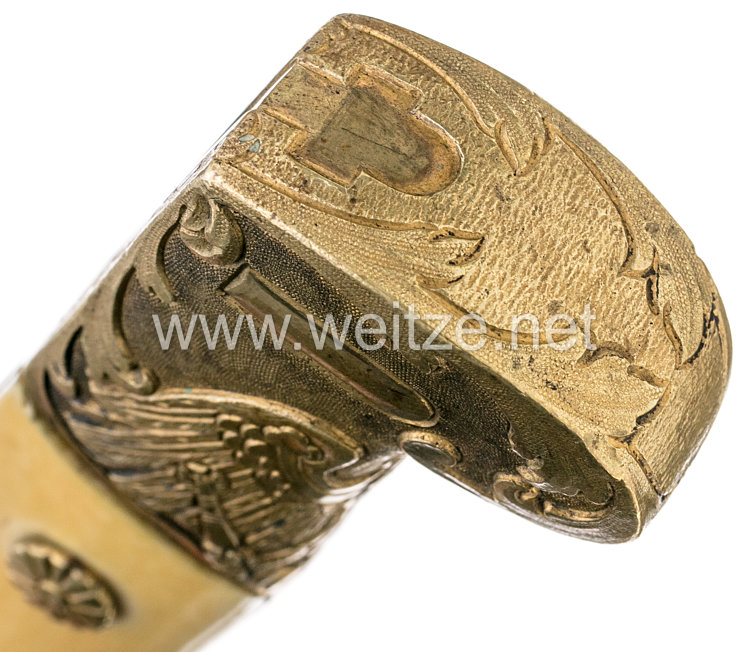
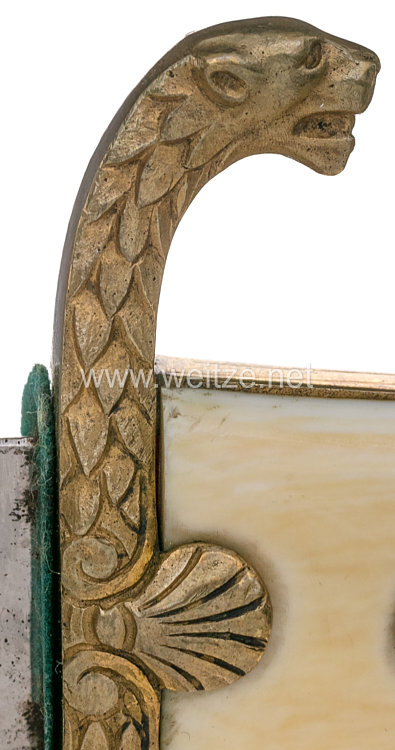
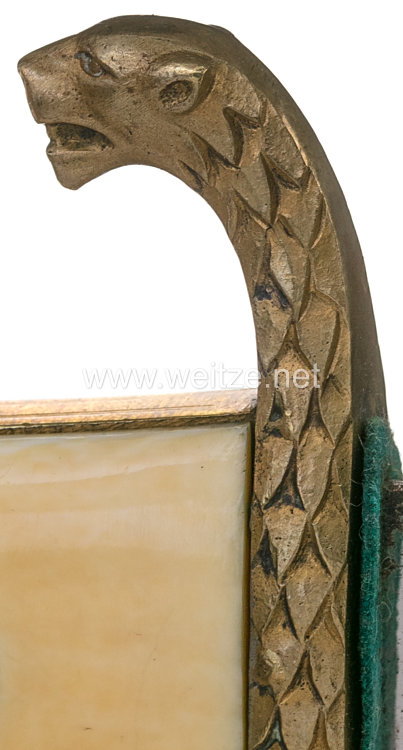
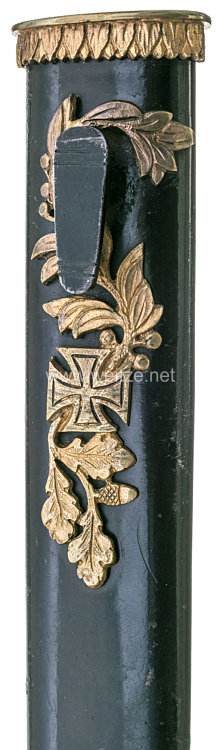
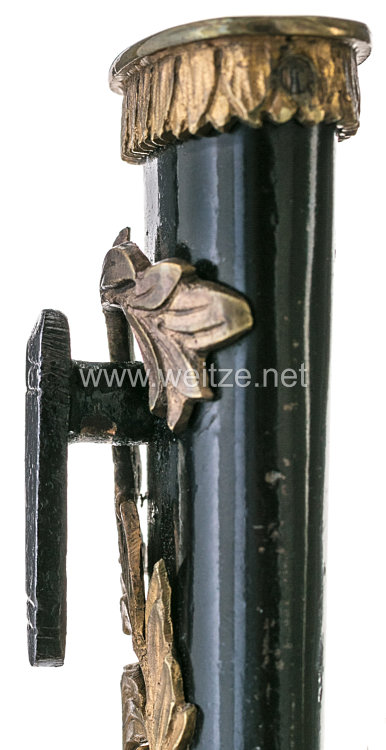
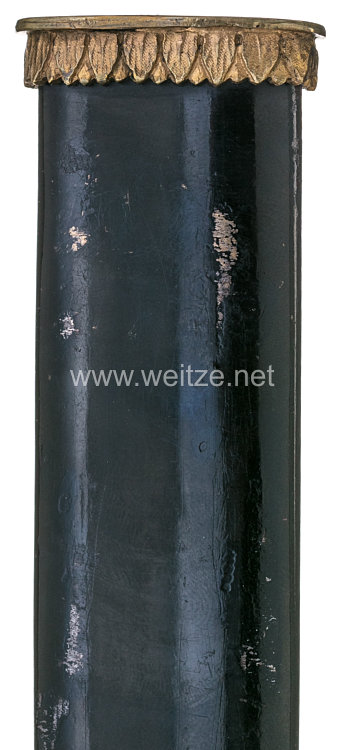
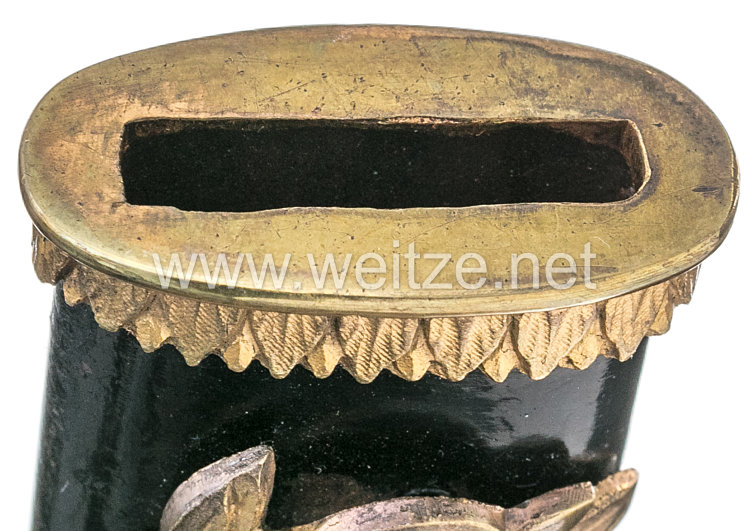
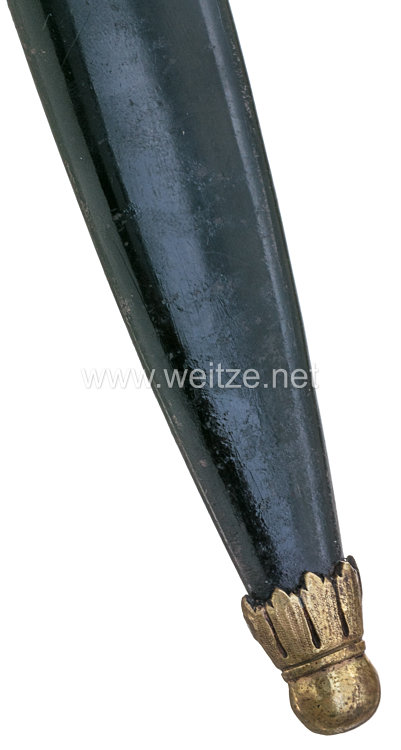
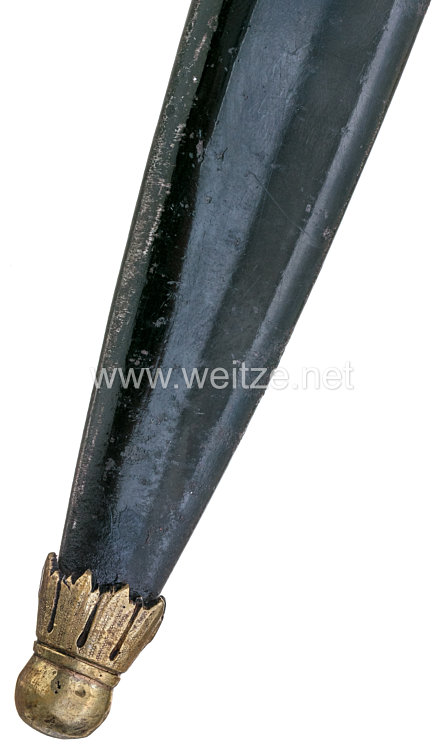
circa 1919. Nickel-plated fuller blade, both sides with blued etching, on the obverse “Dem scheidenden Kompagnieführer 23.7.19.” (To the departing company commander 23.7.19.), reverse “Kompanie Eickenbrock, Freikorps Petsch.” Laterally on the blade spine with maker's mark “M. Neumann, Berlin”. The hilt in special execution of gilt brass, hand engraved. The push button and bayonet mounting device are only suggested. Top with large hand-engraved Prussian eagle, the crossguard with laurel leaf decoration, terminating in a lion's head. The grip scales of ivory, each held by 2 decorative rivets. The scabbard black lacquered with applied gilt mounts on the throat, below the frog stud, and at the chape. Overall length with scabbard 41 cm. Only slight signs of age in exceptionally fine condition.
Certainly one of the finest presentation weapons we have been able to offer in many years.
319159

Weimar Republic: Presentation Sidearm Bayonet of the Freikorps Petsch

This exceptional presentation bayonet embodies a pivotal moment in the turbulent early phase of the Weimar Republic, when Germany oscillated between revolutionary chaos and the search for order. The weapon was presented on 23 July 1919 to a departing company commander of Kompanie Eickenbrock within Freikorps Petsch, one of the paramilitary volunteer formations that played a controversial yet formative role in the immediate postwar years.

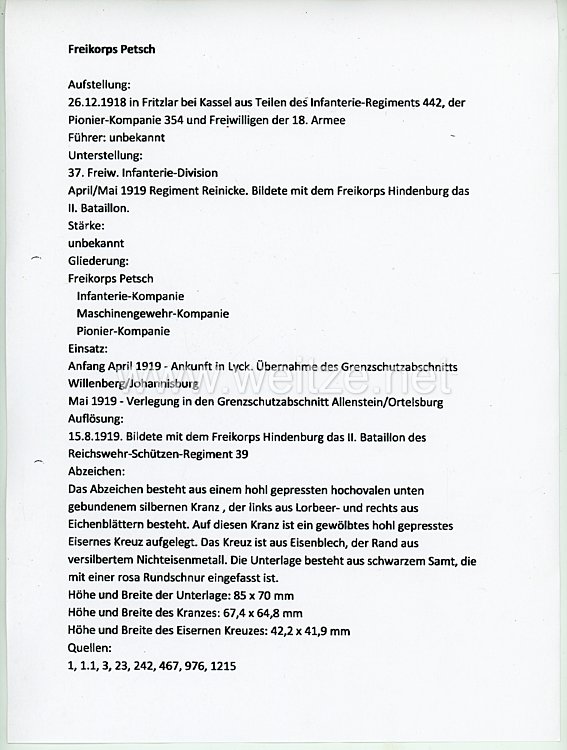
Freikorps Petsch belonged to the 37th Volunteer Infantry Division (37. Freiwilligen Infanterie-Division), which operated in the area of Generalkommando XX. Armeekorps in Allenstein, East Prussia. This division was part of the wave of volunteer formations that emerged after German defeat in December 1918. By 1 January 1919, 103 Freikorps units had already been formed, eventually growing to more than 65 corps. These formations consisted primarily of former soldiers, unemployed youth, and other disaffected individuals, led by former officers of the imperial army.

In July 1919, when this ceremonial weapon was presented, Germany found itself in a period of intense political instability. The Freikorps had already crushed the Spartacist Uprising in Berlin in January 1919—a bloody episode that ended with the murders of Karl Liebknecht and Rosa Luxemburg. In April and May 1919, they participated in suppressing the Bavarian Soviet Republic. In June 1919, just one month before this bayonet's presentation, the Treaty of Versailles had been signed, imposing severe restrictions on Germany.

The Freikorps were predominantly nationalistic and radically conservative in orientation, employed by the new republican government to suppress left-wing revolts in Berlin, Bremen, Brunswick, Hamburg, and other cities. President Ebert and the Weimar government faced the dilemma of utilizing these armed formations whose political orientation and reliability were causing increasing concern.

The 37th Volunteer Infantry Division, to which Freikorps Petsch belonged, was later dissolved and used to form Reichswehr-Brigade 20 as part of the reorganization into the provisional Reichswehr in 1919-1920. This restructuring was part of efforts to transform the sprawling volunteer formations into regular military structures.

The fate of the Freikorps movement was already becoming apparent. In March 1920, under Allied pressure following the Treaty of Versailles, President Ebert ordered the disbandment of most Freikorps units. Some units responded with the Kapp Putsch, an attempted right-wing coup that failed within days. In the early 1920s, the Weimar Republic began systematically disbanding the Freikorps, having recognized the threat they posed. Their functions were eventually assumed by regular army and police work or later absorbed by Nazi paramilitary units.

Many former Freikorps members later joined Nazi organizations, including the SA (Sturmabteilung) and SS. Ernst Röhm, the eventual SA leader, was himself a Freikorps commander. However, recent research indicates that former Freikorps fighters were no more likely to join Nazi organizations than the average German male population.

This ceremonial weapon, manufactured around 1919 and supplied by the Berlin firm M. Neumann, is not a standardized military weapon but an individually commissioned presentation piece. The use of high-quality materials—nickel-plated blade with blued etching, hand-engraved gilt brass hilt with Prussian eagle and laurel leaf decoration, ivory grip scales, and black-lacquered scabbard with gilt mounts—underscores its ceremonial character and the esteem in which the departing company commander was held. It documents the military comradeship culture of a transitional period when old Prussian-military traditions carried over into the new republican order.

The presentation on 23 July 1919 occurred during the operational peak of the Freikorps, when these formations numbered in the thousands and wielded considerable influence. Within a year, however, the political landscape would shift dramatically, leading to their systematic dissolution. This bayonet thus represents a fleeting moment of legitimacy for these controversial formations, captured in metal, ivory, and gilt before history would render a harsher judgment on their legacy.