Wehrmacht Large Presentation Portfolio from the Estate of General der Kavallerie Freiherr Kreß von Kressenstein

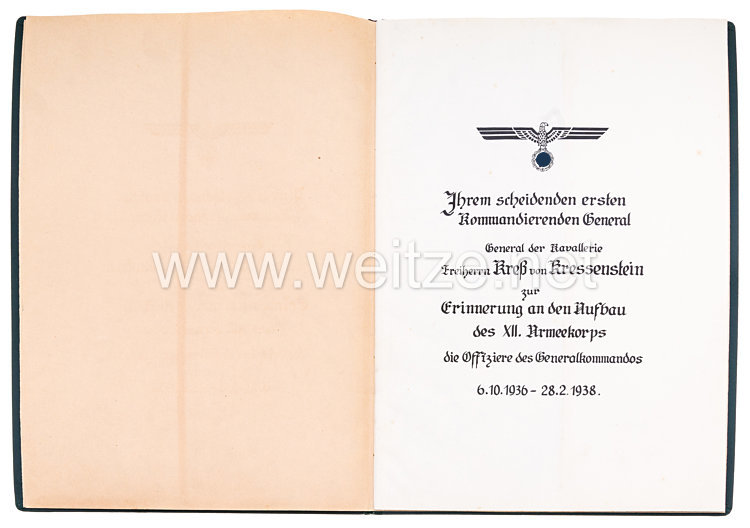
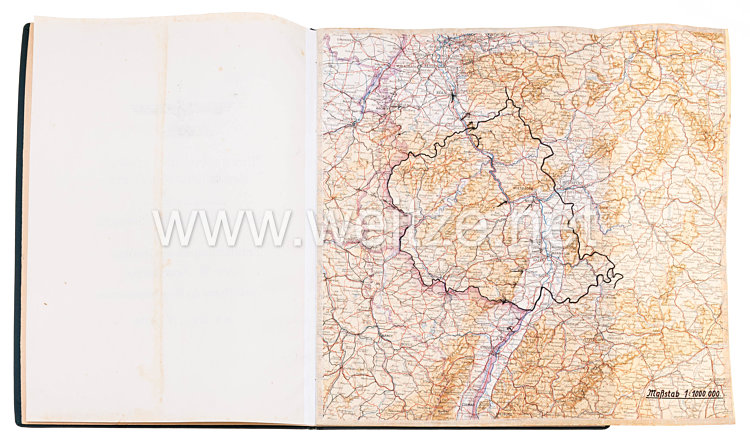
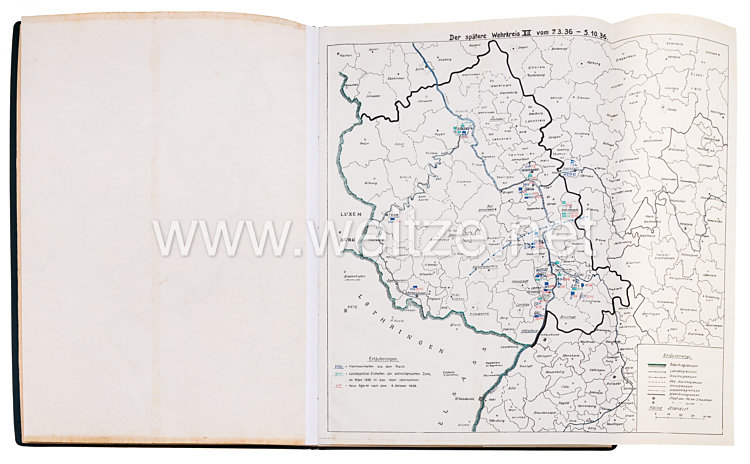
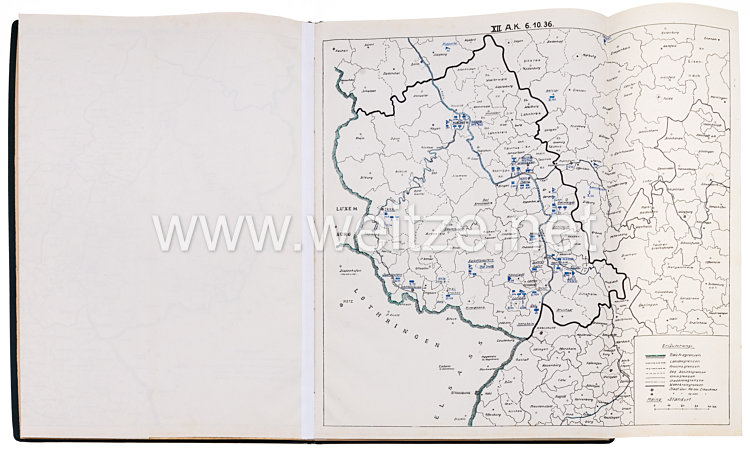
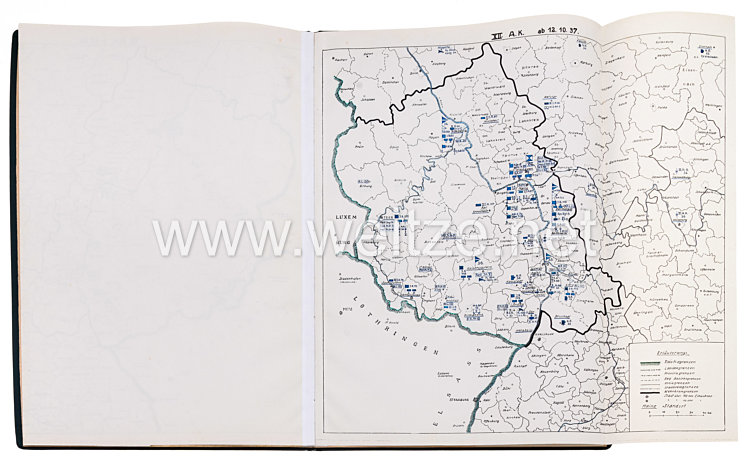
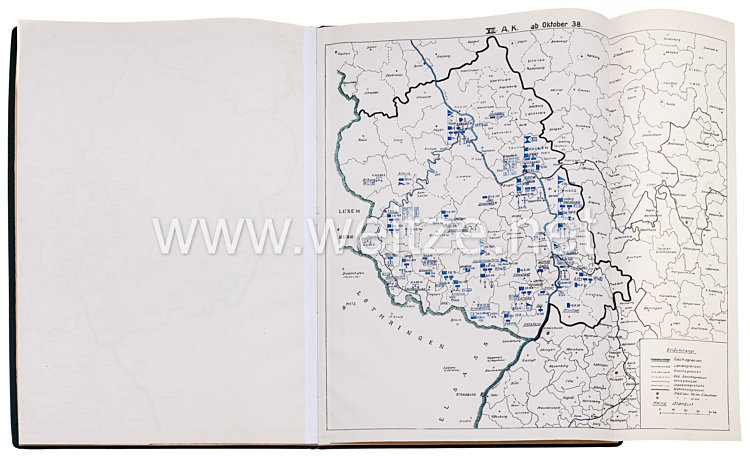
Large-format presentation portfolio "To their departing first Commanding General General der Kavallerie Freiherr Kreß von Kressenstein in remembrance of the establishment of the XII. Armeekorps from the Officers of the General Command 6.10.1936-28.2.1938". The portfolio contains 5 fold-out map sections with explanations regarding the development of the Wehrkreis of the XII. Armeekorps. Condition 2.

Franz Freiherr Kreß von Kressenstein, born July 23, 1881 in Augsburg, died January 14, 1957 in Planegg. Entered the Bavarian Army in 1900 as Fahnenjunker, promoted to Leutnant in 1902. In World War I as Rittmeister, lastly as 1st General Staff Officer of the Bavarian Cavalry Division. Transferred to the Reichswehr, promoted to Oberstleutnant in 1926. From 1928 Commander of Reiter-Regiment 7. Promoted to Generalmajor in 1933 and Chief of Staff of Gruppenkommando 1. In 1935 Commander of the 14th Division and promoted to Generalleutnant. On October 1, 1936 promoted to General der Kavallerie and appointed Commanding General of the XII. Armeekorps and Commander in Wehrkreis XII, Wiesbaden. Retired from active service on February 28, 1938 with permission to wear the uniform of Reiter-Regiment 17.
Freiherr Kreß von Kressenstein died on January 14, 1957 in Planegg and was buried with full military honors.
305359
600,00

Wehrmacht Large Presentation Portfolio from the Estate of General der Kavallerie Freiherr Kreß von Kressenstein

This magnificent Wehrmacht presentation portfolio documents a significant moment in the history of German rearmament in the 1930s. It was presented to General der Kavallerie Freiherr Kreß von Kressenstein upon his departure as the first Commanding General of XII. Armeekorps on February 28, 1938, by the officers of the General Command.

The portfolio represents a long tradition of military gift culture, whereby high-ranking officers were honored by their subordinates during important career transitions. Such presentations served not only as personal tokens of appreciation but also documented institutional developments and military organizational achievements. The period from October 6, 1936, to February 28, 1938, marks the formative phase of XII. Armeekorps under Kressenstein's leadership.

The XII. Armeekorps, headquartered in Wiesbaden, was part of the systematic expansion of the Wehrmacht following the reintroduction of universal conscription in 1935. The associated Wehrkreis XII (Military District XII) encompassed important territories in the Rhine-Main region. The five fold-out map sections with explanations contained in the portfolio vividly document the territorial and organizational development of this military district – a rare contemporary testament to military planning during these years.

Franz Freiherr Kreß von Kressenstein (1881-1957) embodied the professional cavalry officer whose career spanned three German state forms. Born on July 23, 1881, in Augsburg, he entered the prestigious Bavarian Army in 1900 as a Fahnenjunker (officer cadet). His career was characterized by steady advancement: promotion to Lieutenant in 1902, and during World War I he served as a Rittmeister (cavalry captain), ultimately as First General Staff Officer of the Bavarian Cavalry Division.

Kressenstein successfully transitioned into the Reichswehr of the Weimar Republic – a sign of his professional competence during a time of drastic military reduction. He was promoted to Oberstleutnant (Lieutenant Colonel) in 1926, and from 1928 commanded Reiter-Regiment 7 (Cavalry Regiment 7). This command position was of particular significance in the Reichswehr, limited to 100,000 men, as cavalry units still enjoyed high prestige despite modern warfare developments.

With the seizure of power in 1933, Kressenstein's career accelerated markedly. Promotion to Generalmajor and appointment as Chief of Staff of Gruppenkommando 1 positioned him in the highest leadership level of the expanding Wehrmacht. In 1935 followed command of the 14th Division and promotion to Generalleutnant. The pinnacle came on October 1, 1936, with promotion to General der Kavallerie (General of Cavalry) and appointment as Commanding General of XII. Armeekorps and Commander of Wehrkreis XII.

The presentation portfolio thus documents the recognition of a general who was instrumental in building up a significant army corps. Such presentation folders were manufactured by specialized workshops and were often elaborately designed. The inclusion of detailed cartographic materials underscores the documentary character and elevates this portfolio beyond purely symbolic gifts.

Kressenstein's retirement from active service on February 28, 1938 – at age 56 and at the height of his career – raises questions that the portfolio itself does not answer. The granting of permission to wear the uniform of Reiter-Regiment 17 was an honor that emphasized his status as a respected cavalry officer.

After the war, Kressenstein lived in retirement. His death on January 14, 1957, in Planegg and burial with full military honors demonstrate that he was accorded respect even in the Federal Republic – recognition not taken for granted for high-ranking Wehrmacht officers at that time.

This presentation portfolio is today an important military-historical document. It connects personal career history with the institutional development of the Wehrmacht and offers, through the cartographic materials, unique insights into the territorial organization of German armed forces during the critical phase of the late 1930s. As an object of military commemorative culture, it documents traditions of the officer corps that reach far back into Prussian-German military history.

r