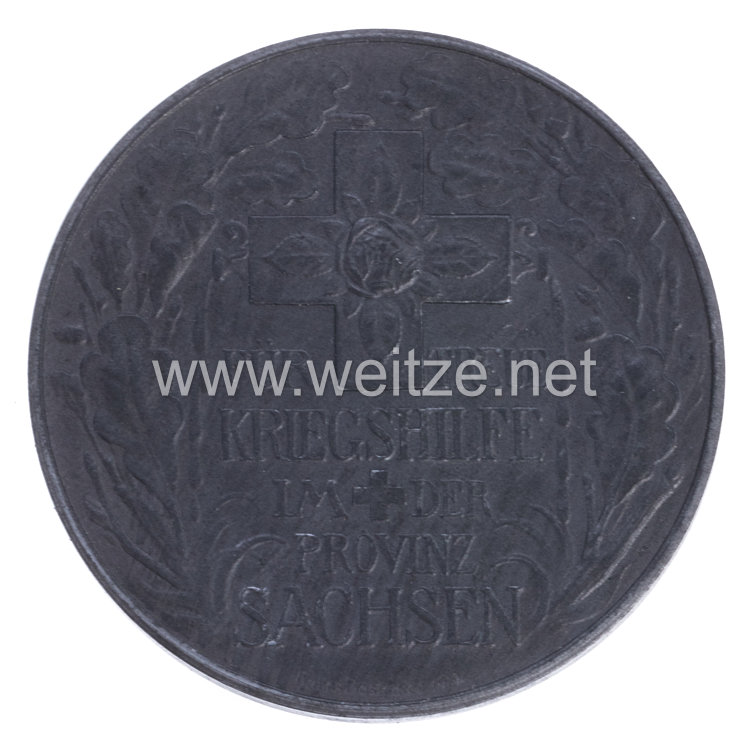
Kingdom of Saxony Red Cross Merit Medal for War Relief
The Merit Medal of the Red Cross for War Relief of the Kingdom of Saxony represents a significant testament to humanitarian efforts during World War I. This decoration was created to honor the exceptional merits of individuals who distinguished themselves in war relief and medical services under the aegis of the Red Cross.
The present example was designed by the artist Hanns Bastanier in 1919 and bears his signature. Bastanier was a renowned medalist of the Weimar period, known for his precise work and artistic design of decorations. The medal is made of zinc, a material frequently used in the late phase of World War I and the immediate post-war period, as war-essential metals such as bronze and copper were scarce. With a diameter of 38 mm, it corresponds to the typical dimensions of Saxon merit medals of this era.
The Kingdom of Saxony was one of the most important federal states of the German Empire and maintained its own extensive system of orders and decorations. During World War I (1914-1918), the Red Cross played a crucial role in caring for wounded soldiers, organizing field hospitals, and supporting the civilian population. The Saxon government recognized early the necessity of acknowledging this often hidden work through official decorations.
The establishment of such medals occurred during a time of enormous humanitarian challenges. The Red Cross, whose principles dated back to the Geneva Convention of 1864, was one of the few organizations during the war that could operate across all fronts. In Saxony, as in other German states, it was primarily women, doctors, nurses, and volunteer helpers who performed their duties under the most difficult conditions.
The dating to 1919 is of particular historical significance. The year marks not only the end of World War I with the Treaty of Versailles, but also the end of the German monarchies. In November 1918, King Friedrich August III had renounced the Saxon throne, and Saxony became a Free State within the newly founded Weimar Republic. The fact that this medal was still created in 1919 under the designation “Kingdom of Saxony” demonstrates the transitional phase in which traditional monarchical decorations were still awarded, although the monarchy itself had already become history.
The use of zinc as a material is characteristic of the economic hardship of the post-war period. During the war, precious metals had been requisitioned for the armaments industry, and even after the war ended, there was a significant shortage of raw materials. Zinc offered a viable alternative, although it could not achieve the aesthetic luster of bronze or silver. Nevertheless, this should not diminish the value of the decoration for its recipients – it represented recognition for selfless service during one of the darkest periods in German history.
The artistic design by Hanns Bastanier combines traditional heraldic elements with the iconography of the Red Cross. Such medals were usually worn on a ribbon whose colors symbolized affiliation with the respective federal state. The Saxon colors of white and green were typical elements of such decorations.
As a historical object, this medal documents several important aspects: first, the role of humanitarian organizations in total war; second, the recognition culture of the German individual states; third, the material constraints of the war and post-war period; and fourth, the political upheaval from monarchy to republic. For collectors and historians, such decorations represent important sources for understanding the social and cultural history of this turbulent era.
The Merit Medal of the Red Cross for War Relief joins the broad spectrum of Saxon decorations, which ranged from high military orders to civilian merit medals. It commemorates the thousands of people who, at great personal sacrifice, contributed to alleviating the suffering of war, and whose commitment was honored by the Kingdom of Saxony.