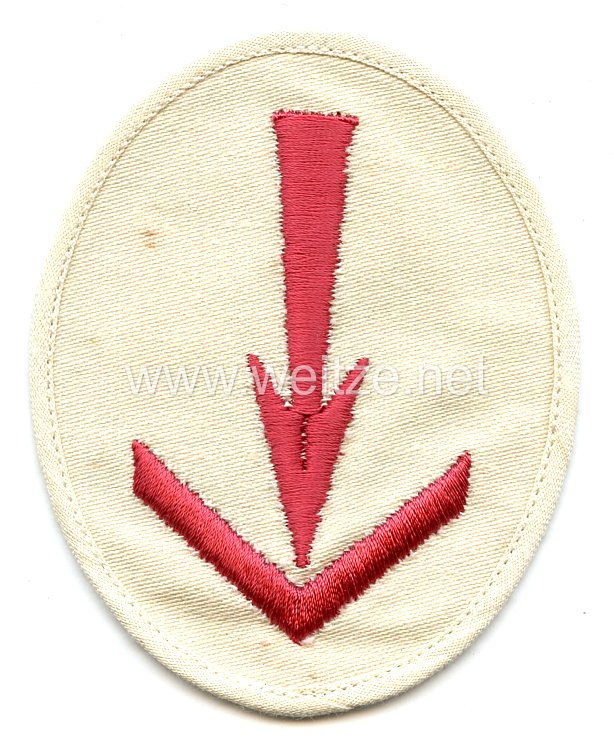
Kriegsmarine Sleeve Insignia Special Training Underwater Sound Detection Operator Enlisted Course

For the white blouse, condition 2.
415659
20,00

Kriegsmarine Sleeve Insignia Special Training Underwater Sound Detection Operator Enlisted Course

The Kriegsmarine Sleeve Badge for Special Training as Underwater Sound Detector (Unterwasserhorcher) represents a fascinating testament to the highly specialized technical training within the German Navy during World War II. This badge was awarded to enlisted personnel who successfully completed the training course for underwater sound detection, a specialization that was crucial for submarine warfare and coastal defense.

The Unterwasserhorcher or hydrophone operators were highly qualified specialists responsible for passive sonar systems. Their task consisted of identifying underwater sounds, locating enemy vessels, and determining their course and speed. This capability was especially vital for submarines, as they often had to operate while submerged and depended on acoustic reconnaissance. Training as an underwater sound detector required not only technical understanding but also exceptional hearing and the ability to filter even the faintest sounds from the background noise of the ocean.

The introduction of special career badges in the Kriegsmarine occurred as part of a comprehensive reorganization of the training and promotion system. According to the Kriegsmarine uniform regulations, special training badges were worn on the left upper sleeve of the white blouse, the summer uniform for enlisted personnel. These badges served not only as external identification of special qualifications but also to enhance esprit de corps and crew motivation.

The badge itself followed the typical design principle of Kriegsmarine specialty badges. It was usually manufactured in the form of an oval or round emblem that displayed specific symbols of the respective training on a dark blue cloth background. For underwater sound detectors, these typically consisted of stylized representations of sound waves or hydrophones. Production was done in hand embroidery or machine manufacture, using gold-yellow or silver-colored thread.

The training for underwater sound detectors took place at specialized naval schools, particularly at the Navy Signal School. The course encompassed theoretical foundations of acoustics, technical training on listening devices, and practical exercises in sound recognition. Trainees had to learn to distinguish between different ship types solely by their characteristic sound signatures—a skill that could often decide the life or death of a submarine crew.

The technical equipment with which underwater sound detectors worked developed steadily during the war. Early systems such as the Group Listening Device (Gruppenhorchgerät or GHG) were supplemented by improved models like the Balkon-Gerät, which enabled more precise bearing. The listeners often sat for hours in their positions, concentrated on their headphones, to perceive even the slightest indication of enemy presence.

Condition 2 of the badge described here indicates that it is a worn example that was possibly used in active service. Such badges were issued after passing the examination and had to be attached to the uniform. They were part of the official service dress and subject to strict wearing regulations.

In the larger context of submarine warfare, underwater sound detectors played an increasingly important role, especially as Allied anti-submarine measures became ever more effective. The ability to detect enemy destroyers and escort vessels early was often the only advantage a submerged submarine possessed. With the introduction of Allied sonar technology (ASDIC), a veritable acoustic war developed underwater, with listeners on both sides attempting to locate the enemy without being discovered themselves.

The acoustic specialists had to master numerous skills: recognizing propeller noises, distinguishing between merchant vessels and warships, estimating distances based on sound intensity, and identifying depth charges or torpedoes. The psychological strain of this work was considerable, as a mistake in interpretation could have fatal consequences for the entire crew.

The organizational structure of the Kriegsmarine's acoustic service was complex. Trained sound detectors were assigned to various units: primarily to U-boats, but also to surface vessels, coastal stations, and harbor defenses. Each posting required specific adaptations of the basic skills learned during training.

After the war, many of these specialty badges became sought-after collectibles. They document not only the technical specialization of the Kriegsmarine but also the development of underwater warfare. Today, authentic examples are important study objects for military historians and uniform researchers investigating the complex organization and training structure of the German Navy.

The existence of such highly specialized training badges underscores the technological complexity of modern naval warfare in the first half of the 20th century and the importance attached to human expertise despite increasing mechanization.