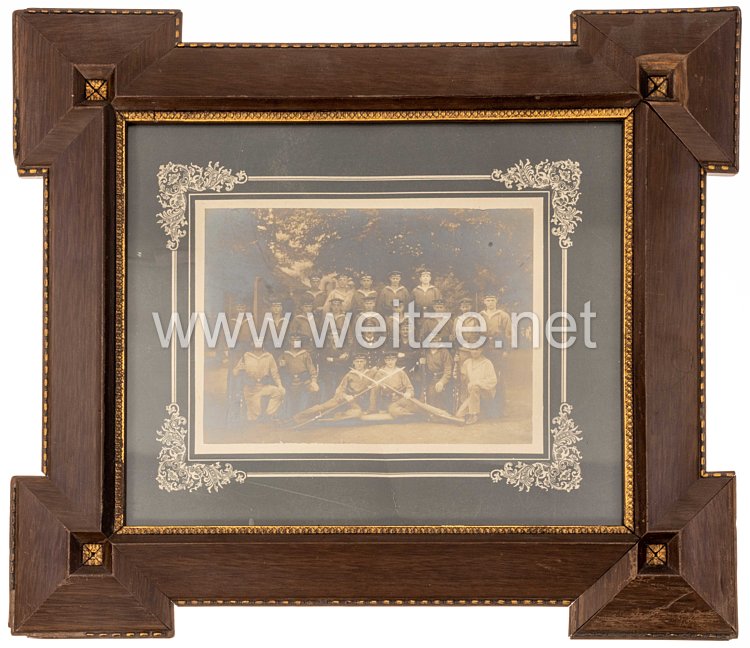
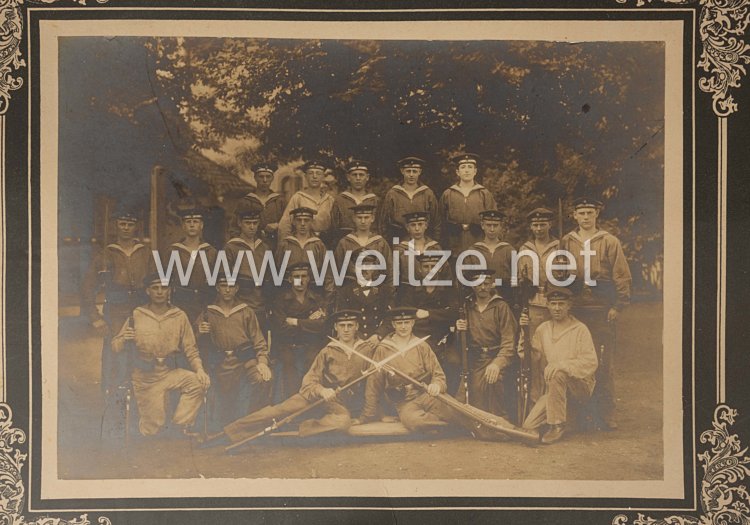
Imperial Navy Framed Photograph of a Shipyard Division

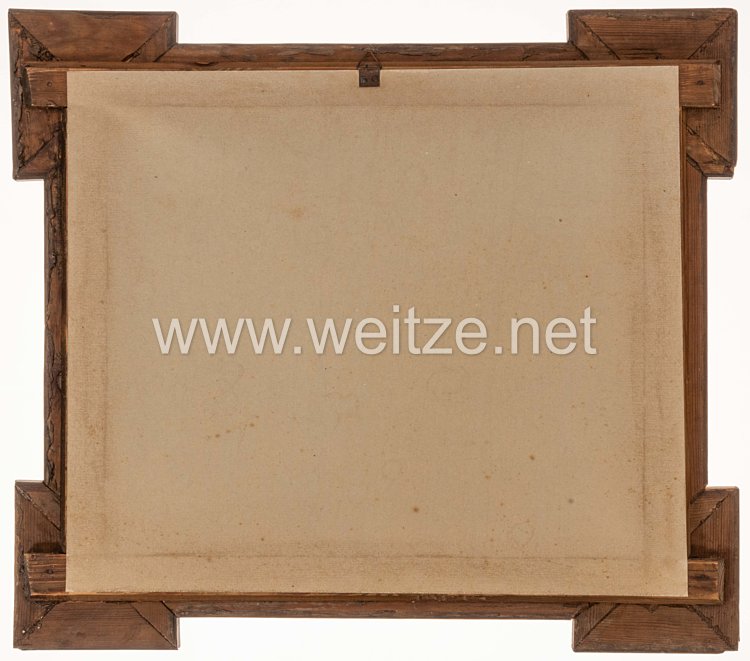
Circa 1910. Dimensions approximately 49.7 x 44 cm. The frame slightly damaged at the edges. Condition 2.
421759
80,00

Imperial Navy Framed Photograph of a Shipyard Division

This framed photograph of a dockyard division from the Imperial German Navy (Kaiserliche Marine) dating from around 1910 represents a significant document of German naval history during the era of Wilhelmine imperialism. Such group photographs served not only as personal mementos but also as expressions of the heightened self-confidence of the German naval forces in the years preceding World War I.

The Kaiserliche Marine, which emerged from the Prussian Navy in 1871, experienced unprecedented expansion under Kaiser Wilhelm II and the Imperial Naval Office led by Grand Admiral Alfred von Tirpitz. The so-called Flottenpoliti (naval policy), implemented through the Naval Laws of 1898 and 1900, resulted in a massive buildup of the German war fleet, which had not only military but also considerable industrial and social ramifications.

The dockyard divisions (Werft-Divisionen) played a central role in this context. They were responsible for the maintenance, repair, and technical operation of warships at the major naval bases. The most important locations were Wilhelmshaven, Kiel, and Danzig. The personnel of these units consisted of highly specialized craftsmen, engineers, and technicians who had undergone several years of training. The hierarchy was strictly military in organization, with deck officers, chief petty officers, and petty officers of various specializations.

Around 1910, the Imperial Navy was at the height of its development. The fleet comprised modern dreadnought battleships, armored cruisers, light cruisers, and torpedo boats. The dockyard workers and technical personnel were crucial to the operational readiness of these highly complex weapons systems. Work in the dockyards was technically demanding and required knowledge of metalworking, mechanical engineering, electrical engineering, and maritime construction.

Photographs like the present example were typically produced by professional naval photographers or local studio photographers who specialized in military photography. The images often followed a standardized format: crews were arranged in rows, with officers and senior non-commissioned officers seated or standing in the center, while ordinary sailors formed the outer rows. Flags, standards, or maritime emblems were frequently integrated into the composition.

The uniforms of the Imperial Navy around 1910 followed the regulations of the naval clothing ordinance. The characteristic dark blue uniform with white or blue collars, the flat caps with cap ribbons, and the rank insignia on the sleeves allowed clear identification of rank and function. Dockyard personnel sometimes also wore work clothes, depending on the official occasion of the photograph.

The historical context of this period was characterized by increasing international arms races, particularly with Great Britain. The Anglo-German naval race was a significant factor that contributed to the deterioration of bilateral relations and ultimately to the constellation that led to World War I. The men in such photographs thus represented not only their individual biographies but also the larger geopolitical tensions of their time.

The framing of such photographs was customary at the time and gave the images an official, permanent character. The frames were usually made of dark wood, sometimes decorated with maritime ornaments. They were hung in officers' messes, administrative buildings, or private homes and served to maintain tradition and esprit de corps.

From today's perspective, such photographs are valuable historical sources. They document not only the material aspects of naval uniforms and equipment but also social-historical dimensions: the composition of crews, the social origins of naval personnel, and the role of the navy in Wilhelmine society. The Imperial Navy attracted personnel from all regions of the German Empire and offered particularly attractive career opportunities for technically skilled young men.

The condition of preservation, with slight frame damage, is quite typical for objects over a hundred years old and hardly diminishes the historical value. Such photographs are valued today by military historians, naval museums, and collectors as authentic testimonies of a past epoch of German naval history that ended in 1918 with defeat in World War I and the scuttling of the High Seas Fleet at Scapa Flow.

r