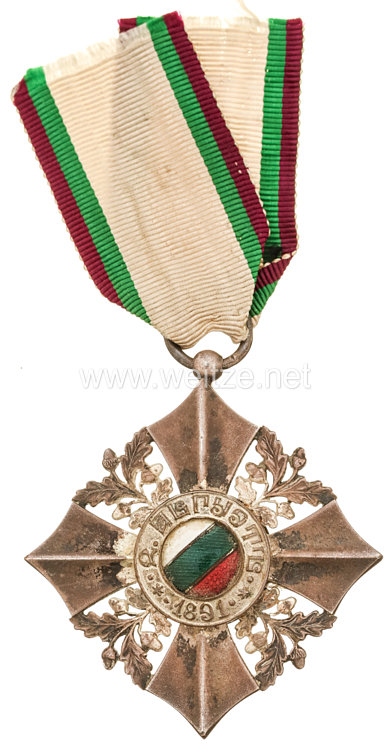
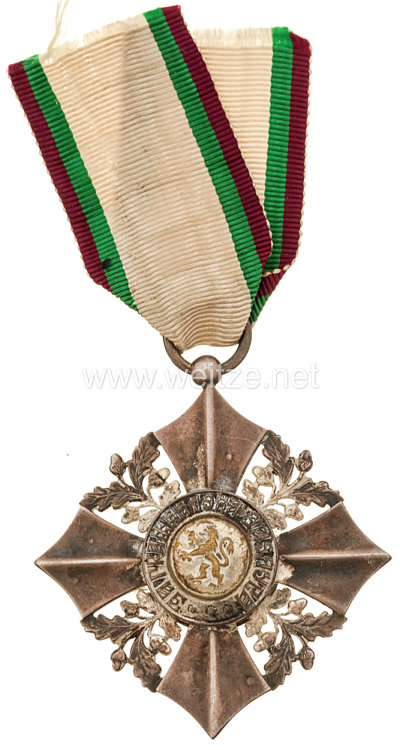
Bulgaria Order of Civil Merit 1944-1946 6th Class Silver Merit Cross

Silver-plated cross on ribbon. Condition 2.
In the 1944-1946 model, the monogram on the reverse was replaced by the national colors.
353859
120,00

Bulgaria Order of Civil Merit 1944-1946 6th Class Silver Merit Cross

The Bulgarian Order of Civil Merit represents a significant decoration of the Bulgarian state, awarded in recognition of special achievements in the civil sphere. The Silver Cross of Merit of the 6th Class described here, from the period 1944-1946, represents a particularly interesting transitional phase in Bulgarian history, characterized by profound political and social upheavals.

The Order of Civil Merit was originally established in 1891 during the reign of Prince Ferdinand I and underwent several modifications throughout its existence. The decoration was divided into six classes, with the 6th class presented here being the lowest, yet still honorable, level of distinction. The system typically included Grand Crosses, Commander's Crosses, and Crosses of Merit in various executions.

The distinctive feature of the 1944-1946 version lies in the significant alteration of the reverse side: the royal monogram was replaced by the Bulgarian national colors. This modification was by no means purely aesthetic, but rather reflected the dramatic political changes in Bulgaria during this turbulent period. On September 9, 1944, the monarchist-authoritarian government was overthrown by the Fatherland Front, a coalition under communist leadership. This coup marked the beginning of the transition from kingdom to people's republic.

The removal of the monogram from the order's insignia symbolized the gradual elimination of monarchist symbols from public life. Nevertheless, the order initially retained its traditional form and designation, reflecting the transitional phase until the final abolition of the monarchy through the referendum of September 1946. The young Tsar Simeon II, who had reigned under a regency since 1943, was deposed, and Bulgaria was officially declared a People's Republic.

The technical execution of the order conforms to the traditional standards of Bulgarian order manufacturing. The silver-plated cross displays the characteristic cross form with typical design elements of Bulgarian phaleristics. The ribbon bears the Bulgarian national colors of white, green, and red, which have symbolized national identity since Bulgaria's liberation from Ottoman rule in 1878.

The conferral practice of the Order of Civil Merit during this period was shaped by the extraordinary circumstances of the time. During the years 1944-1946, Bulgaria found itself in a complex situation: the country was formally still a monarchy, but was in fact already under the control of communist-dominated government structures. The decorations were awarded both for traditional civil merits and increasingly for achievements in line with the new political system.

The condition grade 2 of the present decoration indicates a well-preserved, lightly worn medal, which in collector's terminology typically means minimal signs of use with overall very good preservation. This is remarkable, as many orders from this transitional period were later destroyed or melted down, either by the new communist authorities or by their owners who wished to conceal their connections to the old regime.

The historical significance of such transitional pieces cannot be overestimated. They document a decisive turning point in Bulgarian history, as the country transformed from a constitutional monarchy to a communist state. After 1946, new decoration systems were introduced that corresponded to socialist ideals, and the old monarchist orders became largely obsolete.

For collectors and historians, pieces from the period 1944-1946 represent particularly valuable testimonies, as they document the brief transitional phase. The combination of traditional order form and the deliberate renunciation of monarchist symbolism makes them unique historical artifacts. They tell the story of a country in upheaval, caught between its monarchist past and its communist future.

The research and documentation of such decorations contributes significantly to understanding the complex history of Southeastern Europe in the 20th century and illustrates how political changes manifest themselves in seemingly small details such as the design of state decorations.

r