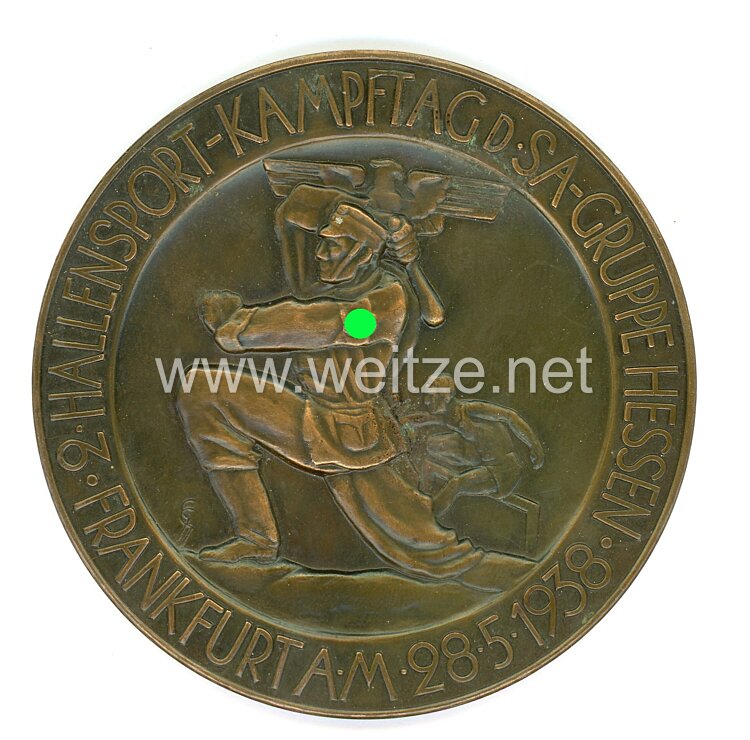
SA Non-Wearable Winner's Medal “2nd Indoor Sports Competition Day of SA-Gruppe Hessen Frankfurt a.M. 28.5.1938”

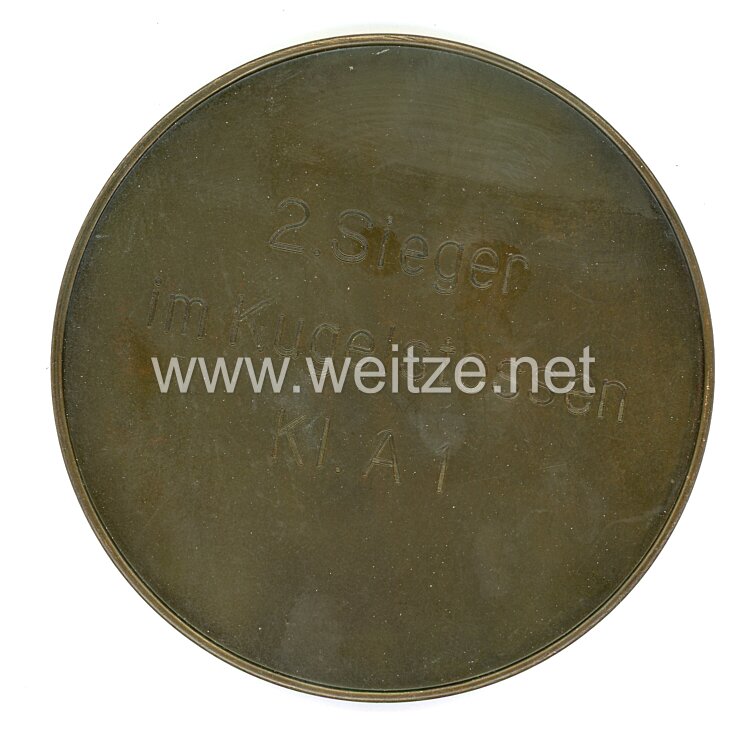
Large bronzed aluminum medal, diameter 85 mm, reverse engraved “2. Sieger im Kugelstossen Kl. A 1” (2nd Place Shot Put Class A 1). Condition 2.
238458
200,00

SA Non-Wearable Winner's Medal “2nd Indoor Sports Competition Day of SA-Gruppe Hessen Frankfurt a.M. 28.5.1938”

This SA sports medal from 1938 represents a fascinating chapter in National Socialist physical culture and the paramilitary organizational structure of the Sturmabteilung (SA). This bronzed aluminum medal with a diameter of 85 mm was awarded on the occasion of the 2nd Indoor Sports Competition Day of SA Group Hesse on May 28, 1938, in Frankfurt am Main.

The SA, founded in 1920/21 as the NSDAP's security force, had developed by 1933 into one of the most powerful paramilitary organizations in National Socialist Germany. After the events of the so-called “Röhm Putsch” on June 30, 1934, the SA lost considerable political power but remained as a mass organization and increasingly focused on sports and pre-military training.

The SA Group Hesse was one of the regional administrative units of the SA, encompassing the Hesse region with headquarters in Frankfurt am Main. These groups were further subdivided into brigades, regiments, and smaller units. After 1934, the focus of SA activities shifted increasingly toward physical fitness and paramilitary sports training, which was understood as preparation for military service.

The systematic organization of sports competition days was an essential component of SA work in the second half of the 1930s. These events served multiple purposes: they were meant to promote the physical fitness of SA men, strengthen competitive spirit, solidify camaraderie within units, and not least present the SA as an organization close to the people. The competitions typically included track and field disciplines such as shot put, long jump, running, as well as strength sports.

The engraving “2nd Place Winner in Shot Put Class A 1” on the reverse of the medal indicates a classification system, presumably based on age or performance level. Shot put was a particularly popular discipline at SA sports competitions, as it combined strength and technique and was considered relevant to military sports.

The manufacture of the medal from bronzed aluminum is characteristic of the mid to late 1930s. Aluminum was a modern, lightweight material that was increasingly produced in Germany. The bronzing gave the cost-effective aluminum medals a more prestigious appearance. At 85 mm in diameter, this is an above-average sized medal, which underscores the importance of the event.

The year 1938 was domestically a year of consolidation of Nazi rule and internationally characterized by the aggressive expansionist policy of the German Reich with the “Anschluss” of Austria in March and the Sudeten Crisis in autumn. The SA played a supporting role in these events and benefited organizationally from the territorial expansion.

Such sports medals were not part of the official awards system of the German Reich but were produced and awarded independently by the respective SA groups. This explains the great variety of designs, sizes, and materials among SA sports awards. The medals served as incentives for participants and as mementos of the events.

From today's historical perspective, such objects are important testimonies to everyday culture in National Socialism. They document the penetration of social life by Nazi organizations and show how sports and physical fitness were instrumentalized to pursue political and ideological goals. The pre-military training in the SA served to prepare for the coming war, which was already being planned by Nazi leadership in 1938.

For collectors and historians, such non-portable medals are interesting objects of study, as they provide insights into the regional organization of the SA and the concrete activities at the local level. The fact that this was the “2nd Indoor Sports Competition Day” suggests that such events took place regularly and were firmly anchored in the annual calendar of SA Group Hesse.

These artifacts remind us of how totalitarian regimes sought to control and militarize all aspects of civil society, including recreational sports, transforming them into instruments of ideological indoctrination and military preparation. The medal thus stands as material evidence of the Nazi regime's comprehensive control over German society in the years leading up to World War II.