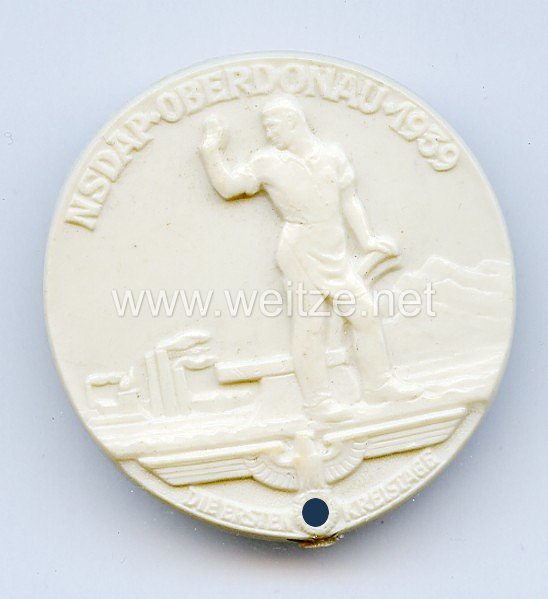
NSDAP - Oberdonau 1939 - The First Kreistage

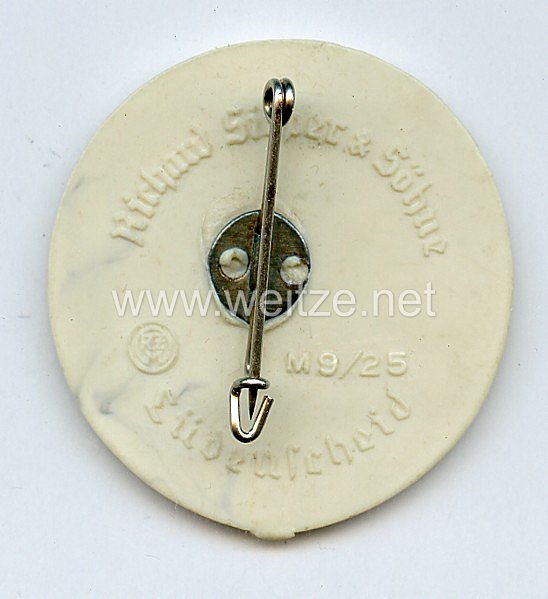
Plastic badge, with pin fastener, maker: RZM M9/25 Richard Sieper & Söhne Lüdenscheid, condition 2
431658
40,00

NSDAP - Oberdonau 1939 - The First Kreistage

This badge commemorates a significant event in the history of National Socialist Austria: The First Kreistage (District Assemblies) in Reichsgau Oberdonau in 1939. This plastic badge, manufactured by RZM M9/25 Richard Sieper & Söhne of Lüdenscheid, represents the organizational consolidation of NSDAP structures in the newly created Austrian Gaue following the so-called “Anschluss” of 1938.

Following the forcible incorporation of Austria into the German Reich in March 1938, a comprehensive administrative reorganization of the former Austrian federal states took place. Reichsgau Oberdonau was formed from parts of Upper Austria and took its name from the Danube River, which flows through this region. The Gau headquarters was located in Linz, a city of personal significance to Adolf Hitler, as he had spent his youth there.

The Reichszeugmeisterei (RZM) had been the central procurement office of the NSDAP for uniforms, badges, and other equipment since 1929. The RZM marking guaranteed official recognition and quality of party paraphernalia. The manufacturer number M9/25 clearly identifies the firm Richard Sieper & Söhne of Lüdenscheid, a company that was among the most important producers of party badges and military decorations during the NS era.

The first Kreistage in 1939 represented an important milestone in the organizational penetration of the newly incorporated territories. Kreistage were assemblies at the district level of the NSDAP hierarchy, where party functionaries gathered to discuss political guidelines, coordinate local party work, and ideologically align the population. These events served not only administrative purposes but were also propagandistic mass events designed to demonstrate the party's power and presence.

The use of plastic as a material for this badge is typical of the period and economically significant. From the mid-1930s onward, as part of the NS regime's autarky efforts, there was increased reliance on substitute materials. Plastics such as Bakelite or other early polymers increasingly replaced traditional materials like metal, which was needed for armaments production. This was part of the economic preparation for war and reflects the resource scarcity that the German Reich faced even before the outbreak of war.

The company Richard Sieper & Söhne in Lüdenscheid was an established enterprise in the metalworking industry of the Bergisches Land region. Lüdenscheid had developed into a center of the metal goods and jewelry industry since the 19th century. During the NS period, numerous firms in this region produced medals, decorations, and party badges. The RZM strictly controlled the awarding of manufacturer licenses, and only approved firms were permitted to produce official party insignia.

Such event badges fulfilled several functions: they served as proof of participation and souvenirs for functionaries, strengthened the sense of community within the party organization, and documented the hierarchical structure of the NSDAP. Wearing such badges signaled loyalty and active participation in party life. At the same time, they were an expression of NS symbolic politics, which aimed to penetrate all areas of life.

Reichsgau Oberdonau encompassed approximately 14,000 square kilometers and had about 1.04 million inhabitants. The Gauleiter from 1938 to 1945 was August Eigruber, one of the most radical and brutal NS functionaries, who was responsible for numerous crimes, including the establishment and operation of the Mauthausen concentration camp in his Gau. The administrative division into Kreise (districts) corresponded to the typical NS administrative structure, which increasingly merged party and state organization.

From today's perspective, such objects are important witnesses to contemporary history. They document the organizational structures of the NS regime, the penetration of all social spheres by the party, and the economic framework conditions of the pre-war and war periods. The scholarly examination of such artifacts enables a better understanding of the mechanisms of totalitarian rule and everyday reality under National Socialism. At the same time, they serve as a reminder to remain vigilant against authoritarian tendencies and to defend democratic values.