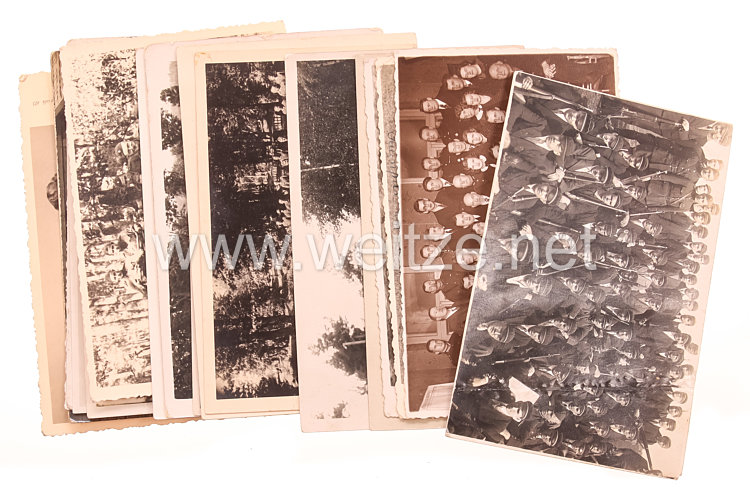
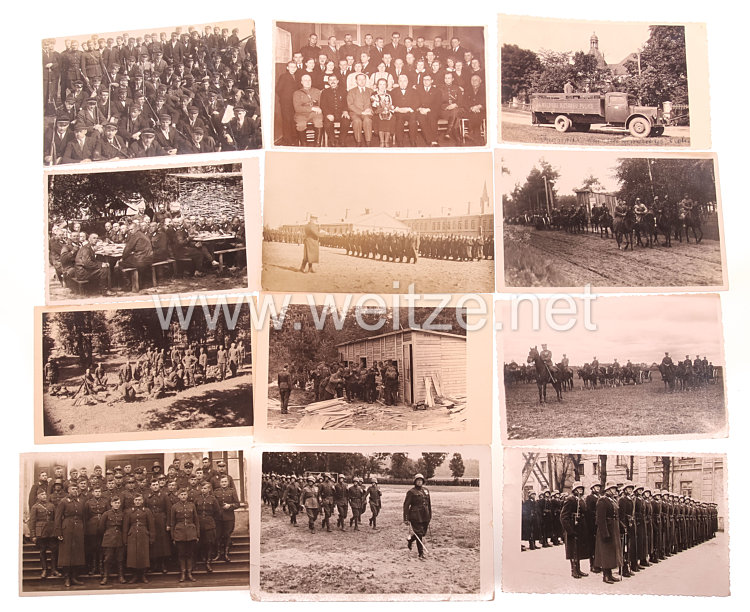
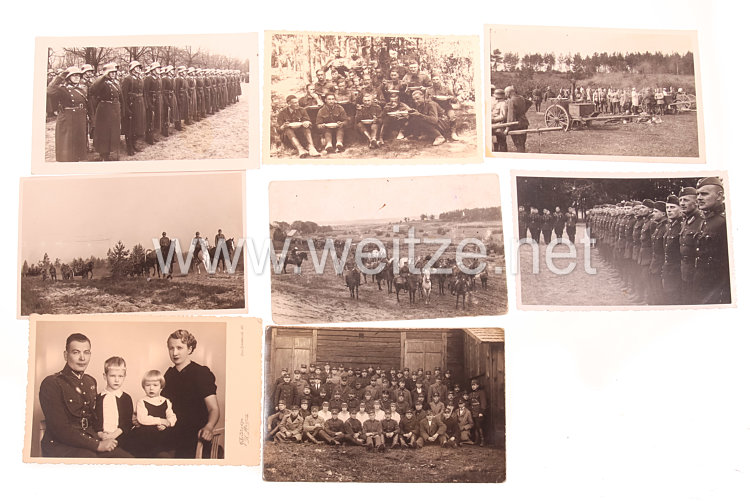
Latvia Collection of 20 Military Photographs
Latvian Military Photographs from the 1930s: Documentation of an Interwar Army
This collection of twenty military photographs from Latvia in postcard format from the 1930s represents a significant historical document of the Latvian armed forces during the interwar period. This era was crucial for the young Latvian state, as the country had to reorganize itself militarily and politically after gaining independence in 1918.
Historical Context of Latvian Independence
Latvia gained its independence on November 18, 1918, following the collapse of the Russian Empire and the end of World War I. The Latvian Army (Latvijas armija) was officially founded in 1919 during the Latvian War of Independence, when the country had to fight against Soviet, German, and Russian White forces. By 1920, Latvia had militarily secured its independence and received international recognition through the Treaty of Riga on August 11, 1920.
The Latvian Army in the 1930s
During the 1930s, when these photographs originated, the Latvian Army had developed into a professional fighting force. After the military coup by Kārlis Ulmanis on May 15, 1934, Latvia became an authoritarian regime, which also affected the role and representation of the armed forces. At this time, the army comprised approximately 20,000 to 30,000 men and was organized into several divisions.
Military equipment came from various sources: French, British, Czechoslovakian, and domestic production. Uniforms were based on Western European standards with characteristic Latvian national emblems.
Military Photography as a Medium of the 1930s
Photographs in postcard format (typically 9x14 cm or 10x15 cm) were the standard size for personal and documentary images in the 1930s. Military photographs of this type served multiple purposes: they were keepsakes for soldiers and their families, propaganda material for the state, and historical documentation of military affairs.
Photography had advanced significantly by the 1930s. Small-format cameras became more affordable, and print quality improved considerably. Professional military photographers documented maneuvers, parades, garrison life, and official occasions. Private photographs by soldiers frequently showed scenes of camaraderie, training situations, or portraits in uniform.
Typical Subjects of Latvian Military Photographs
Photographic collections from this period typically show: group photographs of units, officer and enlisted portraits, military ceremonies and parades (especially for Independence Day on November 18), training scenes, military equipment and weapons, and garrison buildings and barracks. The main garrison in Riga and other important military locations such as Liepāja, Daugavpils, and Jelgava were frequent photography sites.
Uniforms and Insignia
Latvian military uniforms of the 1930s had distinctive designs. Field uniforms consisted of khaki or gray-green fabric. Characteristic were the cockades in the national colors of red-white-red. Rank insignia were worn on collars and sleeves. Officers frequently wore higher-quality uniforms with additional distinguishing features.
The Political Dimension
The 1930s were a time of growing foreign policy tensions for Latvia. Between the Soviet Union to the east and Nazi Germany to the west, the small Baltic country found itself in a precarious position. The army was understood as the guarantor of national independence, which was also reflected in visual representation through photographs.
Collector Value and Historical Significance
Such photo collections from the Latvian interwar period are of considerable historical value today. They document a period that ended abruptly in 1940 with the Soviet occupation of Latvia. Many military documents and photographs were lost during World War II and Soviet rule, making preserved collections particularly valuable for historical research.
Condition and Material
The condition described as “used” is typical for photographs of this age. Common signs of aging include yellowing, edge wear, occasional creases, or stains. Photographic prints from the 1930s were usually produced on baryta paper, which is relatively stable when properly stored but sensitive to moisture and light.
Research Perspectives
For military historians, uniform specialists, and researchers of Baltic history, such photographs offer valuable primary sources. They provide insights into uniform details, military organizational structures, social aspects of military service, and the visual self-representation of the Latvian armed forces. Analysis of such collections contributes to a better understanding of Latvian military history between 1918 and 1940.
These photographs serve as tangible links to a brief but significant period of Latvian sovereignty, representing not just military history but also national identity and the aspirations of an independent state during the turbulent interwar years.