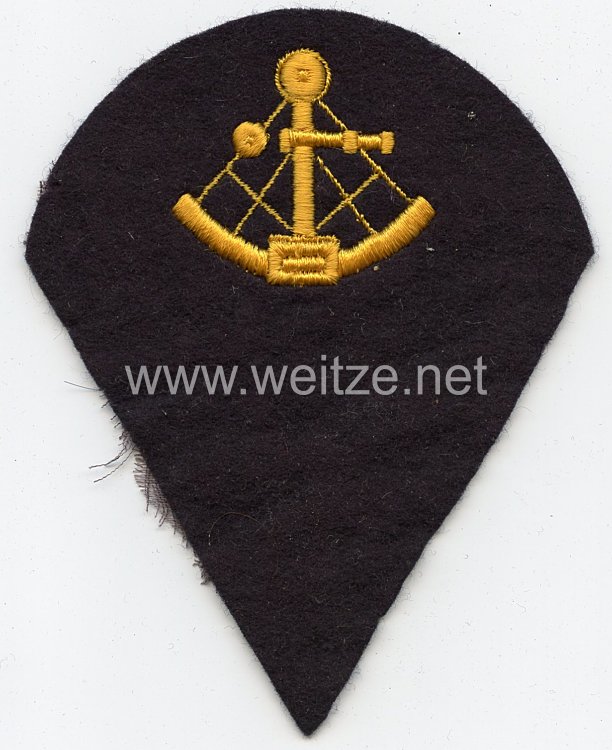
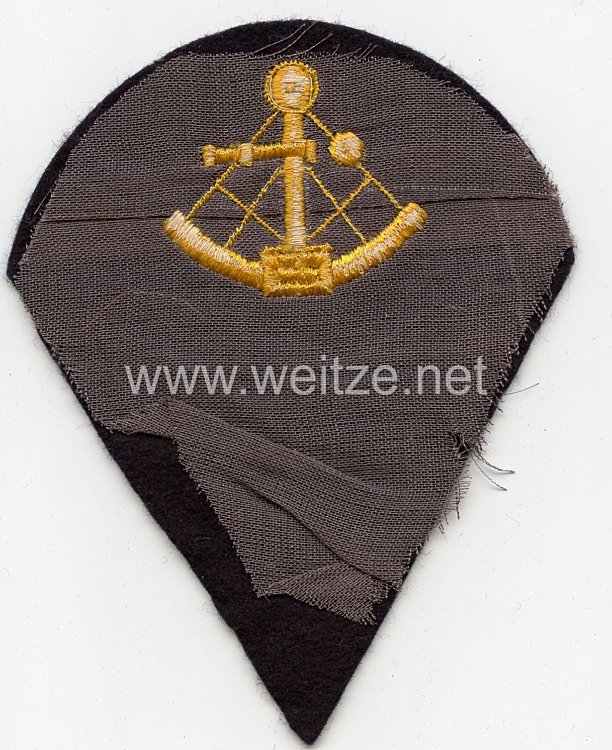
Kriegsmarine Enlisted Personnel Sleeve Insignia for Survey/Hydrographic Branch

Version for blue collar uniform, condition 2.
376658
18,00

Kriegsmarine Enlisted Personnel Sleeve Insignia for Survey/Hydrographic Branch

The Kriegsmarine sleeve badge for enlisted personnel in the surveying career path represents a fascinating example of the differentiated career badge system of the German Kriegsmarine during World War II. These specialized badges were introduced to visually identify the various specialized career paths within the naval organization and to document the professional specialization of naval personnel.

The surveying career path (Vermessungslaufbahn) belonged to the technical-scientific specialized careers of the Kriegsmarine and was of considerable strategic importance. Surveying personnel were responsible for hydrographic mapping, coastal surveying, depth measurement, and the production of nautical charts. These activities were essential for the safe navigation of warships, submarines, and for planning amphibious operations.

The legal basis for wearing career badges was regulated by various Kriegsmarine ordinances, particularly through the dress regulations for the Kriegsmarine. The badge was worn on the left upper sleeve of the uniform, above any rank insignia. For enlisted ranks, the position was precisely specified and had to comply with uniform technical regulations.

The execution for the Kolani (force compensation suit) refers to a special variant of the badge designed for the blue working suit of the Kriegsmarine. The Kolani was a practical working uniform worn during daily service aboard ship and during land activities. Unlike parade uniforms, badges for the Kolani were often manufactured in more robust execution to withstand the demands of daily service.

The surveying career path required specialized training. Aspiring surveying mates underwent theoretical and practical training in navigation, cartography, astronomy, mathematics, and the use of precise measuring instruments. Training took place at specialized naval schools, where personnel were prepared for the complex requirements of maritime surveying.

Historically, the German Navy had a long tradition in hydrographic surveying. The Imperial Navy already maintained its own surveying service, and this tradition was continued in the Reichsmarine of the Weimar Republic. With the expansion of the Kriegsmarine from 1935 onwards, the surveying career path gained increasing importance as the German Reich significantly extended its maritime operational areas.

The surveying vessels of the Kriegsmarine operated not only in home waters but also in distant areas such as the Mediterranean, the Baltic Sea, the Black Sea, and even in overseas waters. The accuracy of their work was decisive for the war effort, as inaccurate sea charts could lead to ship losses, failed operations, and strategic disadvantages.

The career badge itself typically consisted of an embroidered or woven emblem displaying the specific symbols of the surveying career path. These symbols were standardized throughout the Kriegsmarine and enabled immediate identification of a naval soldier's professional specialization. The coloring and material execution varied depending on the type of uniform and rank.

After the end of the war in 1945, the Kriegsmarine was dissolved, and with it ended the use of these specialized career badges. In the later Bundesmarine, a similar system of career badges was introduced, but with completely new design and symbolism that consciously distanced itself from the Nazi era.

Today, original Kriegsmarine career badges are sought-after collectibles for militaria collectors and naval historians. They document the complex organizational system of the German Kriegsmarine and the diversity of professional specializations within the naval forces. The preservation and scientific documentation of such objects contributes to understanding the social and organizational history of the Kriegsmarine.

r