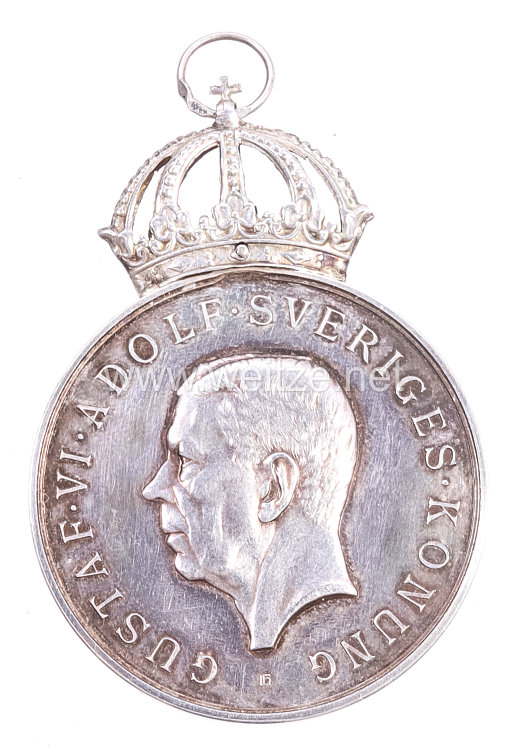
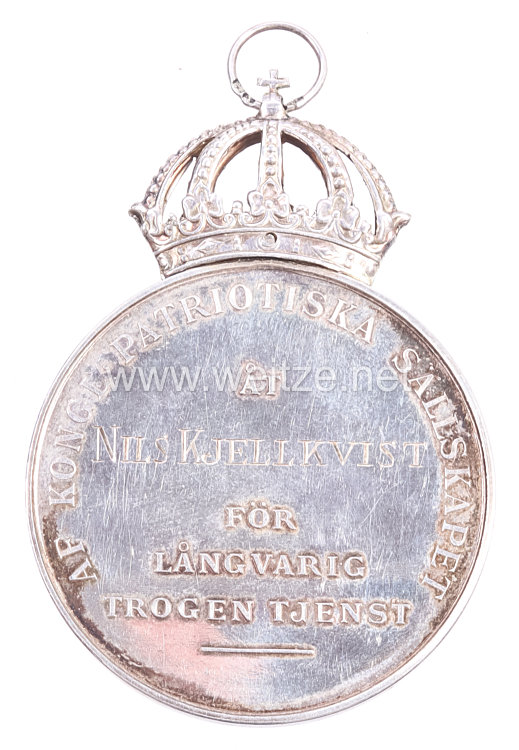
Kingdom of Sweden Merit Medal Gustaf VI Adolf Sveriges
Diameter approx. 41 mm. Condition 2.
The Royal Swedish Medal of Merit of Gustaf VI Adolf represents a significant decoration within the Swedish honors system from the mid-20th century. This medal was awarded during the reign of King Gustaf VI Adolf (1882-1973), who ruled as King of Sweden from 1950 to 1973.
King Gustaf VI Adolf, born Oscar Fredrik Wilhelm Olaf Gustaf Adolf on November 11, 1882, was the eldest son of King Gustaf V and Queen Victoria of Baden. He ascended to the throne at the age of 67 and became known as a scholarly monarch with great interest in archaeology, history, and art history. His reign was characterized by the modernization of Sweden and the consolidation of its position as a neutral nation during the Cold War.
The Swedish order system has a long and distinguished history dating back to the 17th century. Medals of merit formed an important component of this system and were awarded for various services to the Kingdom. Unlike higher orders such as the Order of the Seraphim or the Order of the Sword, which were primarily bestowed upon nobility and high-ranking individuals, medals were often intended for services rendered by citizens of various social classes.
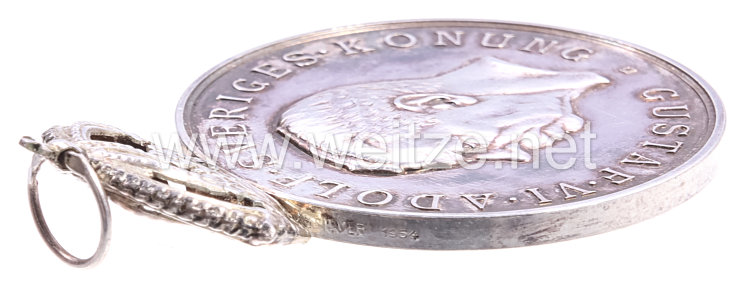
The present medal has a diameter of approximately 41 mm, which was typical for Swedish merit medals of this period. The edge inscription “Silver 1954” provides important information about the material and the year of minting. The designation as silver demonstrates the quality of the award and its significance within the hierarchy of Swedish honors. The year 1954 falls within a significant phase of Swedish post-war history, when the country was consolidating its position as a prosperous, neutral nation.
The 1950s were a time of economic growth and social reform for Sweden. The so-called “Swedish Model” of a welfare state took concrete form during this period. King Gustaf VI Adolf supported this development and represented a modern, citizen-oriented monarchy. In this context, merit medals were awarded not only for military achievements but increasingly for civilian services in areas such as culture, science, education, and public service.
The award to Nils Kjellkvist in 1954 was made in accordance with royal statutes and regulations governing the conferment of honors. Such awards were typically processed through the Royal Court Marshal's Office and recorded in official documents. The medal was likely manufactured at the Royal Mint in Stockholm, which was responsible for producing all state decorations.
The design of such medals from the reign of Gustaf VI Adolf followed established iconographic traditions. They typically displayed the King's portrait with appropriate inscription on the obverse, while the reverse often bore symbolic representations or the royal coat of arms. The artistic design of Swedish medals from this period was characterized by classical elegance and craftsmanship precision.
The condition of the medal is given as “Condition 2,” which according to numismatic and phaleristic standards indicates very fine to extremely fine preservation. This suggests that the medal was carefully preserved and shows only minimal signs of wear, which is not unusual for a personal decoration, as such pieces were usually worn only on special occasions.
In the broader context of the Swedish awards system, this medal stands as an example of a state tradition that recognizes civilian merit through a differentiated system of orders and medals acknowledging various levels of achievement. Sweden's neutral position during the World Wars and the Cold War enabled the country to develop an independent honors system largely independent of military conflicts.
Today, such medals from the reign of Gustaf VI Adolf are sought-after collectibles possessing not only material but also historical and cultural value. They document the history of modern Sweden and the development of its state institutions in the 20th century.