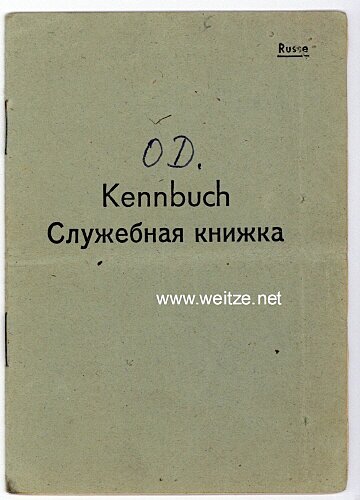
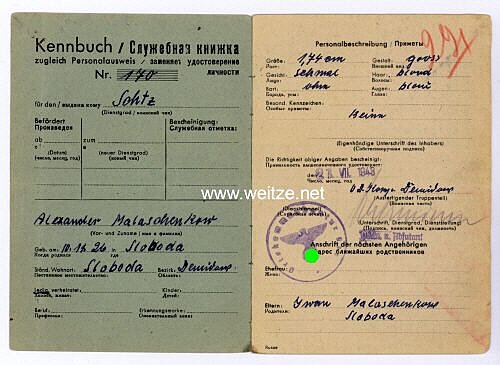
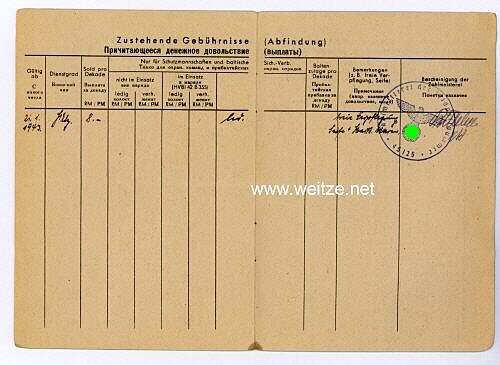
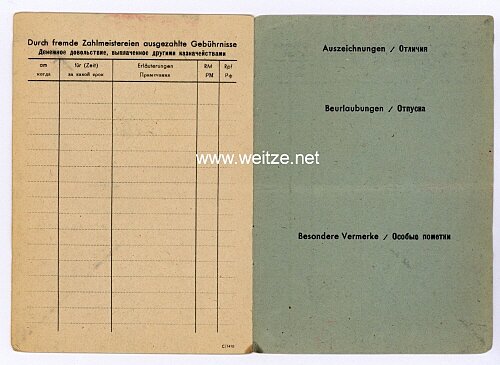
Kennbuch eines russischen Freiwilligen in der deutschen Wehrmacht
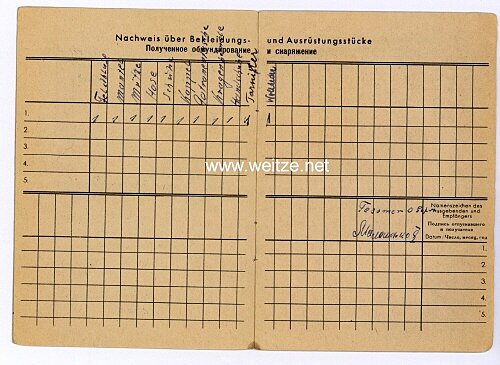
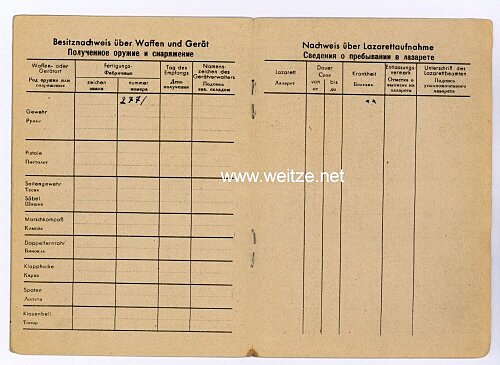
für einen Schützen des Jahrgangs 1926, ausgestellt am 21.7.1943 durch die Ortskommandantur 936, neben den persöhnlichen Daten, noch eingetragen, ausgehändigte Bekleidungs-und Ausrüstungsstücke, und zustehende Gebührnisse welche er im Juli 1943 Sold bekam; zweisprachiger Vordruck, gebrauchter Zustand.
Die Ortskommandantur 936 (OK 936) wurde am 11. November 1940 im Protektorat Böhmen und Mähren aufgestellt. Der Stab wurde als Heerestruppe beim Wehrmachtbefehlshaber Böhmen-Mähren aufgestellt. Nach der Aufstellung wurde der Stab in das Generalgouvernement verlegt. Dort wurde der Stab dem Militärbefehlshaber im Generalgouvernement unterstellt. Der Stab wurde von diesem in Kozienice und Radomsko stationiert. Im Sommer 1941 wurde der Stab weiter in den Osten verlegt. Dort wurde der Stab im Juni 1941 der Heeresgruppe Mitte unterstellt. Von dieser wurde der Stab im Bereich der 286. Sicherungs-Division eingesetzt. Dabei wurde der Stab 1941 noch in Belynitschi und Malojaroslawez stationiert. 1943 unterstand der Stab der 3. Panzerarmee. Im Jahr 1943 wurde der Stab in Demidow stationiert. 1944 wurde der Stab aufgelöst.
Die Ortskommandantur 936 (OK 936) wurde am 11. November 1940 im Protektorat Böhmen und Mähren aufgestellt. Der Stab wurde als Heerestruppe beim Wehrmachtbefehlshaber Böhmen-Mähren aufgestellt. Nach der Aufstellung wurde der Stab in das Generalgouvernement verlegt. Dort wurde der Stab dem Militärbefehlshaber im Generalgouvernement unterstellt. Der Stab wurde von diesem in Kozienice und Radomsko stationiert. Im Sommer 1941 wurde der Stab weiter in den Osten verlegt. Dort wurde der Stab im Juni 1941 der Heeresgruppe Mitte unterstellt. Von dieser wurde der Stab im Bereich der 286. Sicherungs-Division eingesetzt. Dabei wurde der Stab 1941 noch in Belynitschi und Malojaroslawez stationiert. 1943 unterstand der Stab der 3. Panzerarmee. Im Jahr 1943 wurde der Stab in Demidow stationiert. 1944 wurde der Stab aufgelöst.