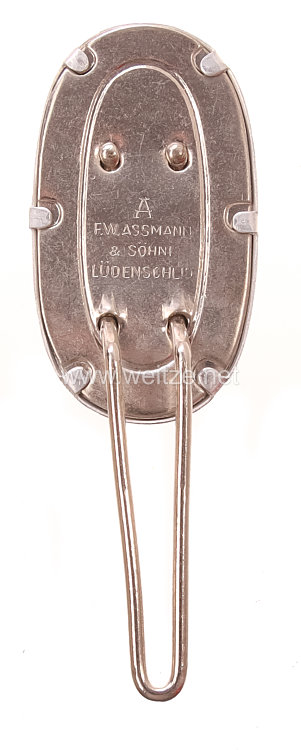
Federal Republic of Germany (FRG) Shako Plate for the Berlin Police Shako
The field badge for the police shako of the Berlin Police from around 1957 represents a fascinating chapter in German post-war history and the unique development of Berlin during the Cold War. This object, made of non-ferrous metal and aluminum, embodies the complex political situation of the divided city and the reorganization of police forces in the young Federal Republic of Germany.
After the end of World War II in May 1945, Berlin was divided into four sectors administered by the victorious powers: the USA, Great Britain, France, and the Soviet Union. The police had to be completely rebuilt under Allied supervision after the Nazi structures had been dissolved. In the western sectors of Berlin, an independent police organization emerged that differed significantly from that in the Soviet sector.
The Berlin Police in the western sectors underwent a phase of consolidation and professionalization during the 1950s. The year 1957, when this field badge was created, marks an important stage in this development. At this time, Berlin was already characterized by the political tensions of the Cold War, although the construction of the Wall would not occur until 1961. The police in West Berlin not only had to fulfill normal police duties but also found themselves in an exposed position at the border between political systems.
The shako, a tall cylindrical headgear with a visor, has a long tradition in European police and military units. Its origins lie in the 18th century, when it was first worn by Hungarian hussars. In the 19th century, it became a characteristic component of many European uniforms. In German police history, the shako played a significant role as parade uniform and for special occasions.
The field badge or cockade attached to the shako served as a sovereign emblem and identification marker. The use of non-ferrous metal and aluminum in this specimen is characteristic of the post-war period, when high-quality materials were scarce and practical yet representative solutions had to be found. The combination of these materials enabled cost-effective production while maintaining an appealing appearance.
The uniform design of the Berlin Police in the 1950s was oriented toward democratic principles and was intended to deliberately represent a departure from the militaristic aesthetics of the Nazi era. At the same time, a certain authority and seriousness had to be conveyed. The field badges and uniform insignia were important elements of the police's visual identity and contributed to restoring public confidence in the security forces.
In the special situation of West Berlin, the police held a unique position. The city was not legally a complete part of the Federal Republic of Germany but was subject to Allied reservation. Nevertheless, the organization and equipment of the police were oriented toward West German standards while maintaining their own identity as the Berlin Police.
Shakos were typically worn at parades, honor guards, and official occasions. They were part of the dress uniform or gala uniform and not intended for daily patrol duty. This underscores the ceremonial character of this headgear and its badges. The care and wearing of these uniform pieces were precisely regulated and understood as an expression of professional discipline.
The condition of this specimen, classified as condition 2, indicates good preservation with only slight signs of use. This is remarkable for an object that is now over 65 years old and shows that it was either carefully stored or used only to a limited extent. Such objects are today important testimonies of German police history and are valued by collectors and historical museums.
The study of such police badges provides valuable insights into the development of state institutions in post-war Germany. They document the transition from the occupation period to independence, the formation of democratic structures, and the special role of Berlin as a divided city. The field badge is thus not only a decorative uniform piece but a historical document of considerable significance for understanding German history of the 1950s.