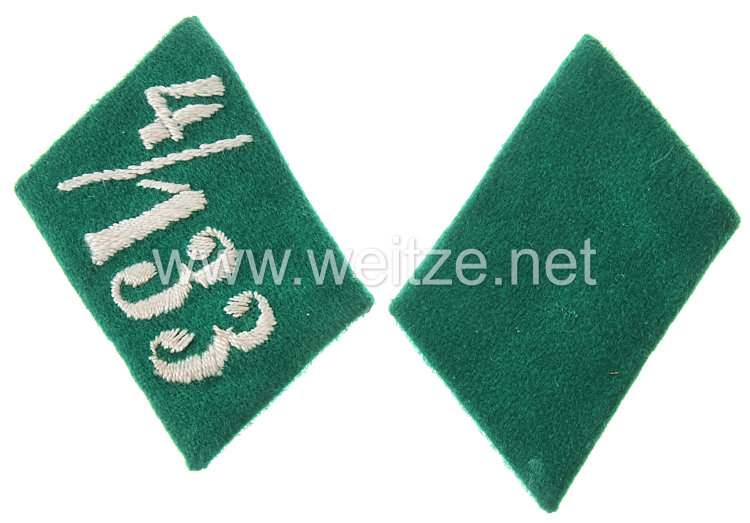
SA Pair of Collar Tabs SA-Gruppe Sachsen Sturm 4 of Standarte 133

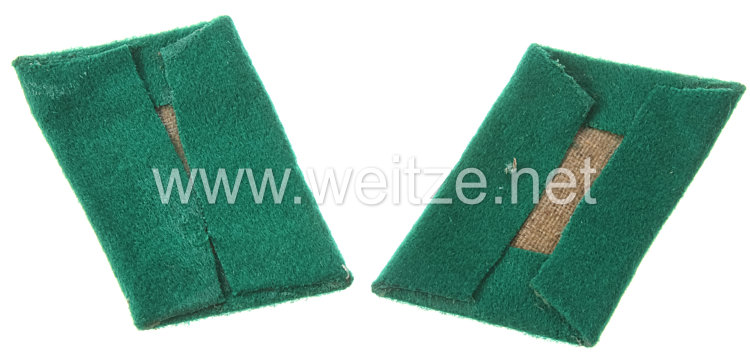
Location Zwickau, circa 1933. Green wool with white embroidery, unissued in good condition.
384457
70,00

SA Pair of Collar Tabs SA-Gruppe Sachsen Sturm 4 of Standarte 133

These SA collar tabs represent a significant testimony to the organizational structure of the Sturmabteilung (SA) during the early phase of National Socialist rule. These insignia belonged to Sturm 4 of Standarte 133 of the SA-Gruppe Sachsen based in Zwickau and date from around 1933, a pivotal year for the political transformation of Germany.

The SA was founded in 1920/21 as a paramilitary combat organization of the NSDAP. Its primary task initially consisted of protecting political events and disrupting opposing rallies. After the re-establishment of the SA in 1925, it developed into the largest mass organization of the NSDAP. The structure followed military models, organized into Stürme (troops), Standarten (regiments), Brigaden (brigades), and superior Gruppen (groups) that corresponded to geographic regions.

The SA-Gruppe Sachsen was one of the regional high commands of the SA, encompassing the territory of the Free State of Saxony. Standarte 133 formed one of the numerous sub-units, with each Standarte normally comprising several Stürme. A Sturm corresponded in size approximately to a company and typically consisted of 70 to 120 men. The location of Zwickau, as a significant industrial city in western Saxony, was an important base for SA activities in the region.

The collar tabs served as an important identifying feature within the SA hierarchy. The green cloth with white embroidery followed the official SA uniform regulations. The coloring of the collar tabs had specific significance: the green indicated membership in the SA-Gruppe Sachsen, while other SA groups had different group colors. The white embroidery, which in this case displayed the Sturm number “4” and possibly other markings, enabled precise identification of the unit.

The year 1933 marked a dramatic turning point both for Germany and for the SA itself. After the seizure of power on January 30, 1933, the SA experienced enormous membership growth. While it counted approximately 400,000 members at the end of 1932, its strength swelled to over 2 million by the end of 1933. Many opportunistic new members joined to secure advantages in the new state. The old SA fighters derisively called these new members “Märzgefallene” (March casualties).

Uniforms played a central role in the SA for creating esprit de corps and for public impact. The brown shirts of the SA became a symbol of the National Socialist movement. Besides the shirt, collar tabs, shoulder straps, armbands, and various badges belonged to the standard equipment. The precise regulations for uniforms were set forth in official dress regulations that were revised multiple times.

The unworn condition of these collar tabs is remarkable and raises questions about their history. Possibly they were made for a member who did not enter service, or they remained unused for other reasons. They could also be reserve pieces or uniform parts that were no longer needed during the later dissolution or reduction of SA units.

After the “Röhm Affair” of June 30 to July 2, 1934, also known as the “Night of the Long Knives,” the SA drastically lost significance. Ernst Röhm, the long-time SA Chief of Staff, and many other SA leaders were murdered. The SA was subsequently degraded to a largely insignificant organization, while the SS under Heinrich Himmler took over its role as the most important paramilitary formation.

For historical research, such uniform items as these collar tabs are important material witnesses. They document the detailed organizational structure of the SA at the local level and enable insights into the penetration of German society by National Socialist organizations. The precise identification down to the Sturm level illustrates the paramilitary character and the degree of organization of the SA.

The location of Zwickau itself was of economic and political significance during the Nazi era. The city had important automobile factories and coal mining. The local SA played an active role in enforcing National Socialist rule, in boycott actions against Jewish businesses, and in intimidating political opponents.

Today, such objects are part of the confrontation with the National Socialist past. They serve in museums and collections as illustrative material for education and research and serve as reminders for critical reflection on this dark epoch of German history.