Prussian Helmet from the Estate of Lieutenant Colonel Count von Korff of the Leib-Kürassier-Regiment Großer Kurfürst (Silesian) No. 1 - in Deluxe Quality

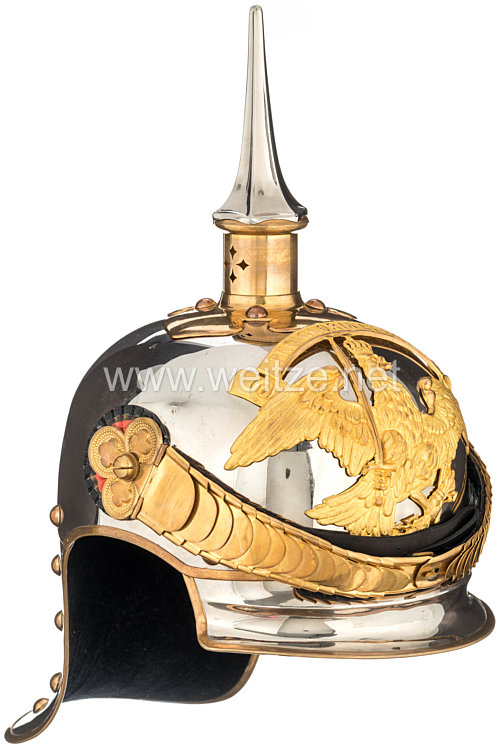
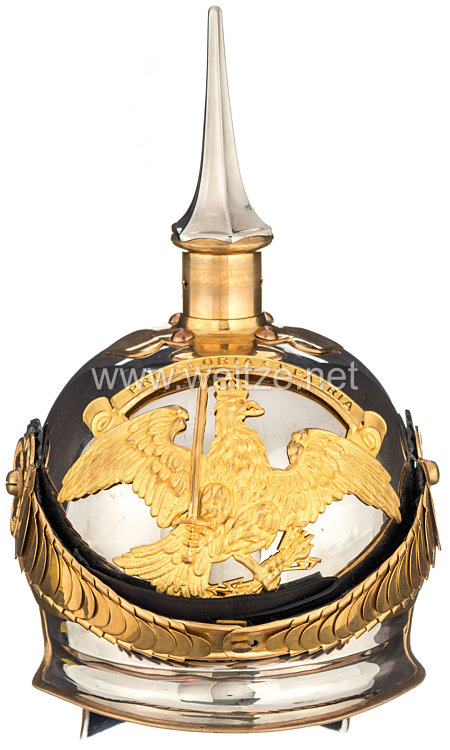
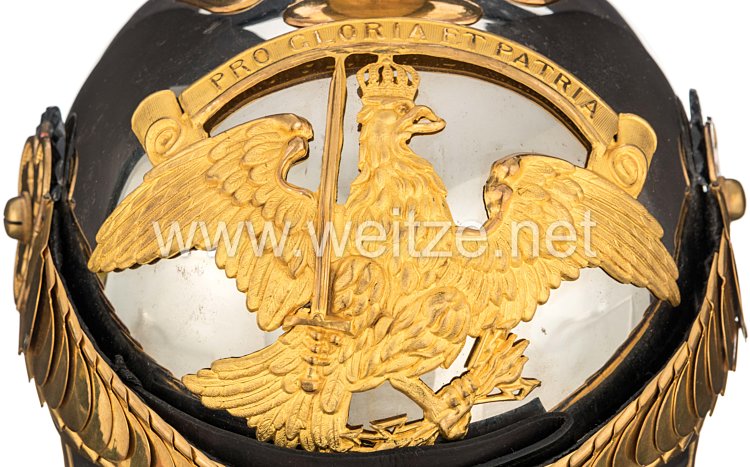
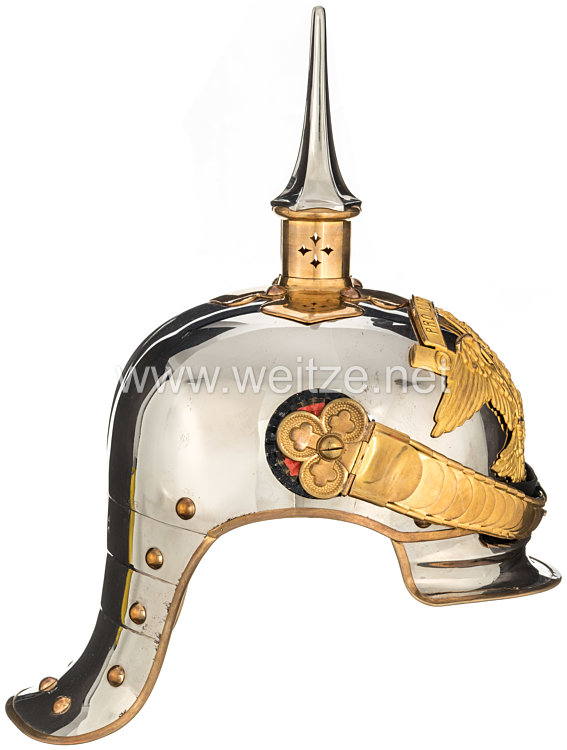
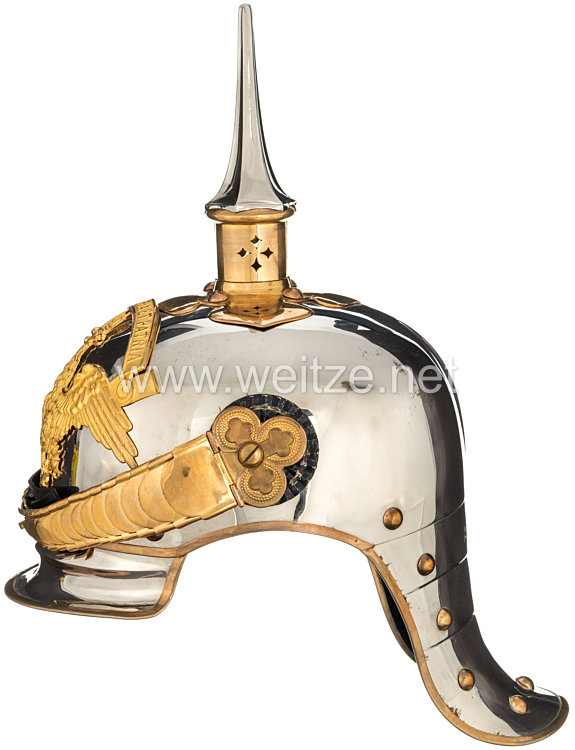
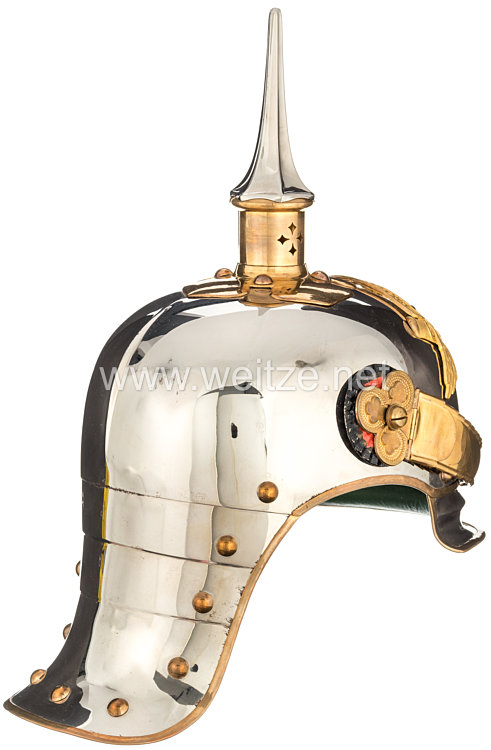
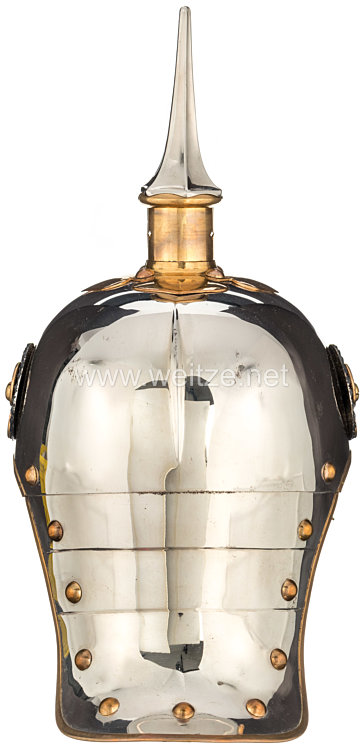
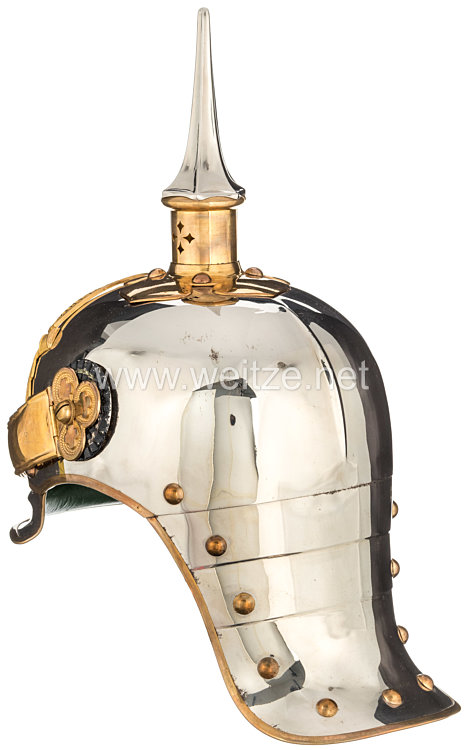
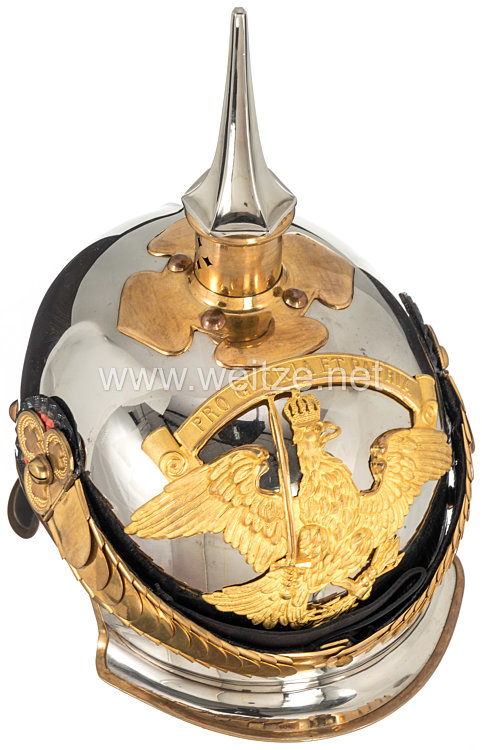
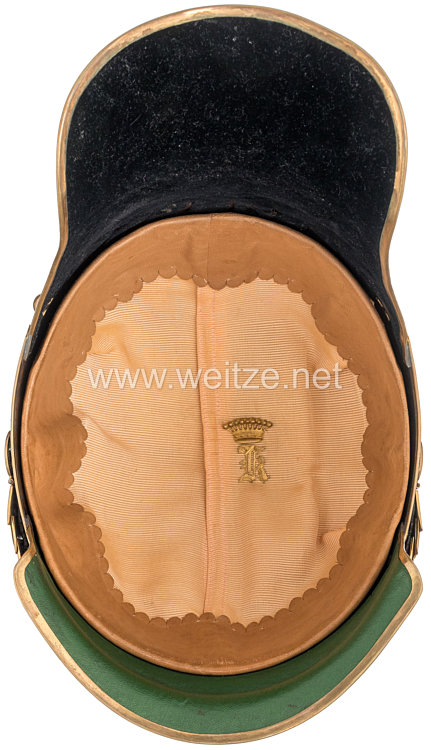
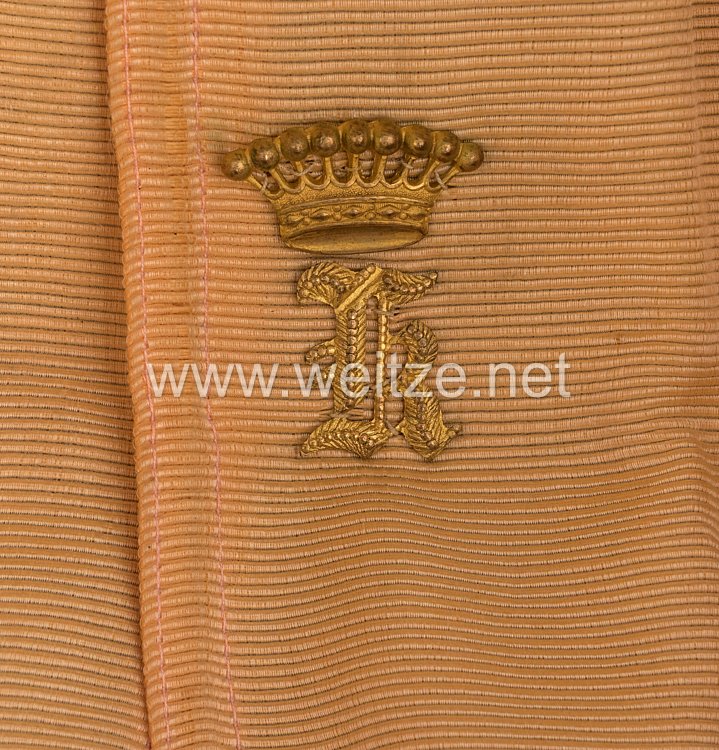
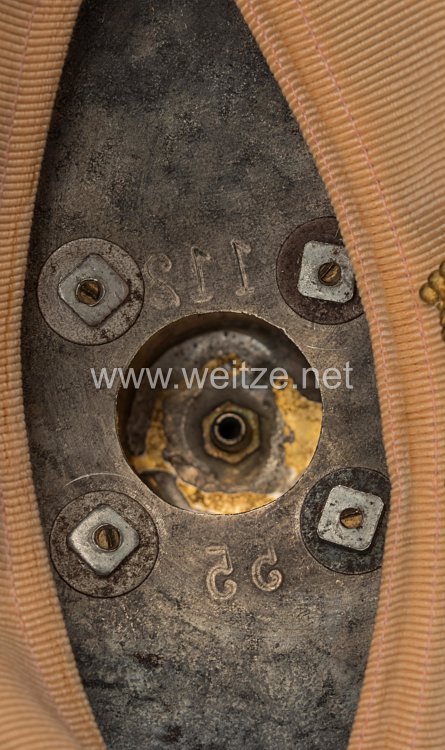
Breslau, circa 1914. Elegant helmet in the final pattern. The helmet skull of light nickel-plated sheet iron, complete with all fittings in gilt finish. On the front the flying eagle introduced on July 1, 1902, with the bandeau “Pro Gloria et Patria,” fire-gilt with polished edges. Special gilt flat scale chains with edge stamping on screws, both cockades in the special “Alt-Hessian” form. Interior with light leather sweatband and salmon-colored silk lining. Inside the lining, applied in metal, the count's crown with 9 pearled points and the cipher “K.” The front visor lined with green leather, the rear visor lined with black velvet. On the helmet skull beneath the crosspiece of the spike, size marking “55” and number “118.” The helmet is nearly unworn, only on the rear of the helmet skull are two very small spots on the nickel plating present. Condition 2++.
One of the very few originals in outstanding state of preservation! One of the best-preserved helmets of the regiment, we have not encountered a finer helmet in over 30 years! The highlight for any helmet collection.

Price upon request.
373857

Prussian Helmet from the Estate of Lieutenant Colonel Count von Korff of the Leib-Kürassier-Regiment Großer Kurfürst (Silesian) No. 1 - in Deluxe Quality

The Cuirassier Helmet Model 1889/1902 of the Leib-Kürassier-Regiment „Großer Kurfürst" (Schlesisches) Nr. 1 represents one of the most prestigious cavalry regiments of the Prussian Army and an extraordinary military tradition spanning two and a half centuries. This magnificent helmet from around 1914 embodies not only the military excellence of Imperial Germany on the eve of World War I, but also the special status of this storied regiment.

The regiment was founded in 1674 as the Dragoner-Garde, making it the oldest cavalry regiment of the Prussian Army. In 1718, it was converted to a cuirassier regiment, corresponding to the heavily armored elite cavalry units. On January 27, 1867, the Kaiser's birthday, the regiment received the honorary name „Großer Kurfürst" (Great Elector), an acknowledgment of its historical significance and military achievements.

The regiment received a special distinction in 1902 when it became the only unit in the entire Prussian Army to receive a special helmet plate: the Frederickan „flying eagle" bearing the motto „Pro Gloria et Patria" (For Glory and Fatherland). This unique helmet ornament distinguished the Leib-Kürassier-Regiment Nr. 1 from all other cuirassier regiments and underscored its special status as the oldest and most traditional regiment of this branch. The fire-gilded eagle with its spread wings and motto banner became an unmistakable identifying feature of the regiment's members.

This helmet belonged to Oberstleutnant Graf von Korff, as evidenced by the count's crown with nine points decorated with pearls and the cipher „K" applied to the interior liner. The helmet bowl of light nickel-plated iron corresponds to the Model 1889, a development of the heavier Model 1867. All fittings are executed in gilded form, indicating officer quality. The special gilded flat chinscales and the cockades in the so-called Old Hessian form testify to the luxurious equipment of this ceremonial helmet.

The regiment was garrisoned in Breslau, the capital of Silesia, where this helmet was manufactured around 1914. At the outbreak of World War I, the Leib-Kürassier-Regiment „Großer Kurfürst" first marched into the Battle of the Marne in 1914. Subsequently, the regiment fought on the Eastern Front in Russian Poland and the Pripyat marshes from 1914 to 1918. During the war, the regiment was converted to Kavallerie-Schützen-Kommando 11 (Cavalry Rifle Command 11) and fought in the Champagne region until the end of the war.

After the armistice in November 1918, the regiment was ordered to Berlin to protect the Reich government against the insurgent Volksmarinedivision (People's Naval Division). The dissolution of this traditional regiment occurred in 1918-1919. Its tradition was continued in the Reichswehr by the 1st Squadron of the 7th (Prussian) Cavalry Regiment in Breslau, as ordered by General Hans von Seeckt on August 24, 1921.

The cuirassier helmet itself became unsuitable for field use during World War I and was replaced by field-gray equipment. The Pickelhaube was discontinued in 1916, and after 1918 cuirassier helmets no longer existed as regulation equipment. Helmets such as this remained as ceremonial objects and historical mementos of inestimable value to collectors and military historians, documenting the glorious era of the Imperial cavalry.

r